Film & TV
Casablanca (film, 1942) Starring Humphrey Bogart, Ingrid Bergman, Paul Henreid and Claude Rains
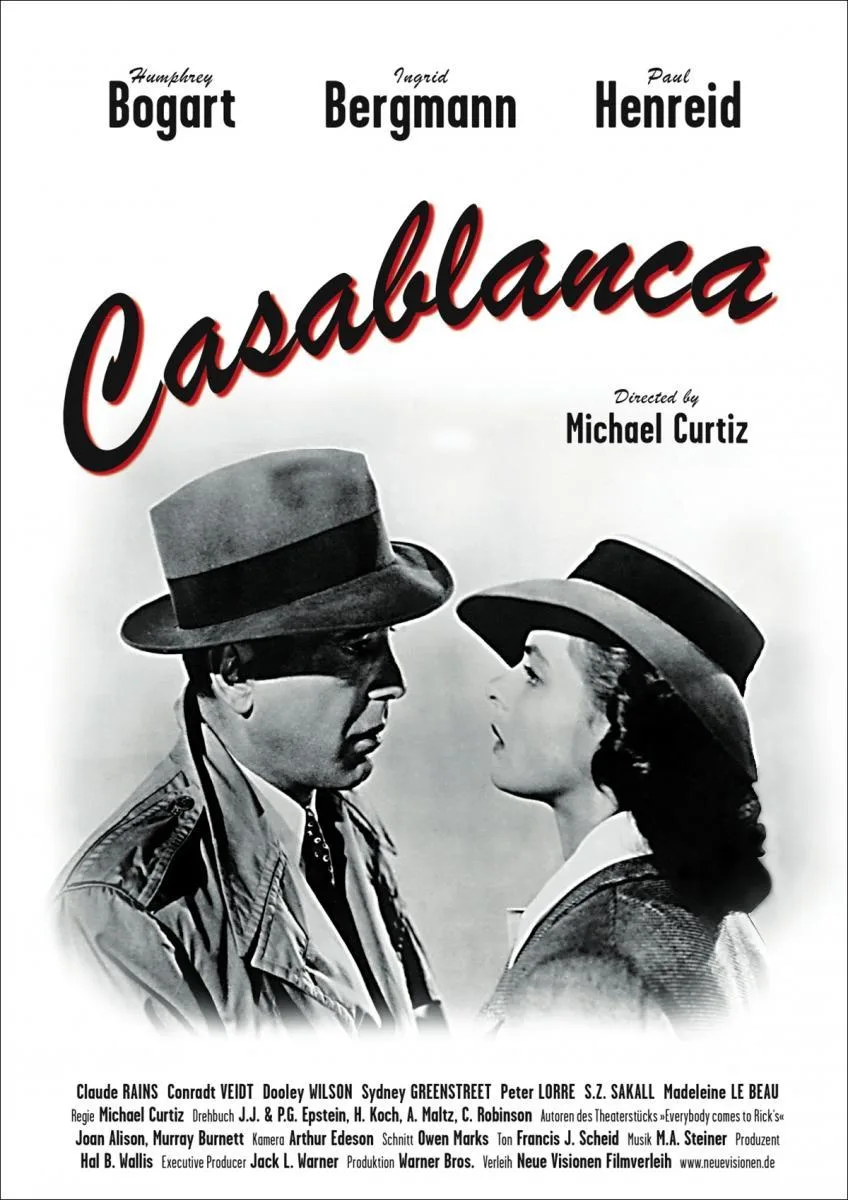
Casablanca (1942) is an American romantic drama directed by Michael Curtiz, set in the tense, transient world of Vichy-controlled Morocco during the Second World War. Humphrey Bogart plays Rick Blaine, an American expatriate who has built a nightclub around himself and taught himself not to care.
That fragile detachment collapses when Ilsa Lund(played by Ingrid Bergman), the woman who left him in Paris, walks into Rick’s Café Américain with her husband, the anti-Nazi resistance leader Victor Laszlo(played by Paul Henreid). The film transforms a love triangle into a question of duty, sacrifice, and the difficult moment when private longing must give way to history.
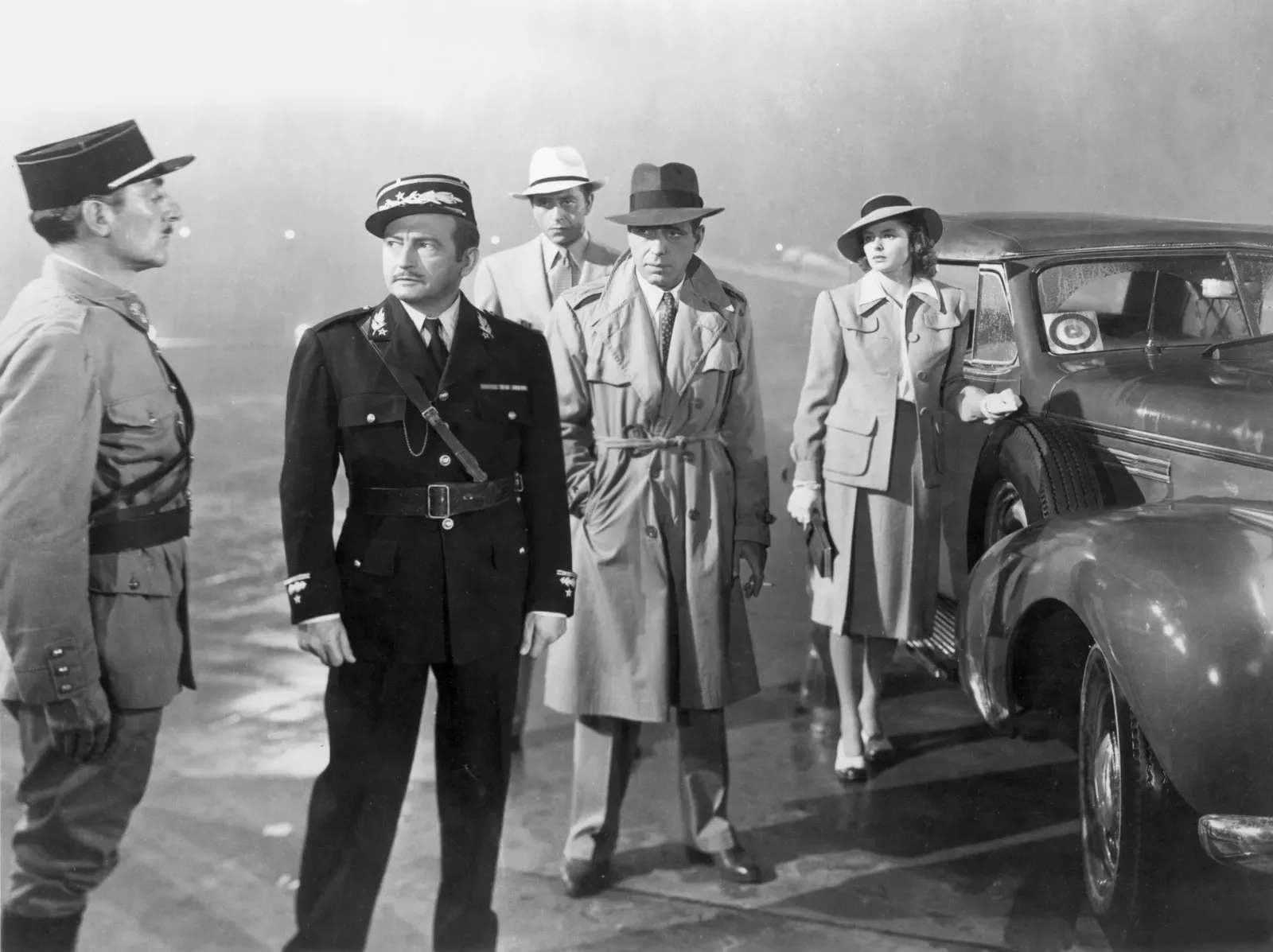
Plot
Casablanca has become a crowded waiting room for refugees, exiles, adventurers, criminals, and people with nowhere else to go. Everyone is searching for exit visas that might carry them onward to Lisbon and, eventually, to the United States.
Rick Blaine runs the city’s most glamorous nightclub. He drinks with gamblers, police officials, smugglers, and displaced aristocrats, offering each person exactly enough welcome to keep the evening moving. Rick insists that he sticks his neck out for nobody.
Ugarte, a nervous criminal, comes into possession of two valuable letters of transit. Before he can sell them, he leaves them with Rick for safekeeping and is arrested by Captain Louis Renault.
The letters become essential when Victor Laszlo arrives in Casablanca with Ilsa Lund. Laszlo is a celebrated leader of the resistance and must escape before Major Heinrich Strasser and the German authorities can stop him.
Rick has not seen Ilsa since Paris, where they had planned to leave together as German troops approached. She vanished without explanation, leaving him with a railway ticket, an unanswered question, and a wound he has never allowed to close.
Ilsa asks Rick for the letters of transit. Rick refuses, caught between his love for her and his bitterness. Yet he must finally decide whether his future lies with a woman he cannot forget, or with a cause that is larger than either of them.
Cast
- Humphrey Bogart as Rick Blaine
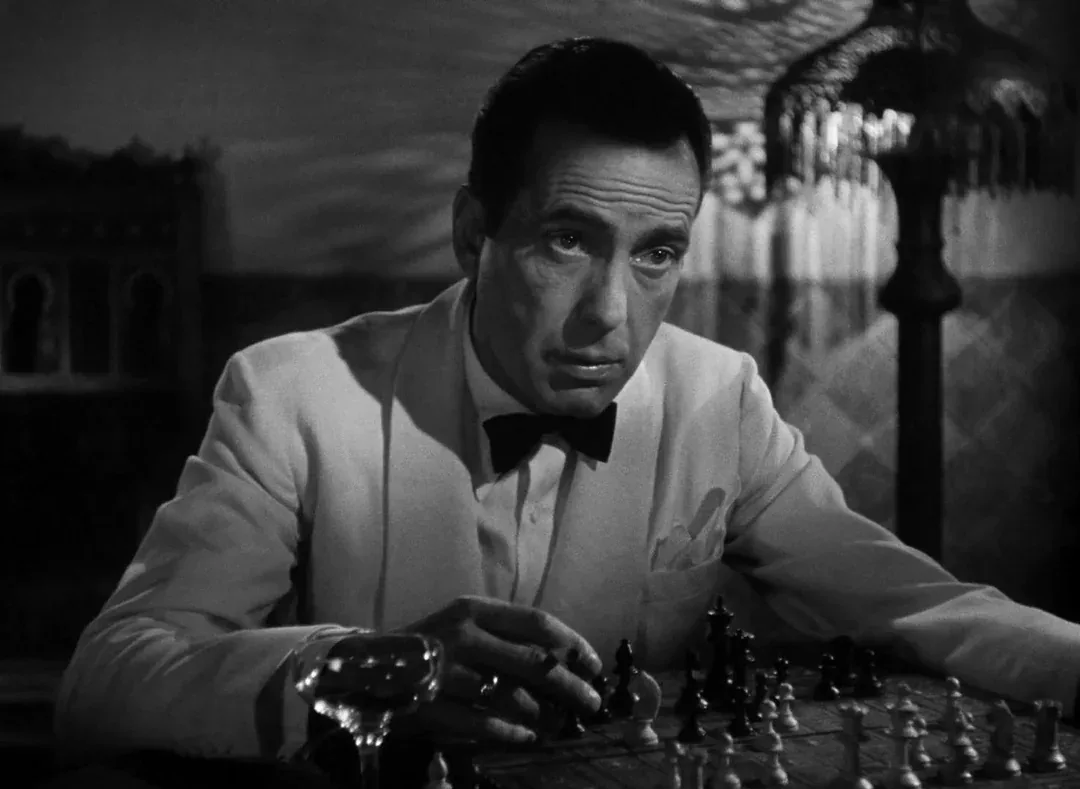
Humphrey Bogart as Rick Blaine in film Casablanca (1942) - Ingrid Bergman as Ilsa Lund
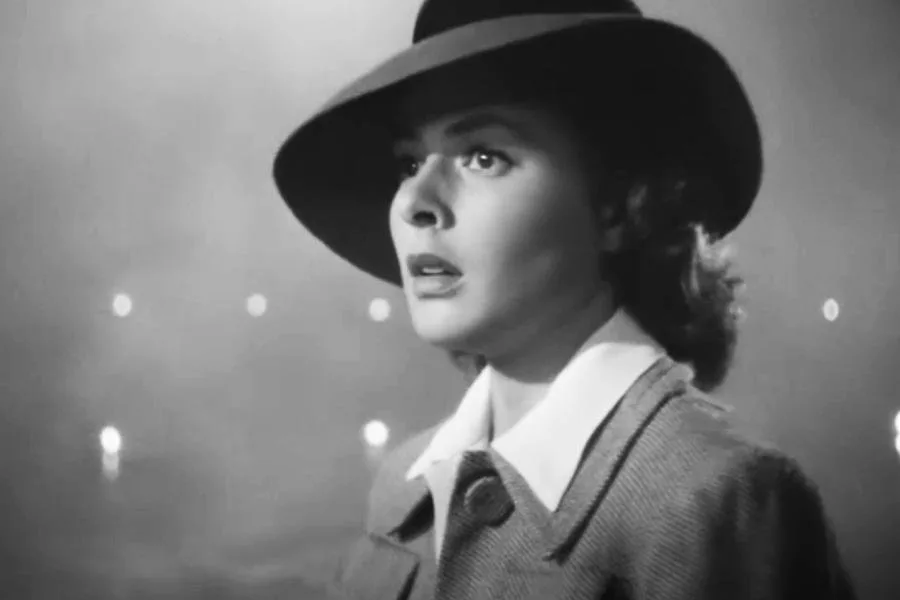
Ingrid Bergman as Ilsa Lund in film Casablanca (1942) - Paul Henreid as Victor Laszlo
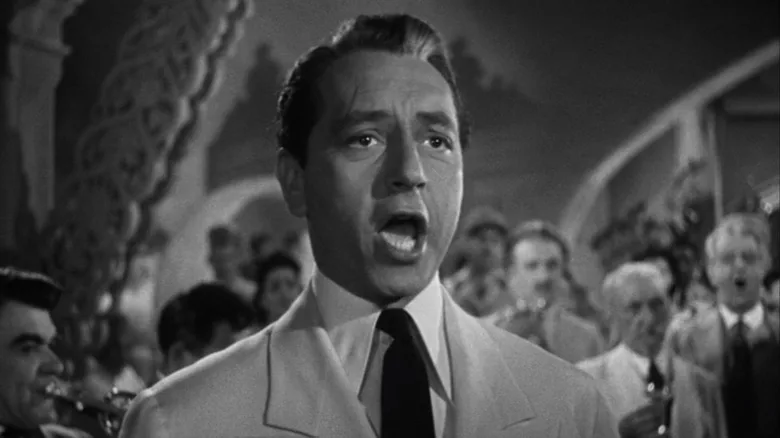
Paul Henreid as Victor Laszlo in film Casablanca (1942) - Claude Rains as Captain Louis Renault
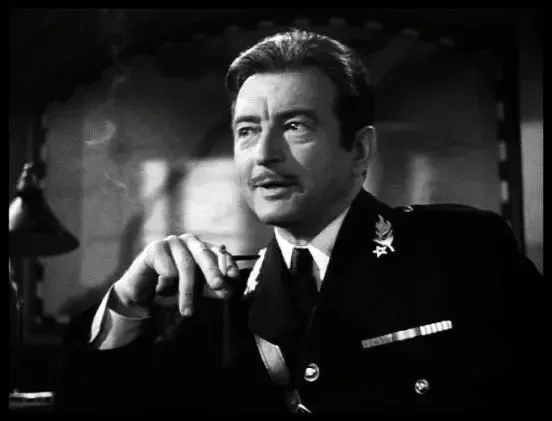
Claude Rains as Captain Louis Renault in film Casablanca (1942) - Conrad Veidt as Major Heinrich Strasser
- Sydney Greenstreet as Signor Ferrari
- Peter Lorre as Ugarte
- Dooley Wilson as Sam
Humphrey Bogart gives Rick Blaine a rare blend of hardness and ache. Rick’s white dinner jacket, clipped voice, and deliberate indifference create the appearance of a man beyond disappointment. The performance allows the audience to see that this is only a discipline, not a truth.
Ingrid Bergman plays Ilsa Lund with a luminous uncertainty. She remains the film’s most debated figure because she does not explain everything at once. Her pauses, lowered eyes, and sudden resolve make her seem caught between love, loyalty, and a past that cannot be revised.
Claude Rains brings wit and elegance to Captain Renault, a man who survives by treating morality as a matter of convenience. Paul Henreid’s Victor Laszlo is not merely a noble obstacle to romance. His calm conviction gives the story its moral weight.
Production
Warner Bros. bought Murray Burnett and Joan Alison’s unproduced play, Everybody Comes to Rick’s, for $20,000. The title was changed, the story was shaped into a wartime romance, and the studio moved quickly. The screenplay passed through several writers, with Julius J. Epstein, Philip G. Epstein, and Howard Koch receiving the final screen credit.
Michael Curtiz directed the production at the speed and discipline of the Warner Bros. studio system. Filming began in May 1942 and ended in early August, only a few months before the picture reached its first audiences. Much of the dialogue was still being refined during shooting, which contributed to the uncertainty surrounding the ending.
Nearly all of Casablanca was filmed on the Warner Bros. lot in Burbank, California. Only the arrival of Major Strasser used an exterior location, at Van Nuys Airport. The Moroccan streets, the Paris station, the Blue Parrot, and Rick’s Café were studio inventions, created through shadow, fog, painted backdrops, rear projection, and carefully crowded interiors.
Carl Jules Weyl’s production design makes Rick’s Café feel like a small universe. The room contains gamblers, waiters, refugees, Nazis, resistance figures, and minor aristocrats, each with a story suggested in a glance or a gesture. Ceiling fans turn slowly above the room, champagne is poured, cigarettes glow in the darkness, and danger is always seated at a nearby table.
Arthur Edeson’s cinematography gives the film its velvety black-and-white atmosphere. Ingrid Bergman is lit with extraordinary softness, often with her face framed by haze or a luminous close-up. Humphrey Bogart is photographed more sharply, usually in shadows that protect the emotional truth Rick tries to hide.
Orry-Kelly’s costumes establish the film’s world with apparent simplicity. Humphrey Bogart’s ivory dinner jacket has become inseparable from Rick Blaine, its immaculate surface suggesting a man who can still preserve style while everything around him is unstable. Ingrid Bergman’s pale suits, tailored jackets, hats, gloves, and satin evening clothes make Ilsa seem both impeccably dressed and slightly removed from the disorder of Casablanca.
The wardrobe also helped articulate the difference between the film’s men. Victor Laszlo’s formal European suits suggest steadiness and moral seriousness. Captain Renault’s immaculate white uniform makes corruption look charming. Major Strasser’s German uniform requires no explanation.
One of the film’s most famous scenes takes place in Rick’s Café, when German officers begin to sing “Die Wacht am Rhein.” Victor Laszlo responds by asking the orchestra to play “La Marseillaise.” The room joins in, drowning out the German voices. Madeleine LeBeau, who plays Yvonne, had fled France during the war, and her tears in the scene were real.
Max Steiner composed the film’s score, but its emotional signature belongs equally to “As Time Goes By,” the Herman Hupfeld song played by Dooley Wilson as Sam. Wilson was a drummer rather than a pianist, so another musician played the piano off camera. When Warner Bros. considered replacing the song, Ingrid Bergman had already cut her hair for For Whom the Bell Tolls (1943), making reshoots impossible. “As Time Goes By” remained.
Release/reception
Warner Bros. had originally planned a later release, but world events altered the schedule. Allied forces invaded French North Africa in November 1942, and Casablanca suddenly became a name in newspaper headlines. The studio moved the New York premiere forward to 26 November 1942, only weeks after Operation Torch.
The film opened nationally in the United States on 23 January 1943. Its mixture of wartime urgency, romance, suspense, humor, and music found an immediate public, even though few at the studio expected it to become a permanent classic.
At the 1944 Academy Awards, Casablanca won Best Picture, Michael Curtiz won Best Director, and Julius J. Epstein, Philip G. Epstein, and Howard Koch won Best Adapted Screenplay. It had been nominated for eight Academy Awards in total.
Its reputation has only deepened with time. The screenplay’s lines have entered everyday language, though several expressions commonly associated with the film are remembered inaccurately. Its real achievement is more enduring than quotation. Casablanca makes an intimate heartbreak feel inseparable from a world at war, then allows its final act to turn renunciation into one of cinema’s most elegant forms of love.