Chanson
Por una cabeza (1935) by Carlos Gardel
Title: Por una cabeza
Lyrics: Alfredo le pera
Music: Carlos Gardel
Release: 1935
Performers: Carlos Gardel
Lyrics: Alfredo le pera
Music: Carlos Gardel
Release: 1935
Performers: Carlos Gardel

Carlos Gardel ( 11 December 1890 – 24 June 1935)
Carlos Gardel (born Charles Romuald Gardès; 11 December 1890 – 24 June 1935) was a French Argentine singer, songwriter, composer and actor, and the most prominent figure in the history of tango. Gardel's baritone voice and the dramatic phrasing of his lyrics made miniature masterpieces of his hundreds of three-minute tango recordings. Together with lyricist and long-time collaborator Alfredo Le Pera, Gardel wrote several classic tangos.
For many, Gardel embodies the soul of the tango style. He is commonly referred to as "The King of Tango", "El Mago" (The Wizard), and ironically "El Mudo" (The Mute).
For many, Gardel embodies the soul of the tango style. He is commonly referred to as "The King of Tango", "El Mago" (The Wizard), and ironically "El Mudo" (The Mute).

Alfredo Le Pera(1900-1935)
Alfredo Le Pera was born in São Paulo, Brazil, the son of Italian immigrants who moved to Buenos Aires, Argentina in 1902. At the beginning of his career, he worked for several Argentinian periodicals as a journalist and theatre critic and in 1928 became involved in the film industry. He worked for Paramount Pictures while living in Paris and in 1932 the studio arranged for him to work with Carlos Gardel, at a time when the company was looking for ways to increase Gardel's international appeal . Le Pera wrote the scripts for a series of films, including Melodía de Arrabal (1933), Cuesta abajo (1934), El Tango en Broadway (1934), El día que me quieras (1935) and Tango Bar (1935), and also wrote the lyrics for tangos composed and performed by Gardel in these films. These tangos would become classics of the genre across the Spanish-speaking world.
Gardel and Le Pera were coming to the end of a promotional tour for the film El dia que me quieras when, on Monday, 24 June 1935, the plane in which they were taking off from the airport in Medellin, Colombia crashed into another plane on the runway, killing them both and most of the other passengers on board, including the other musicians travelling with them.
Gardel and Le Pera were coming to the end of a promotional tour for the film El dia que me quieras when, on Monday, 24 June 1935, the plane in which they were taking off from the airport in Medellin, Colombia crashed into another plane on the runway, killing them both and most of the other passengers on board, including the other musicians travelling with them.
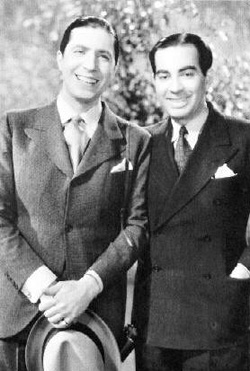
Alfredo Le Pera(1900-1935) with Carlos Gardel(1891-1935)
The name of the song "Por Una Cabeza" is a Spanish horse-racing phrase meaning "by a head", which refers to a horse winning a race narrowly - by just the length of its head. The lyrics speak of a compulsive horse-track gambler who compares his addiction for horses with his attraction to women.
The starting phrase in the B section may be inspired by Mozart's Rondo for violin and orchestra in C major, K. 373.
The song was originally composed in A major. It was thereafter adapted to the violin and the piano sometimes in A major, sometimes in G major.
The starting phrase in the B section may be inspired by Mozart's Rondo for violin and orchestra in C major, K. 373.
The song was originally composed in A major. It was thereafter adapted to the violin and the piano sometimes in A major, sometimes in G major.

Lyrics: Letra Espanol
Por una cabeza
Por una cabeza de un noble potrillo
que justo en la raya afloja al llegar
y que al regresar parece decir:
no olvides, hermano,
vos sabes, no hay que jugar...
Por una cabeza, metejon de un dia,
de aquella coqueta y risueña mujer
que al jurar sonriendo,
el amor que esta mintiendo
quema en una hoguera todo mi querer.
Por una cabeza
todas las locuras
su boca que besa
borra la tristeza,
calma la amargura.
Por una cabeza
si ella me olvida
que importa perderme,
mil veces la vida
para que vivir...
Cuantos desengaños, por una cabeza,
yo jure mil veces no vuelvo a insistir
pero si un mirar me hiere al pasar,
su boca de fuego, otra vez, quiero besar.
Basta de carreras, se acabo la timba,
un final reñido yo no vuelvo a ver,
pero si algun pingo llega a ser fija el domingo,
yo me juego entero, que le voy a hacer.
Por una cabeza
Por una cabeza de un noble potrillo
que justo en la raya afloja al llegar
y que al regresar parece decir:
no olvides, hermano,
vos sabes, no hay que jugar...
Por una cabeza, metejon de un dia,
de aquella coqueta y risueña mujer
que al jurar sonriendo,
el amor que esta mintiendo
quema en una hoguera todo mi querer.
Por una cabeza
todas las locuras
su boca que besa
borra la tristeza,
calma la amargura.
Por una cabeza
si ella me olvida
que importa perderme,
mil veces la vida
para que vivir...
Cuantos desengaños, por una cabeza,
yo jure mil veces no vuelvo a insistir
pero si un mirar me hiere al pasar,
su boca de fuego, otra vez, quiero besar.
Basta de carreras, se acabo la timba,
un final reñido yo no vuelvo a ver,
pero si algun pingo llega a ser fija el domingo,
yo me juego entero, que le voy a hacer.

The music of "Por Una Cabeza" is featured in a famous tango scene in Martin Brest's Scent of a Woman (1992), in the opening scene of Steven Spielberg's Schindler's List (1993) and in James Cameron's True Lies (1994).