Music
Étude in C minor, Op. 10, No. 12, "Revolutionary" by Frédéric Chopin (1810–1849)
Frédéric Chopin’s "Revolutionary" Étude is a brief but overwhelming drama for solo piano. While the left hand races through dark, turbulent waves of sound, the right hand answers with a proud and impassioned melody. Written during the years of Poland’s failed uprising against Russian rule, it became associated with Chopin’s grief for his homeland, though its famous nickname was not his own.
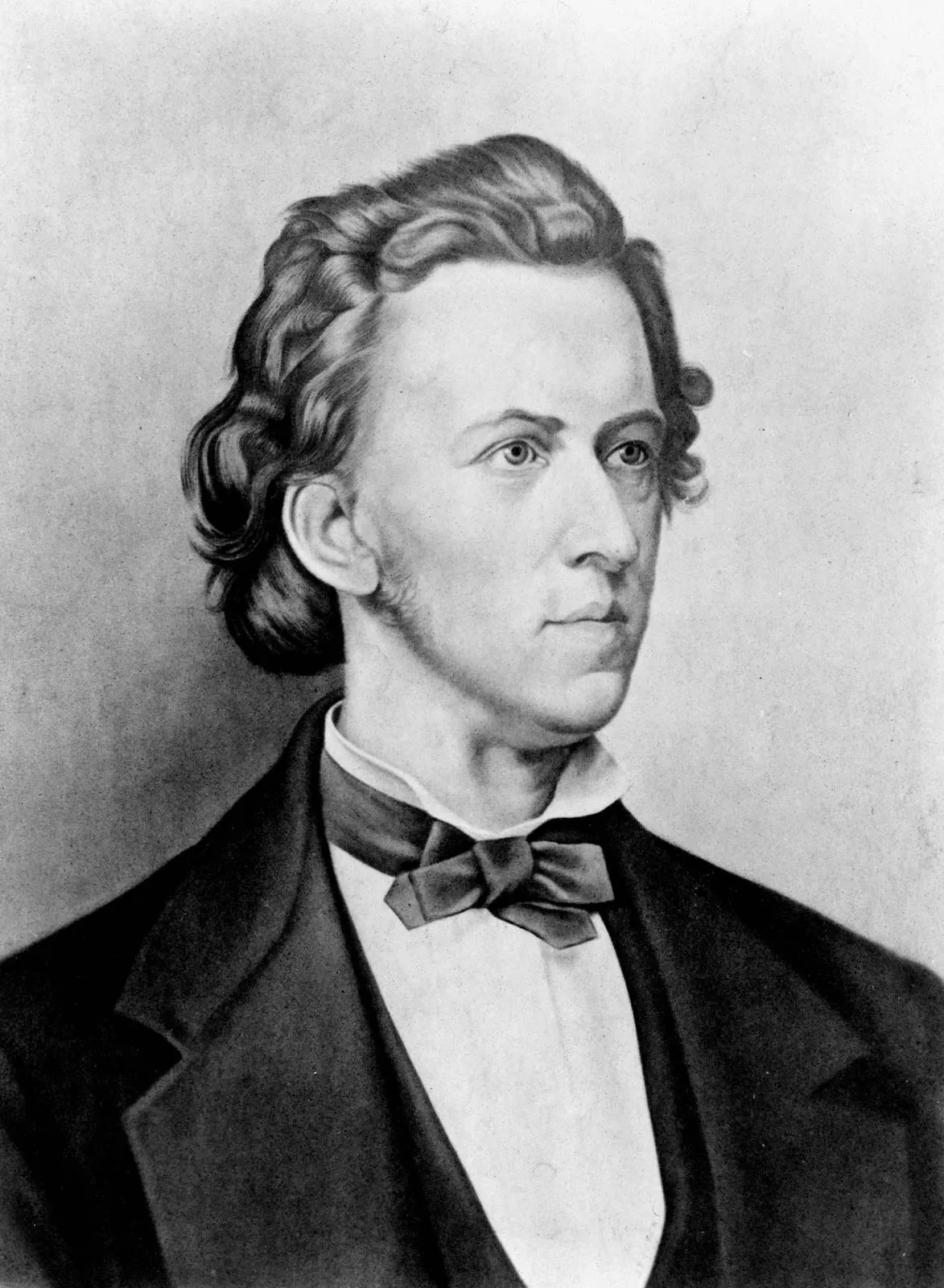
THE MUSIC
The "Revolutionary" Étude is one of the most immediately arresting pieces Chopin ever wrote. It begins not with a gentle invitation, but with a fierce, dark chord, followed by a torrent of notes falling through the piano’s lower register.
The left hand scarcely rests. It rushes, plunges and surges across the keyboard while the right hand delivers a grave, resolute melody in powerful chords. The two hands seem to inhabit different emotional worlds: one is in turmoil, the other speaks with stubborn dignity.
Although called an étude, it is no ordinary exercise. Chopin took a form usually intended for technical practice and made it into a concentrated drama. The pianist must keep the left hand in continuous, restless motion while allowing the right-hand melody to remain clear, proud and singing.
The work has often been heard as a cry of rage, but its emotion is more complicated than anger alone. There is defiance, grief and agitation, yet there is also control. Chopin does not let the music collapse into disorder. Even at its most violent, every gesture has shape and direction.
The closing pages bring a fleeting brightness in C major. It is not a soft or peaceful ending. The final sound is emphatic, almost victorious, but it leaves behind the memory of the storm that came before.
THE STORY
Chopin composed his Twelve Études, Op. 10, over several years, from 1829 to 1832. The collection was published in 1833 and dedicated “to his friend Franz Liszt,” then the most celebrated piano virtuoso in Europe. The C minor Étude is the twelfth and final piece in the set.
Today it is universally known as the "Revolutionary" Étude, but Chopin did not give it that name. The nickname became attached to the work later, commonly associated with Franz Liszt. It is powerful, memorable and evocative, but it should be treated as a later title rather than Chopin’s own.
The title is connected with one of the most painful moments of Chopin’s early life. In 1830, a Polish uprising began against Russian rule. Chopin had left Warsaw shortly before the crisis intensified, hoping to build a career abroad. He never saw his homeland again.
In September 1831, while in Stuttgart on his way to Paris, Chopin learned that Warsaw had fallen to Russian forces and that the uprising had been defeated. His private journal records his anguish and fury. "Oh God, You are! You are and You take no revenge?!" he wrote, followed by an outburst against the Russian oppression of Poland.
For generations, listeners have imagined him sitting down at the piano and writing this Étude in one burst of despair after receiving the news. It is a compelling image, but the evidence does not support it. The work seems to have been conceived before the fall of Warsaw, and Chopin worked on it within the longer composition of the Op. 10 set.
Yet the association is not meaningless. The Étude’s furious energy, its dark C minor world and its final thrust toward light make it understandable that listeners linked it to Chopin’s grief for Poland. The history did not necessarily produce the piece in a single moment, but it gave the music a lasting emotional shadow.
STRUCTURE
The "Revolutionary" Étude is a single, uninterrupted movement. It lasts only a few minutes, but within that brief space Chopin creates the feeling of a much larger drama.
Opening: the first blow
The work opens with a dramatic chord, held in suspense before the music begins to move. The left hand then descends in a violent rush, establishing the unsettled motion that will continue almost without relief.
The opening does not immediately settle into C minor. Chopin delays the feeling of arrival, making the music sound as if it has been thrown into a crisis already in progress.
When the right hand enters with its main melody, it does not sing delicately. It speaks in firm, weighty chords, like a voice trying to remain calm above a sea of agitation.
The central surge
The left hand continues its ceaseless movement, sweeping through low and middle registers of the piano. Beneath this turbulent surface, the right hand’s melody becomes more urgent and more expansive.
The music moves through darker harmonic regions, creating the sensation of an argument that cannot be resolved. The pianist must make the left-hand storms sound alive and dangerous, but never obscure the larger line above them.
This is where the work’s drama becomes most intense. It is not simply fast music. It is music of pressure, as though something immense were being held back.
Return and conclusion
The opening material returns with greater force. The right hand again asserts its grave melody, while the left hand seems to gather even more energy.
Near the end, Chopin briefly allows C major to appear. The shift brings a flash of light after so much darkness. It can sound like hope, victory or simply a moment of hard-won clarity.
The work does not fade away. Both hands descend in a final unison rush across the keyboard, ending with a decisive C major chord. It is a brilliant close, but not an uncomplicatedly happy one. The light has been reached through struggle.
THE PERFORMANCE
For a historic performance, Vladimir Horowitz remains an unforgettable choice. His playing brings extraordinary electricity to the work, with a left hand that seems to erupt from the instrument and a right hand that gives the melody a fearless, dramatic profile.
For grandeur and architectural strength, Maurizio Pollini offers a superb alternative. His performance is disciplined, powerful and unusually clear, revealing that the work’s intensity comes not from chaos but from Chopin’s extraordinary control.
For an intensely personal and volatile interpretation, Martha Argerich is also a compelling choice. Her playing can make the Étude sound less like a polished concert showpiece than an event happening in the moment: dangerous, urgent and alive.
Another particularly appropriate visual choice would be a performance from the International Chopin Piano Competition in Warsaw, presented by the Fryderyk Chopin Institute. Such performances connect the Étude to the city and country whose fate became so closely associated with its later title. The Fryderyk Chopin Institute identifies the piece as the final Étude of Op. 10, composed between 1829 and 1832 and dedicated to Franz Liszt.