People
Camille Saint-Saëns (born Charles-Camille Saint-Saëns; 9 October 1835 – 16 December 1921)
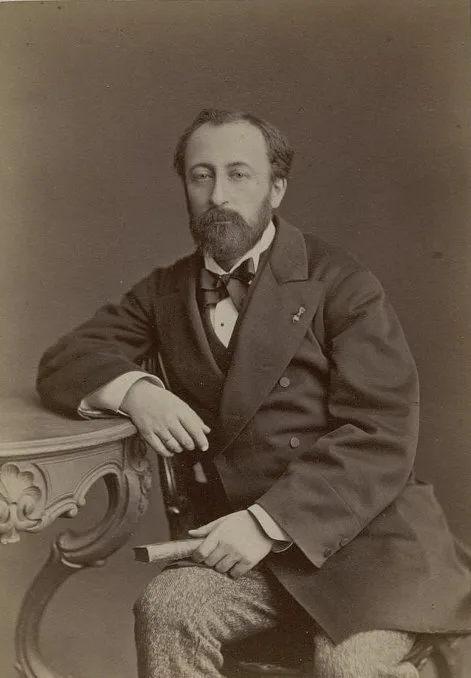
Camille Saint-Saëns (born Charles-Camille Saint-Saëns; 9 October 1835 – 16 December 1921) was a French composer, pianist, organist, conductor, and writer. One of the most naturally gifted musicians of the nineteenth century, he helped restore prestige to French instrumental music while preserving ideals of formal balance, clarity, and craftsmanship. His best-known compositions include Introduction and Rondo Capriccioso (1863), Piano Concerto No. 2 (1868), Dance of Death (Danse macabre, 1874), the opera Samson and Delilah (Samson et Dalila, 1877), Symphony No. 3, known as the “Organ Symphony” (1886), and The Carnival of the Animals (Le Carnaval des animaux, 1886). His long life connected the worlds of Felix Mendelssohn and Franz Liszt to those of early recording and cinema.
Biography
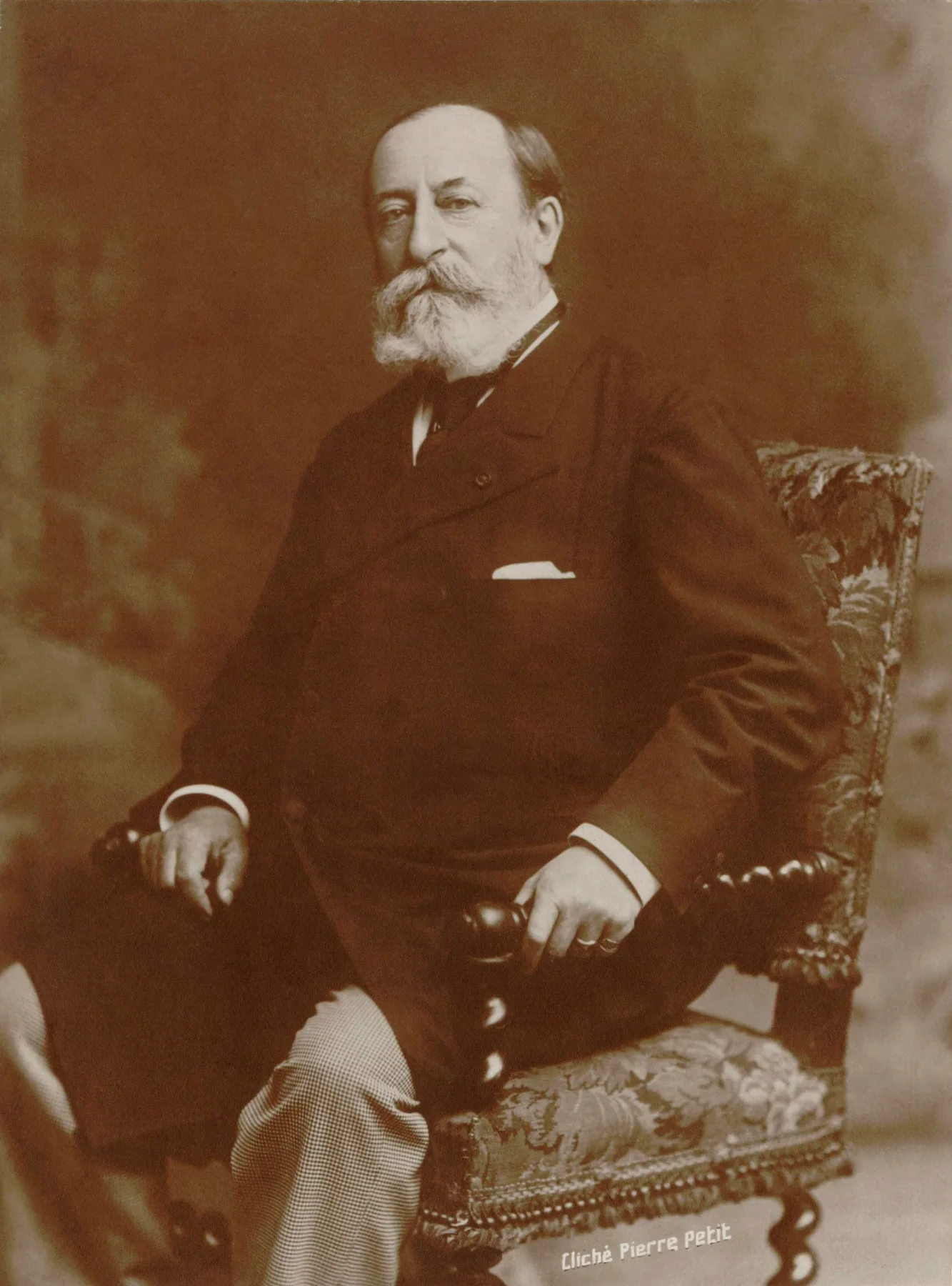
Camille Saint-Saëns was born Charles-Camille Saint-Saëns on 9 October 1835 at 3 Rue du Jardinet in the Latin Quarter of Paris.
His father, Jacques-Joseph-Victor Saint-Saëns, worked for the French Ministry of the Interior. His mother, Françoise-Clémence Collin, was an amateur painter.
Jacques-Joseph-Victor Saint-Saëns died of tuberculosis before his son was three months old. The frail infant was sent to live with a nurse at Corbeil, south of Paris, and remained there for two years.
Back in Paris, he was raised by his mother and her aunt, Charlotte Gayard Masson. Saint-Saëns later wrote that he had been given “two mothers.”
Charlotte Gayard Masson taught him the names of the notes when he was two and a half. She had the family piano tuned for him, and he became furious whenever anyone pulled him away from it.
His first surviving composition is dated 22 March 1839. He was three years and five months old.
His precocity spread far beyond music. As a child he studied Latin, mathematics, botany, geology, and astronomy, disciplines that would remain lifelong enthusiasms rather than passing diversions.
At seven he began formal piano lessons with Camille-Marie Stamaty, a pupil of Friedrich Kalkbrenner. He studied harmony and composition with Pierre Maleden.
On 6 May 1846, at ten, Saint-Saëns made his formal public debut at the Salle Pleyel. The program included music by George Frideric Handel, Johann Sebastian Bach, Wolfgang Amadeus Mozart, and Ludwig van Beethoven.
He played from memory. For an encore, he offered to perform any one of Beethoven’s thirty-two piano sonatas chosen by the audience.
The gesture already revealed the adult Saint-Saëns: prodigious, controlled, and faintly provocative. His technique was not presented as mystery or confession, but as mastery.
In 1848 he entered the Paris Conservatoire. He studied organ with François Benoist and composition with Jacques Fromental Halévy, winning the Conservatoire’s first prize for organ in 1851.
He competed twice unsuccessfully for the Prix de Rome. The failure did little to impede a career that had already begun outside the competition room.
In 1853, at seventeen, Saint-Saëns became organist at the Church of Saint-Merri in Paris. That year he also completed his Symphony in E-flat major (1853), which was performed under the name of an anonymous German composer so that it would be judged without indulgence toward his youth.
The deception worked. When Saint-Saëns was revealed as the composer, Hector Berlioz became one of his admirers.
Berlioz’s famous verdict was perfectly barbed: “He knows everything but lacks inexperience.”
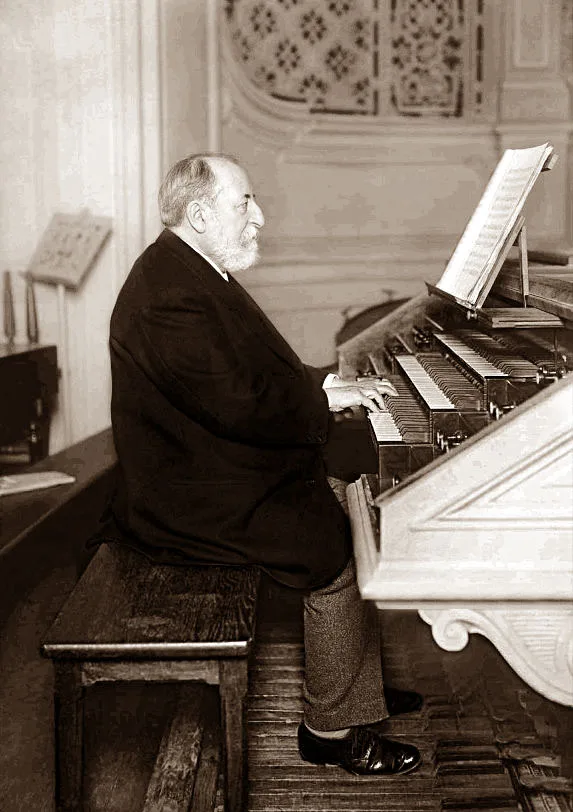
In 1857 Saint-Saëns was appointed organist at the Church of the Madeleine, one of the most prestigious musical posts in Paris. He remained there for twenty years.
His improvisations drew fashionable congregations as well as musicians. After hearing him, Liszt called him the greatest organist in the world.
Saint-Saëns nevertheless had little conventional religious faith. He treated the organ as an immense orchestral instrument, building improvisations through lucid architecture, changing color, and contrapuntal command rather than devotional display.
He traveled to Italy in 1857, beginning a habit that eventually carried him through Europe, North Africa, the Middle East, Asia, and the Americas. Movement gave him freedom from Parisian routines and supplied new colors without loosening his formal discipline.
From 1861 to 1865 he taught piano at the École Niedermeyer, a school created chiefly to train church musicians. His methods were unusually broad.
Alongside the classics, Saint-Saëns introduced his students to contemporary music and arranged evenings of theater and masquerade. His pupils included Gabriel Fauré and André Messager, both of whom remained close to him.
For the Spanish violinist Pablo de Sarasate, Saint-Saëns composed Introduction and Rondo Capriccioso (1863). Its slow opening gives way to a glittering rondo with snapping rhythms, quicksilver runs, and a Spanish accent that never overwhelms the piece’s elegant line.
The work illustrates his particular kind of virtuosity. Difficulty is everywhere, but it is polished into proportion; the performer dazzles without making the composition lose its shape.
Saint-Saëns wrote with astonishing speed. When the Russian pianist Anton Rubinstein decided in 1868 to make his Paris conducting debut, he asked Saint-Saëns to appear as soloist in a new concerto only three weeks later.
Saint-Saëns completed Piano Concerto No. 2 in G minor (1868) in seventeen days. The premiere went badly because he had scarcely had time to learn his own solo part.
The concerto survived the first night. It begins with a grave, Bach-like piano fantasia, turns into a fleet scherzo, and ends in a racing tarantella, a progression later described as beginning with Bach and ending with Jacques Offenbach.
When the Franco-Prussian War began in 1870, Saint-Saëns served briefly in the National Guard. The upheaval sent him to London for several months after the fall of Paris.
France’s defeat strengthened his determination to secure a place for French instrumental music, then overshadowed at home by opera and abroad by the German tradition.
In February 1871 Saint-Saëns and the singer Romain Bussine founded the Société Nationale de Musique. Its motto was “Ars Gallica,” French art.
The society gave young French composers a place to have chamber and orchestral works heard. Its early members included Fauré, César Franck, Henri Duparc, Jules Massenet, Ernest Guiraud, and Paul Taffanel.
Saint-Saëns also became the first French composer to cultivate the symphonic poem systematically. Liszt had developed the form, but Saint-Saëns gave it a tighter, more classically contained profile.
The Spinning Wheel of Omphale (Le Rouet d’Omphale, 1871) turns a myth into circling orchestral motion. Phaeton (Phaéton, 1873) drives toward catastrophe, while The Youth of Hercules (La Jeunesse d’Hercule, 1877) sets sensual temptation against heroic resolve.
The most enduring was Dance of Death (Danse macabre, 1874). A harp marks midnight with twelve strokes, Death tunes his violin to a sharpened, unsettling interval, and the xylophone rattles like dancing bones until the oboe’s cockcrow sends the skeletons back to their graves.
Its macabre subject is handled with precision and wit rather than heaviness. Saint-Saëns could make an orchestra gleam, whisper, or grin without crowding the page.
Charlotte Gayard Masson died in 1872. Saint-Saëns continued to live with his mother, whose judgment of his music remained formidable.
In 1875, approaching forty, he astonished his friends by marrying Marie-Laure Truffot, the nineteen-year-old sister of one of his pupils. Françoise-Clémence Saint-Saëns opposed the match and continued to share their household.
The marriage coincided with an especially productive period. Saint-Saëns completed the biblical opera Samson and Delilah (Samson et Dalila, 1877), with a libretto by Ferdinand Lemaire.
French theaters resisted the work, partly because a biblical subject on the operatic stage seemed improper. Liszt arranged its premiere at Weimar in 1877, conducted by Eduard Lassen and sung in German.
The opera joins French melodic sensuousness to monumental choral writing. Delilah’s music moves in long, perfumed curves, while the Bacchanale uses repeated rhythms, woodwind arabesques, and bright percussion to suggest a world at once seductive and dangerous.
Its beauty is never merely decorative. Samson’s strength, Delilah’s calculation, religious fervor, and physical desire are all carried by orchestral color and vocal line.
In 1877 the wealthy admirer Albert Libon died and left Saint-Saëns a substantial legacy. The money released him from the daily demands of the Madeleine, and he resigned his position that year.
Private disaster followed. In May 1878, his two-year-old son, André Saint-Saëns, fell from a fourth-floor window and died.
Six weeks later, the couple’s infant son, Jean-François Saint-Saëns, died of pneumonia. Saint-Saëns blamed Marie-Laure Saint-Saëns for André’s accident, and the double loss destroyed what little stability the marriage possessed.
He answered grief with work and travel. The Requiem (1878), composed soon afterward, avoids theatrical despair; its restrained sonority and luminous choral textures make sorrow feel ceremonial and contained.
In 1880 Saint-Saëns wrote Violin Concerto No. 3 in B minor (1880) for Sarasate. The solo line alternates between muscular declamation, songful lyricism, and passages of glittering agility, while the orchestra remains transparent enough for every change of character to register.
The next year in 1881, Saint-Saëns was elected to the Académie des Beaux-Arts. That summer, while vacationing with Marie-Laure Saint-Saëns at La Bourboule, he left their hotel without warning.
A letter arrived several days later saying that he would not return. Husband and wife never saw each other again, although they remained legally married.
The abandonment was cold, and Saint-Saëns made no public attempt to excuse it. He increasingly found a substitute family with Gabriel Fauré, Marie Fauré, and their sons, Emmanuel Fauré-Frémiet and Philippe Fauré-Frémiet, who knew him as an affectionate honorary uncle.
His opera Henry VIII (Henry VIII, 1883) was produced at the Paris Opéra with grand ceremonial scale. Saint-Saëns researched historical English music and used its contours to lend the score an archaic gravity without turning it into imitation Tudor music.
In early 1886 he composed The Carnival of the Animals (Le Carnaval des animaux, 1886) while resting in an Austrian village after a difficult concert tour.
The fourteen-part suite was conceived as a private entertainment. Two pianos and a small ensemble parade lions, hens, tortoises, kangaroos, an elephant, an aquarium, birds, fossils, and other specimens through a musical menagerie.
Its comedy is exact. Slow strings turn Offenbach’s cancan into the plod of tortoises, the double bass gives an elephant music borrowed from delicate fairy scenes by Mendelssohn and Berlioz, and pianists appear as animals condemned to practice scales.
In “Aquarium,” rippling keyboards, strings, flute, and glass harmonica create a translucent, suspended world that anticipates colors later associated with musical Impressionism.
“The Swan” places one long cello melody over softly undulating piano figures. Its apparent simplicity depends upon immaculate proportion: the water moves continuously while the bird above it seems not to labor at all.
Saint-Saëns feared that the suite’s frivolity would damage his serious reputation. He allowed “The Swan” to be published, but forbade complete public performance and publication of the rest during his lifetime.
The same year brought his most imposing symphonic achievement, Symphony No. 3 in C minor (1886), commissioned by the Philharmonic Society of London and dedicated to Liszt.
Known as the “Organ Symphony,” it uses piano and organ within the orchestra rather than treating either as a conventional soloist. Themes recur in altered shapes across the work, binding its movements through cyclical transformation.
The famous organ entrance does not arrive as continuous grandeur. Saint-Saëns withholds the instrument until its dark, sustained chords open an unexpected interior space; only in the finale does the organ blaze through C major as brass, strings, and four-hand piano drive the symphony toward its radiant close.
The music demonstrates the balance at the center of his style. The sonority is sumptuous, but the structure remains visible. Color intensifies form instead of concealing it.
Françoise-Clémence Saint-Saëns died in 1888. Her son was devastated and briefly feared for his own sanity.
He left Paris and eventually appeared in Las Palmas under the assumed name Charles Sannois. Disappearing became a habit, part escape and part defense against a public life that had grown ceremonial.
Travel now shaped his existence. He wintered repeatedly in Algeria and Egypt, crossed to Ceylon and Saigon, visited South America, and returned often to the Canary Islands.
The places entered his music through rhythm, scale, and instrumental color, though always refracted through a French concert tradition. The result was not musical documentation, but an elegant nineteenth-century cosmopolitanism with all the curiosities and limitations of its age.
The most successful example is Piano Concerto No. 5 in F major, known as the “Egyptian” (1896). Saint-Saëns developed much of it during a stay in Luxor and played its premiere at a concert marking the fiftieth anniversary of his Salle Pleyel debut.
The concerto combines glittering piano writing with fragments and impressions gathered during his travels. Its middle movement passes through changing scenes, including a melody Saint-Saëns said he heard Nile boatmen sing, while the finale moves with the mechanical energy of a ship’s propellers.
During the 1890s his position in French music changed. The former advocate of the new became an increasingly combative guardian of order as younger composers moved toward different harmonies, looser forms, and new ideas of color.
Saint-Saëns admired talent even when he disliked its direction, but his attacks on modernism could be sharp. The clarity prized in his music became, to hostile critics, evidence of coldness or academic facility.
That judgment misses the range inside his restraint. His best music can be tender, grotesque, sensuous, ceremonial, or very funny, but emotion is made intelligible through line and proportion rather than released as disorder.
His melodies tend to be cleanly profiled. His textures favor transparency, his rhythms have spring and definition, and even at its richest his orchestration lets the ear understand how the sound is built.
He continued to write in nearly every major form: operas, symphonies, concertos, chamber music, songs, sacred works, piano pieces, and music for the stage. He also produced poems, plays, philosophical essays, travel writing, memoirs, and criticism.
Astronomy remained a serious pursuit. He belonged to the Astronomical Society of France, owned a telescope, and sometimes arranged his concert travel around eclipses.
He wrote learnedly on acoustics, ancient instruments, archaeology, and the sciences. Few composers have united such musical facility with so restless and wide-ranging an intellectual appetite.
On 26 June 1904 Saint-Saëns entered a Paris studio and made his first gramophone recordings. At sixty-eight, he recorded excerpts and adaptations of his own works with a brisk, lucid technique.
These discs preserve a style very different from later traditions of heavy Romantic performance. Phrases move forward, rhythms remain taut, and virtuosity is delivered without lingering over its own importance.
In 1908 he entered another new medium. Saint-Saëns composed music for the silent historical film The Assassination of the Duke of Guise (L’Assassinat du duc de Guise, 1908), directed by André Calmettes and Charles Le Bargy from a screenplay by Henri Lavedan.
He worked scene by scene and scored the film for a twelve-player ensemble. He was the first major established composer to write music expressly for the cinema, recognizing that the supposedly minor entertainment could sustain disciplined musical storytelling.
Saint-Saëns remained an international celebrity even as parts of the Parisian musical establishment dismissed him as old-fashioned. He toured widely as pianist, organist, and conductor, performing with physical and technical vigor into his eighties.
In 1915 he traveled to the United States and appeared at the Panama-Pacific International Exposition in San Francisco. The journey made him a living link to a musical era that had already become history.
His nationalism hardened during the First World War, and his public arguments against German influence could be severe. This polemical side was real, though it occupied only one part of a life also spent supporting performers and younger French composers.
Near the end, Saint-Saëns turned with characteristic practicality to neglected instruments. His oboe, clarinet, and bassoon sonatas of 1921 give each instrument music shaped to its breathing, register, and particular shade of voice.
They are late works without late heaviness. The writing is concise, graceful, and transparent, as if the elderly composer were reducing his lifelong values to their clearest form.
In 1921 Saint-Saëns marked seventy-five years as a public performer. Soon afterward he left again for his customary winter in Algiers.
Camille Saint-Saëns died there on 16 December 1921, at the age of eighty-six.
His body was returned to France. After a state funeral at the Madeleine, the church where he had once astonished Paris at the organ, he was buried at Montparnasse Cemetery.
Marie-Laure Saint-Saëns attended the funeral heavily veiled and sat apart from the dignitaries. She had not seen her husband for forty years.
The following year, The Carnival of the Animals was published and performed publicly in full. The private joke Saint-Saëns had withheld became one of his most beloved creations.