Music
Nocturne Op. 9 - No. 1, No.2, No.3 by Frédéric Chopin
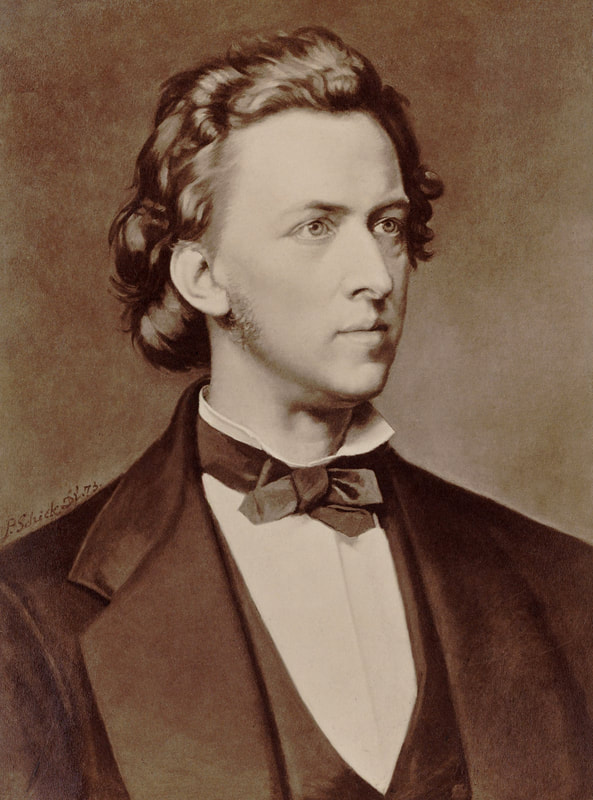
The Nocturnes, Op. 9 are a set of three nocturnes written by Frédéric Chopin between 1830 and 1832, published that year, and dedicated to Madame Marie Pleyel. The second nocturne of the work is regarded as Chopin's most famous piece and is regularly featured in films, television programs and video games.
Nocturne Op. 9 No.1 b-flat minor
00:00
00:00
00:00
Nocturne op.9 No.1 by Frederic Chopin - piano by Vadim Chaimovich
This nocturne has a rhythmic freedom that came to characterise Chopin's later work. The left hand has an unbroken sequence of eighth notes in simple arpeggios throughout the entire piece, while the right hand moves with freedom in patterns of seven, eleven, twenty, and twenty-two notes.
The opening section moves into a contrasting middle section, which flows back to the opening material in a transitional passage where the melody floats above seventeen consecutive bars of D-flat major chords. The reprise of the first section grows out of this, followed by a Picardy third ending.
The opening section moves into a contrasting middle section, which flows back to the opening material in a transitional passage where the melody floats above seventeen consecutive bars of D-flat major chords. The reprise of the first section grows out of this, followed by a Picardy third ending.
Nocturne Op. 9 No.2 e-flat major
00:00
00:00
00:00
nocturne op.9 no. 2 - Frederic Chopin - piano claudio arrau
Chopin composed his best-known Nocturne in E-flat major, Op. 9, No. 2 when he was around twenty years old.
This well-known nocturne is in rounded binary form (A, A, B, A, B, A) with coda, C. The A and B sections become increasingly ornamented with each recurrence. The penultimate bar utilizes considerable rhythmic freedom, indicated by the instruction, senza tempo (without tempo). Nocturne in E-flat major opens with a legato melody, mostly played piano, containing graceful upward leaps which becomes increasingly wide as the line unfolds. This melody is heard again three times during the piece. With each repetition, it is varied by ever more elaborate decorative tones and trills. The nocturne also includes a subordinate melody, which is played with rubato.
A sonorous foundation for the melodic line is provided by the widely spaced notes in the accompaniment, connected by the damper pedal. The waltz-like accompaniment gently emphasizes the 12/8 meter, 12 beats to the measure subdivided into four groups of 3 beats each.
This well-known nocturne is in rounded binary form (A, A, B, A, B, A) with coda, C. The A and B sections become increasingly ornamented with each recurrence. The penultimate bar utilizes considerable rhythmic freedom, indicated by the instruction, senza tempo (without tempo). Nocturne in E-flat major opens with a legato melody, mostly played piano, containing graceful upward leaps which becomes increasingly wide as the line unfolds. This melody is heard again three times during the piece. With each repetition, it is varied by ever more elaborate decorative tones and trills. The nocturne also includes a subordinate melody, which is played with rubato.
A sonorous foundation for the melodic line is provided by the widely spaced notes in the accompaniment, connected by the damper pedal. The waltz-like accompaniment gently emphasizes the 12/8 meter, 12 beats to the measure subdivided into four groups of 3 beats each.
Nocturne Op. 9 No.3 b-major
00:00
00:00
00:00
nocturne op. 9 no. 3 - Frederic Chopin - piano by claudio arrau
It is in ternary form A-B-A. The first section is marked allegretto. The main theme is chromatic, but filled with nostalgic energy. The second contrasting section, Agitato in B minor, is a very dramatic one with a combined melody and counter-melody in the right hand and continuous 8th note arpeggios in the left, which requires an amount of virtuosity. The piece is full of coloratura ornaments, and ends with a wide chord in the left hand accompanied with right hand triplets in a high octave to lead to a legatissimo smorzando adagio (senza tempo).
0 Comments