Film & TV
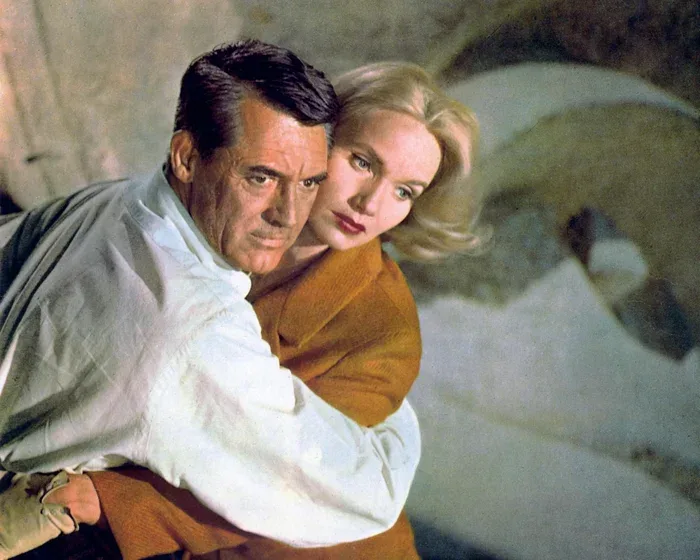
North by Northwest (1959) starring Cary Grant, Eva Marie Saint and James Mason
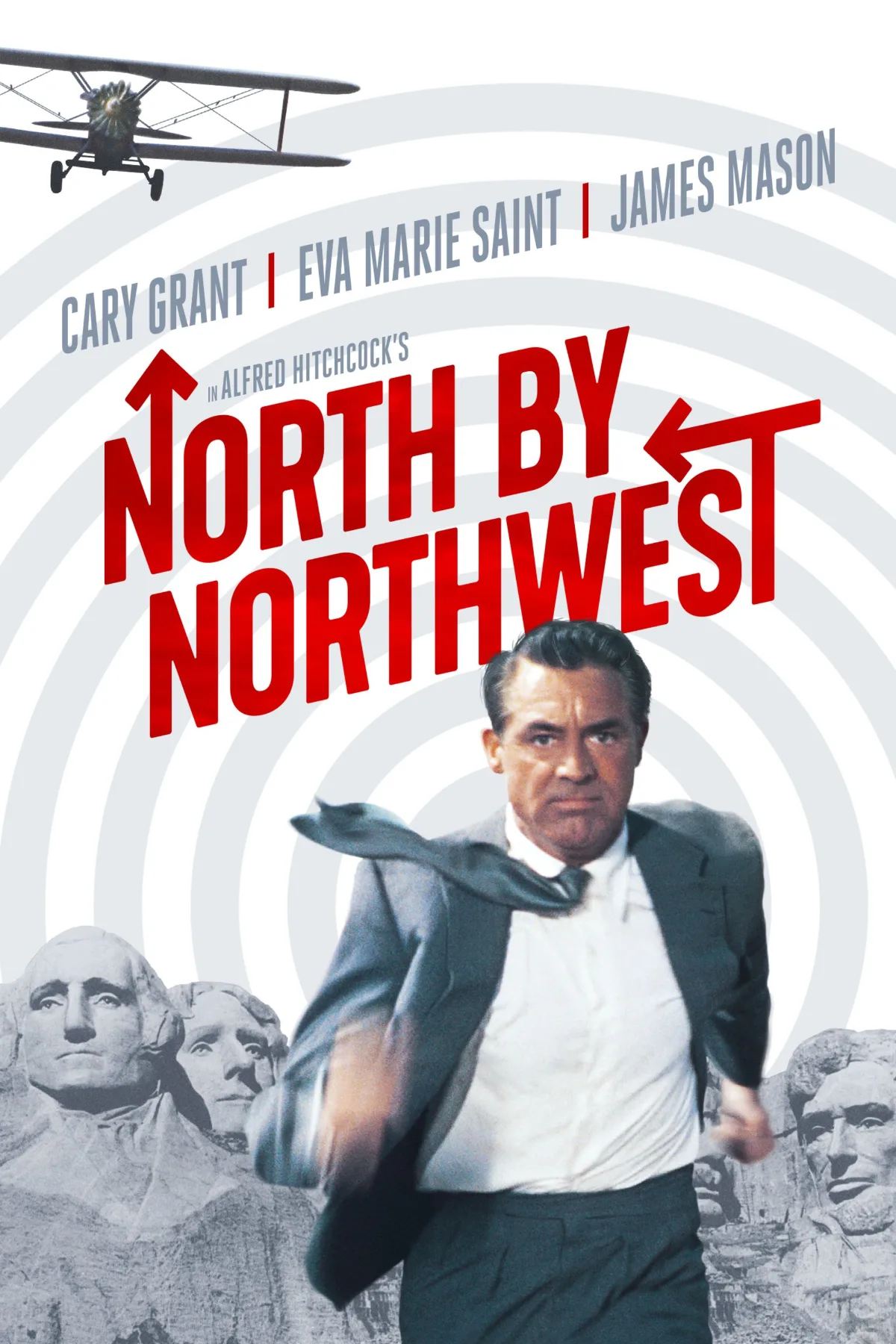
North by Northwest (film, 1959) is an American spy thriller produced and directed by British-born filmmaker Alfred Hitchcock for Metro-Goldwyn-Mayer. The original screenplay is by American writer Ernest Lehman.
British-born American actor Cary Grant plays a New York advertising man who is mistaken for a government agent who does not exist. He runs for his life from the Plaza Hotel to a cornfield in the Midwest, and finally onto the stone faces of Mount Rushmore.
It was the fourth and last film Alfred Hitchcock made with Cary Grant. With its gray suit, its cool blonde, and its crop-dusting plane, it became one of the most stylish and most imitated thrillers ever made.
Plot
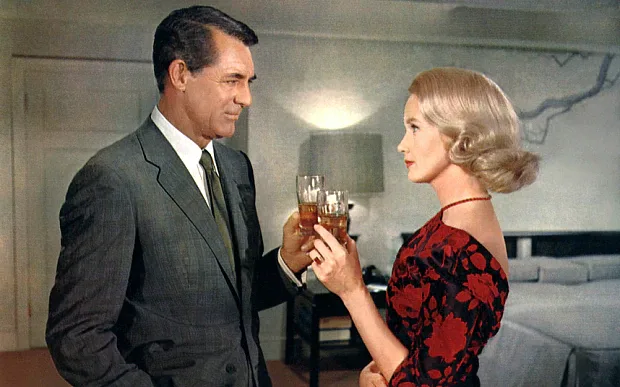
New York, late 1950s. Roger O. Thornhill is a smooth Madison Avenue advertising executive. One evening he stops for a drink in the Oak Room of the Plaza Hotel.
At that moment a waiter is paging a “Mr. George Kaplan.” Roger Thornhill raises his hand to call the same waiter. Two well-dressed men are watching the room. They decide that Roger Thornhill is George Kaplan.
The two men push him into a car at gunpoint. They drive him to a grand estate on Long Island, the home of a man named Lester Townsend.
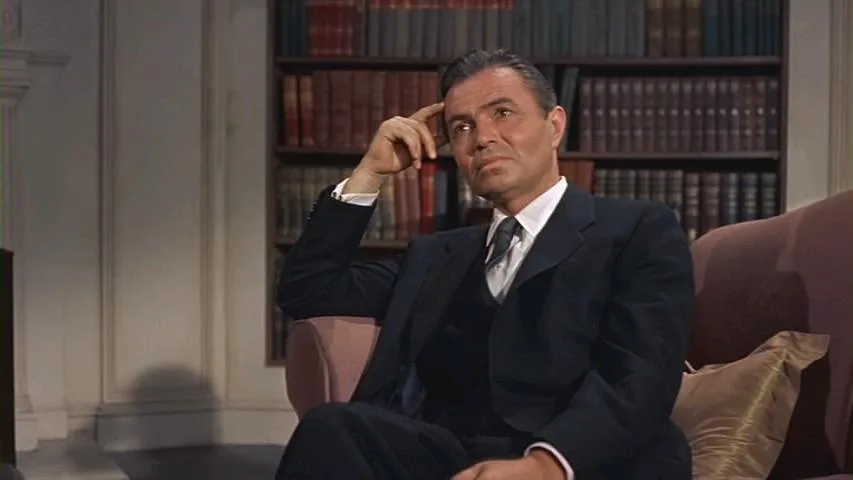
There, a polished, soft-spoken man questions him. Roger Thornhill insists he is not George Kaplan. Nobody believes him.
The men pour bourbon down his throat and put him behind the wheel of a car on a cliffside road. The plan is a fatal drunk-driving accident.
Roger Thornhill survives the drive, only to be arrested for drunk driving. Neither the police nor his mother, Clara Thornhill, believe his story.
He returns to the estate with detectives, but every trace of the night before has vanished. All he learns is that Lester Townsend is a diplomat at the United Nations.
With his mother at his side, Roger Thornhill slips into George Kaplan’s empty room at the Plaza. The kidnappers soon find him there, and he escapes.
He goes to the United Nations to find Lester Townsend. The diplomat he meets is a stranger, not the man who questioned him.
As Roger Thornhill asks the real Lester Townsend about the impostor, a knife flies into the diplomat’s back. Roger Thornhill pulls it out just as a photographer takes his picture. Now he looks like a killer, and he runs.
In Washington, a government intelligence agency reads the news with dismay. George Kaplan is its own invention, a fake agent created as a decoy. The agency chief, known only as the Professor, decides to leave Roger Thornhill to his fate rather than spoil the operation.
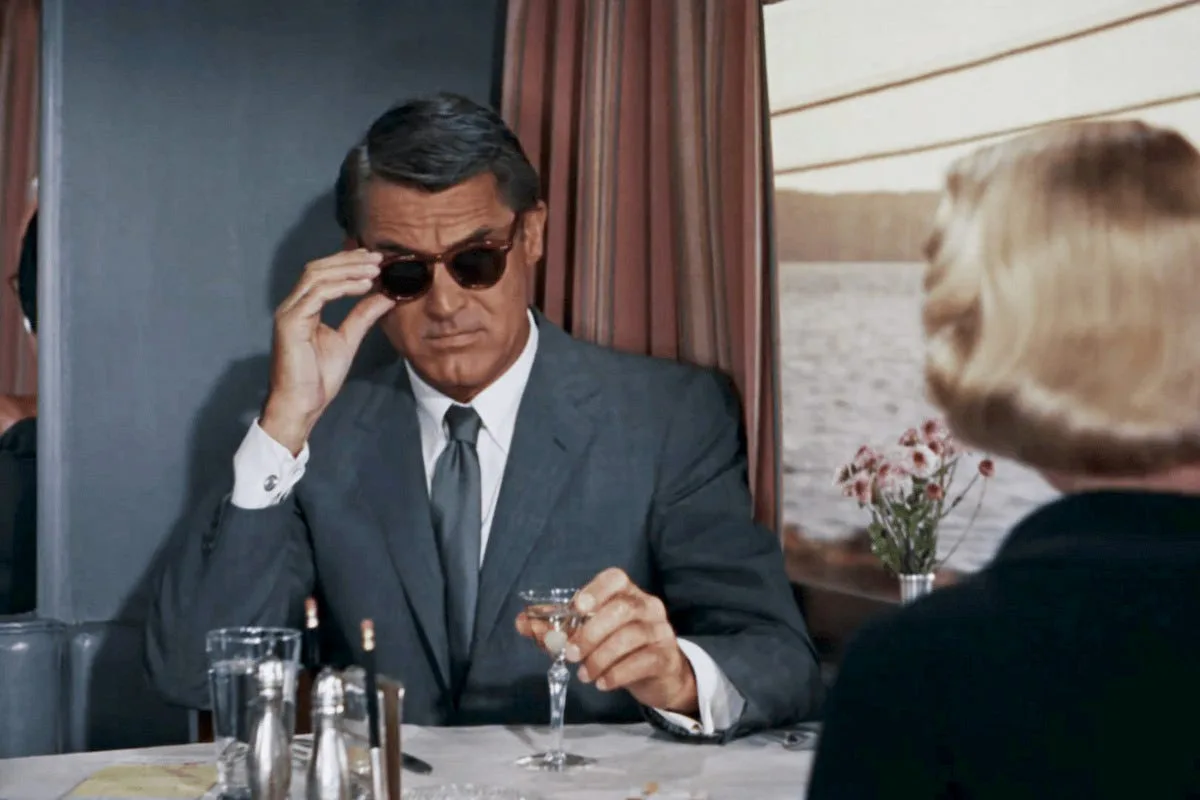
Roger Thornhill boards the 20th Century Limited, the overnight train to Chicago, without a ticket. A beautiful blonde stranger, Eve Kendall, hides him from the police.
In the dining car, Eve Kendall flirts with him over dinner. He lights her cigarette with a matchbook printed with his initials, R.O.T. She asks what the “O” stands for. “Nothing,” he says.
That night she hides him in the upper berth of her compartment. What Roger Thornhill does not see is the note she sends to another compartment on the train.
In Chicago, Eve Kendall tells him she has arranged a meeting with George Kaplan. He is to wait at a lonely bus stop in the flat farmland of Indiana.
Roger Thornhill waits in the empty heat. Nobody comes. A small crop-dusting plane is working the fields in the distance.
Suddenly the plane turns and dives straight at him, firing a machine gun. Roger Thornhill runs into a cornfield, and the plane sprays it with pesticide.
He rushes onto the highway in front of a fuel tanker truck. The plane crashes into the truck, and both go up in flames.
Roger Thornhill steals a pickup truck and drives back to Chicago. At George Kaplan’s hotel, he learns that “Kaplan” checked out before the time Eve Kendall says she spoke to him.
He follows her to an art auction. There he finds her beside the polished man from Long Island. His real name is Phillip Vandamm, and he leads the spy ring.
Phillip Vandamm buys a small statue. His right-hand man, Leonard, stays close.
Trapped by Phillip Vandamm’s men, Roger Thornhill turns the auction into chaos. He makes absurd bids and insults the room until the police come to take him away. For once, he is glad to be arrested.
The Professor steps in and takes him to the airport. There he finally tells Roger Thornhill the truth.
George Kaplan has never existed. Eve Kendall is the agency’s own agent, living as Phillip Vandamm’s mistress. Because of Roger Thornhill, her life is now in danger.
Roger Thornhill agrees to help. They fly to South Dakota, where Phillip Vandamm has a house in the hills above Mount Rushmore.
In the visitor center below the monument, Roger Thornhill plays George Kaplan one last time. In front of Phillip Vandamm, Eve Kendall pulls a gun and shoots him. The bullets are blanks. The “murder” is staged to protect her cover.
Afterward, alone in the woods, Roger Thornhill and Eve Kendall finally speak honestly. He learns that she is to fly abroad with Phillip Vandamm that night.
He begs her not to go. The Professor’s driver knocks him out, and he wakes up locked in a hospital room.
Roger Thornhill escapes through the window and climbs up to Phillip Vandamm’s modern house on the cliff. Hidden outside, he overhears the truth. The statue holds microfilm full of government secrets.
He also hears Leonard prove to Phillip Vandamm that Eve Kendall’s gun fired blanks. Phillip Vandamm decides to throw her out of the plane.
Roger Thornhill writes a warning inside his R.O.T. matchbook and drops it down to her.
As the plane waits, the housekeeper stops Roger Thornhill at gunpoint. Then he realizes that she is holding Eve Kendall’s gun, loaded with blanks.
At the last moment, Eve Kendall grabs the statue and runs to Roger Thornhill. They flee into the dark and reach the top of Mount Rushmore.
They climb down across the giant stone faces of the presidents, chased by Phillip Vandamm’s men. A park ranger shoots Leonard, and the Professor takes Phillip Vandamm into custody.
Eve Kendall slips and hangs from the rock by her fingertips. Roger Thornhill grips her hand and pulls.
The film cuts to a train. Roger Thornhill pulls Eve Kendall up into the upper berth of a sleeping compartment. “Come along, Mrs. Thornhill,” he says.
They kiss, and the train rushes into a tunnel.
Cast
- Cary Grant as Roger O. Thornhill
- Eva Marie Saint as Eve Kendall
- James Mason as Phillip Vandamm
- Jessie Royce Landis as Clara Thornhill
- Leo G. Carroll as the Professor
- Josephine Hutchinson as “Mrs. Townsend”
- Philip Ober as Lester Townsend
- Martin Landau as Leonard
- Adam Williams as Valerian
- Edward Platt as Victor Larrabee
- Robert Ellenstein as Licht
- Les Tremayne as the auctioneer
- Philip Coolidge as Dr. Cross
- Patrick McVey as Sergeant Flamm
- Edward Binns as Captain Junket
- Ken Lynch as Charlie
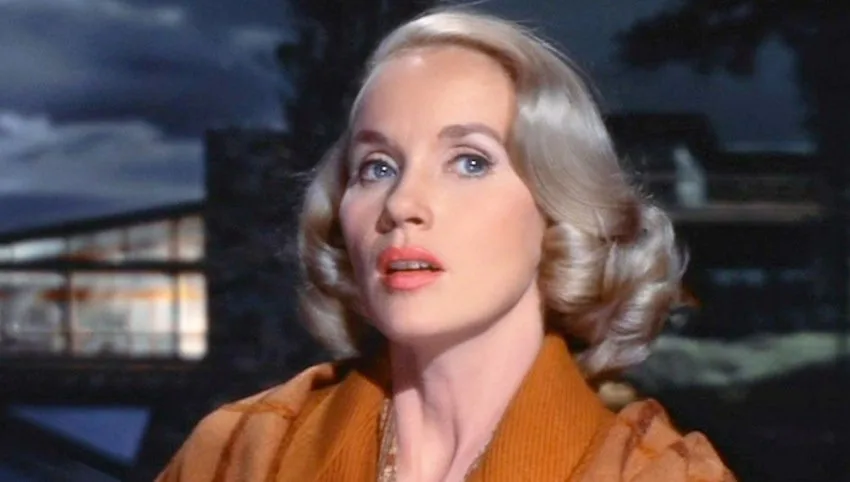
Cary Grant was in his mid-fifties, and Alfred Hitchcock barely needed to direct him. American actress Eva Marie Saint remembered that Alfred Hitchcock gave him no instructions at all for a walk across the lobby of the Plaza Hotel. Afterward the director explained: “He’s been walking across this lobby for years, I don’t need to tell him how.”
Eva Marie Saint had won an Academy Award for the gentle working-class heroine of On the Waterfront (film, 1954). Alfred Hitchcock wanted to turn her into a sophisticated spy.
She credited her husband, American television director Jeffrey Hayden, with persuading her to take the part. She remembered telling him: “Hitchcock sees me as a sexy spy lady!” Her husband answered: “So do I!”
Her mother gave her a tip. Alfred Hitchcock liked women in beige with white gloves. Eva Marie Saint wore exactly that to her next meeting with him, and she believed the outfit helped her win the part.
Metro-Goldwyn-Mayer wanted American dancer and actress Cyd Charisse instead. Alfred Hitchcock refused to give up his choice.
He had Eva Marie Saint cut her waist-length hair short. “I wanted her dressed like a kept woman,” he said, “smart, simple, subtle and quiet.”
His direction for her was famously simple: “Lower your voice, don’t use your hands, and look directly into Cary Grant’s eyes at all times.”
Cary Grant put her at ease. She had been known for tearful dramas, and he teased her about it: “See, Eva Marie, you don’t have to cry in a movie to have a good time.”
On the last shot of the film, Cary Grant pulled her down onto his lap. “Eva Marie,” he said, “you are my favorite leading lady.”
British actor James Mason plays Phillip Vandamm as a villain of perfect manners. Soft-voiced and dressed in fine tweeds, he seems more like an English gentleman than a spy.
American actress Jessie Royce Landis plays Roger Thornhill’s dry, amused mother. In real life she was only about seven years older than Cary Grant.
Alfred Hitchcock discovered American actor Martin Landau on Broadway, in the play Middle of the Night (play, 1956). He had gone to see American actor Edward G. Robinson, but he left impressed by Martin Landau. At MGM, he showed the young actor the storyboards and told him: “You’re now Leonard.”
British-born actor Leo G. Carroll, a regular in Alfred Hitchcock’s films, plays the Professor. A few years later he played a very similar spymaster in the television series The Man from U.N.C.L.E. (TV series, 1964–1968).
Production
The film began with an image in Alfred Hitchcock’s head. He imagined Cary Grant hiding inside the nose of American president Abraham Lincoln on Mount Rushmore, and giving himself away with a sneeze. He joked that the film could be called The Man on Lincoln’s Nose.
Alfred Hitchcock and Ernest Lehman were first supposed to adapt The Wreck of the Mary Deare (novel, 1956), a sea story by British novelist Hammond Innes. Ernest Lehman had been recommended by his friend, American composer Bernard Herrmann.
After a few weeks, Ernest Lehman admitted that he did not know what to do with the novel and offered to quit. Alfred Hitchcock told him they got along so well that they would simply write something else.
Ernest Lehman said he wanted to write “the Hitchcock picture to end all Hitchcock pictures.” Alfred Hitchcock answered: “I always wanted to do a chase across the faces of Mount Rushmore.”
The two men tried out many ideas, including a murder at the United Nations, a murder inside a car factory in Detroit, and a final showdown in Alaska. They chose the United Nations for the beginning and Mount Rushmore for the end.
The key idea came from American journalist Otis Guernsey. He had imagined spies who invent a fake agent as a decoy, and an innocent man mistaken for him. He was inspired by Operation Mincemeat, a real British wartime deception. Alfred Hitchcock bought the idea for $10,000.
In the original story, the hero was a traveling salesman, a part suited to American actor James Stewart. Ernest Lehman made him a Madison Avenue advertising man instead, a job he had once held himself.
The most famous scene began as something else. Alfred Hitchcock wanted to strand the hero in the middle of nowhere, and suggested the villains attack him with a tornado. “But they’re trying to kill him,” Ernest Lehman objected. “How are they going to work up a cyclone?”
Neither man could later say who had the answer. “Somewhere during that afternoon,” Ernest Lehman recalled, “the cyclone in the sky became the crop-duster plane.”
Ernest Lehman went to see the monument for himself. He hired a forest ranger and started to climb one of the stone faces. Halfway up, he lost his nerve. “I’m a screenwriter. What am I doing up here?” he cried.
He climbed back down and had the ranger photograph the top with a Polaroid camera. It turned out there was no room up there for a scene.
The working title was In a Northwesterly Direction, because the story was first planned to end in Alaska. The head of MGM’s story department suggested North by Northwest. “We never did find a [better] title,” Ernest Lehman said.
In 1963 Alfred Hitchcock explained the title to American director Peter Bogdanovich: “It’s a fantasy. The whole film is epitomized in the title—there is no such thing as north-by-northwest on the compass.”
This was Alfred Hitchcock’s only film for Metro-Goldwyn-Mayer. At his insistence, it was shot in VistaVision, a wide-screen process belonging to the rival studio Paramount.
The title sequence was designed by American graphic designer Saul Bass. Lines cross the screen and become the glass grid of a modern office tower on Park Avenue. It was the first film to make such extended use of moving type in its opening credits.
The United Nations refused permission to film on its grounds. So Alfred Hitchcock had Cary Grant step out of a taxi in front of the General Assembly Building, while a hidden camera crew filmed him crossing the plaza.
The Indiana cornfield was really farmland near Wasco, in California. Alfred Hitchcock placed square, Indiana-style road signs along the empty highway. Students from the local high school planted the cornstalks, and the plane was flown by a local crop-duster pilot, Bob Coe.
Mount Rushmore caused a quarrel with the American government. The National Park Service agreed to filming at the monument, but only if no violence was shown on or near the carved faces. When officials learned of the planned chase, the Department of the Interior withdrew the permit, calling it a “patent desecration.”
So the climb down the presidents’ faces was filmed on a giant replica on MGM sound stages in Culver City, California. The only scene shot at the real monument was the fake shooting in the visitor center. When the Interior Department saw the finished film, it complained that the agreement had been broken. It asked MGM to remove the screen credit thanking it for its help.
Phillip Vandamm’s house on the cliff never existed. Alfred Hitchcock asked for a home in the style of American architect Frank Lloyd Wright, then the most famous architect in the country. Production designer Robert F. Boyle gave it a cantilevered living room hanging over the void and walls of limestone. The exterior was a matte painting, and the interiors were built on a sound stage.
Cary Grant’s gray suit became almost a character in itself. It is a lightweight gray, single-breasted suit, worn with a crisp white shirt and a gray tie. It stays with him through a kidnapping, a night train, a cornfield and an auction.
Accounts differ about who made it. Most credit Kilgour, French & Stanbury, Cary Grant’s tailors on Savile Row in London. A label from Quintino of Beverly Hills appears on one suit, because duplicates were needed for the rougher scenes.
Eva Marie Saint’s wardrobe has its own story. The studio prepared clothes for her, but Alfred Hitchcock disliked them. So he took her shopping at the Bergdorf Goodman department store in New York.
As the models walked past, he told her: “Tell me only what you really like.” She fell for a black dress with red embossed roses. “Wrap them up for Eva Marie,” he said. A Bergdorf Goodman label even flashes for a moment inside her open purse in one scene.
Alfred Hitchcock had planned each look for its role in the story. “I suggested she be dressed in a basic black suit (with a simple emerald pendant) to intimate her relationship with James Mason,” he explained, “in a heavy silk black cocktail dress subtly imprinted with wine red flowers, in scenes where she deceived Cary; in a charcoal brown, full-skirted jersey and a burnt orange burlap outfit in the scenes of action.”
The rose dress is the one she wears at the auction. It is heavy black silk, with a fitted bodice, a full, swinging skirt, and a back cut in a deep V. Her hair was styled by the famous MGM hairdresser Sydney Guilaroff.
The censors objected to one of her lines in the dining car. Eva Marie Saint originally said, “I never make love on an empty stomach.” After filming, she had to dub in a new line: “I never discuss love on an empty stomach.”
There is also a private joke in the dining car. Many viewers read the “O” that stands for nothing as a dig at American producer David O. Selznick, who once claimed the “O” in his own name meant nothing.
MGM wanted the film cut by fifteen minutes to bring it under two hours. Alfred Hitchcock had his agent check his contract. He found that he had final control of the cut, and refused.
Alfred Hitchcock’s customary cameo comes in the first minutes. A bus door slams in his face just as his name leaves the screen.
The final shot of the train entering a tunnel is a deliberate joke. In his long interview with French director François Truffaut, published in English as Hitchcock/Truffaut (book, 1967), Alfred Hitchcock called it “probably one of the most impudent shots I ever made.”
Release/Reception
The film opened on 1 July 1959 at the United Artists Theatre in Chicago. In August it reached Radio City Music Hall in New York, where it stayed for seven weeks and topped the American box office the whole time.
In its first two weeks at Radio City it took $404,056, a record for the theater. It cost about $4.3 million and earned rentals of about $5.7 million in the United States and Canada, and $4.1 million abroad.
Critics were delighted. Time magazine called it “smoothly troweled and thoroughly entertaining.” A. H. Weiler of The New York Times praised it as the “year’s most scenic, intriguing and merriest chase.”
British critic Penelope Houston, writing in Sight and Sound, called it “the purest piece of entertainment filmmaking.”
At the Academy Awards in 1960, the film was nominated for Best Original Screenplay, Best Film Editing, and Best Art Direction and Set Decoration in color. It lost two of them to Ben-Hur (film, 1959) and the third to Pillow Talk (film, 1959).
Ernest Lehman won the Edgar Award for best motion picture screenplay. Alfred Hitchcock received the Silver Shell for Best Director at the San Sebastián International Film Festival in Spain, his second in a row after Vertigo (film, 1958).
In 1995 the Library of Congress added the film to the National Film Registry of the United States. In the 2022 Sight and Sound critics’ poll of the greatest films of all time, it shared 45th place.
Its influence has been enormous. It is often called “the first James Bond film,” for its glamorous locations, its elegant, witty hero, and its charming villain. The crop-duster chase inspired the helicopter attack in From Russia with Love (film, 1963).
The film also lent its name, in a playful way, to the South by Southwest festival in Austin, Texas, founded in 1987.
The gray suit has had its own afterlife. In 2006 a panel of fashion experts gathered by GQ magazine named it the best suit in film history and the most influential on men’s style. Later writers have seen its spirit in the Madison Avenue men of Mad Men (TV series, 2007–2015).
For the film’s sixty-fifth anniversary in 2024, Warner Bros. restored it from the original VistaVision camera negative. The new version was shown in 70mm at the Tribeca Festival in New York on 12 June 2024.
Eva Marie Saint, the last of its stars, died at her home in Los Angeles on 6 October 2026, at the age of 102. The world still remembers her as the cool blonde in the dining car, lowering her voice and looking straight into Cary Grant’s eyes, just as she had been told.
Where to watch North by Northwest online
United States: streaming with a YouTube TV subscription, and free with ads on Tubi and Plex. It can also be rented or bought on Amazon Prime Video, Apple TV, and Fandango at Home.
United Kingdom: streaming on NOW with the Entertainment and HBO Max membership. It can also be rented or bought on Apple TV and Amazon Prime Video.
France: streaming on HBO Max and the HBO Max Amazon Channel, as La Mort aux trousses. It can also be rented on Apple TV, Rakuten TV, Canal VOD, and Amazon Prime Video.
Germany: streaming on the WOW Fiction Amazon Channel, as Der unsichtbare Dritte. It can also be rented on Apple TV, Amazon Prime Video, Sky Store, MagentaTV, and Rakuten TV.
Spain: available to rent or buy as Con la muerte en los talones on Amazon Prime Video, Apple TV, and Rakuten TV.
Australia: streaming on HBO Max, HBO Max on Prime, and Foxtel. It can also be rented or bought on Apple TV and Amazon Prime Video.
Canada and other countries: widely available to rent or buy on Apple TV, Amazon Prime Video, and Rakuten TV.
Availability varies by subscription plan and can change over time.