Film & TV
Out of Africa (film, 1985) starring Meryl Streep, Robert Redford and Klaus Maria Brandauer
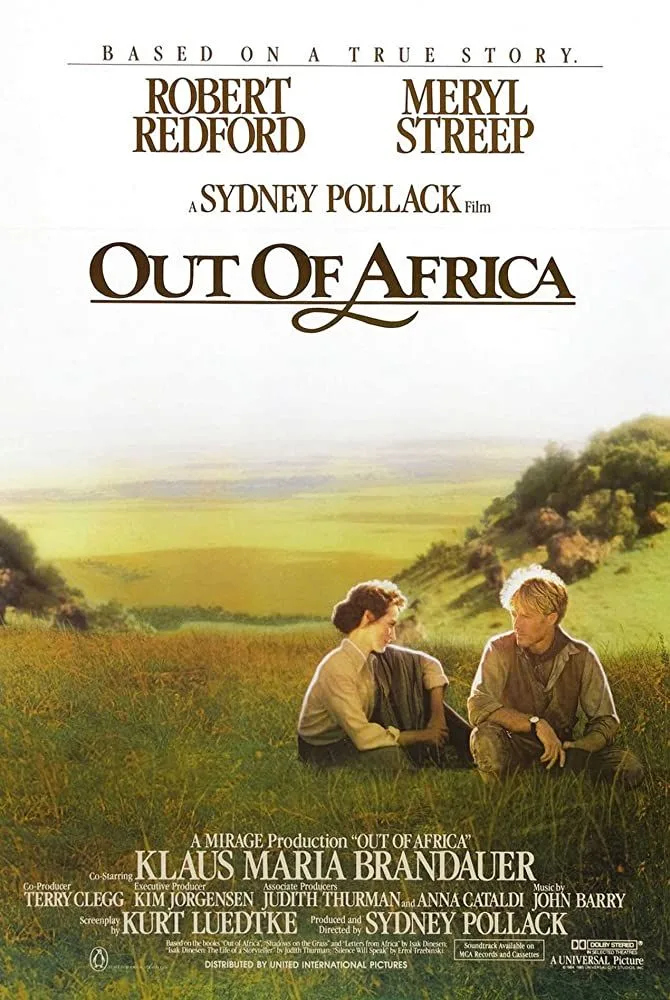
Out of Africa (1985) is Sydney Pollack's adaptation of the memoir by the Danish writer Karen Blixen, who published as Isak Dinesen, with Meryl Streep as Blixen and Robert Redford as the English hunter Denys Finch Hatton. It follows seventeen years in British East Africa, from Blixen's arrival in 1913 to the failure of her coffee farm and Finch Hatton's death.
Kurt Luedtke built the screenplay as six loosely linked episodes carried by Blixen's narration, some of it lifted from her books and the rest written in imitation of her cadence. The film won seven Academy Awards, including best picture, and was the fifth highest grossing release of its year in North America.
Plot
Denmark, 1913. Karen Dinesen is a wealthy Danish woman whose marriage proposal has been refused by a Swedish nobleman. She offers herself instead to his brother, Baron Bror Blixen, as a marriage of convenience. He has a title and no money. She has money and no husband.
Under their agreement, he will go ahead to British East Africa and buy a dairy farm with her capital. She will follow.
On the train to Nairobi she meets Denys Finch Hatton, a big game hunter who knows her fiancé. He asks her to look after his ivory as far as the station.
At Nairobi she is met by Farah Aden, the Somali headman of the household.
They marry, and Karen Dinesen becomes Baroness Blixen. Her husband then tells her he has bought a coffee farm instead of a dairy, at an altitude where coffee is unlikely to ripen. He intends to spend his time guiding safaris.
Karen Blixen takes the farm on herself. She comes to know the Kikuyu living on the land, opens a school for their children, treats their injuries, and settles their disputes. At the same time she assembles a European household, with linen, porcelain, and crystal carried up from the coast.
She becomes close with Felicity Spurway, a young Englishwoman who rides and shoots and has no interest in being a wife.
The war reaches East Africa. The settlers form a militia under Hugh Cholmondeley, Lord Delamere. Bror Blixen and Denys Finch Hatton go out with it toward the German colony.
Word comes that the men in the bush need supplies. Karen Blixen takes an ox wagon into country she does not know. She loses animals to lions and falls sick with exhaustion, but she gets the supplies through.
Karen Blixen learns she has contracted syphilis from her husband. She sails home to Denmark for arsenic treatment. Bror Blixen runs the farm while she is gone.
When she returns she refuses to live with her husband. He continues with his safaris, and his affairs with other women.
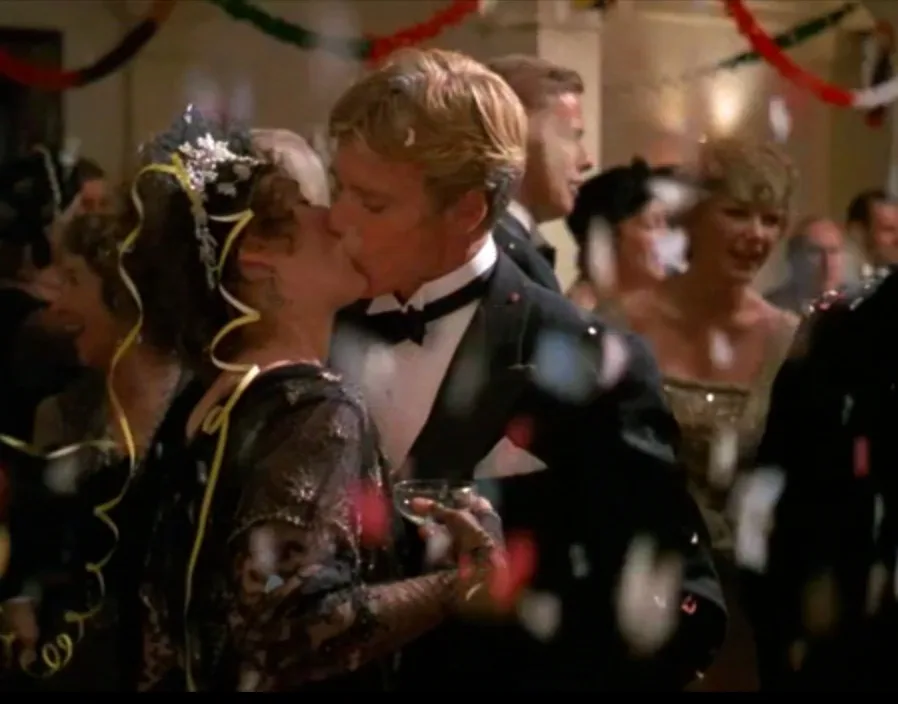
At a New Year's party at the Muthaiga Club she dances with Denys Finch Hatton, and the evening ends in an unplanned kiss. Afterward he begins leaving his books at her house, then living there between expeditions.
He brings her a gramophone, a compass, and Mozart. He buys a Gipsy Moth biplane and takes her up over the Rift Valley, the flamingos, and the Ngong Hills.
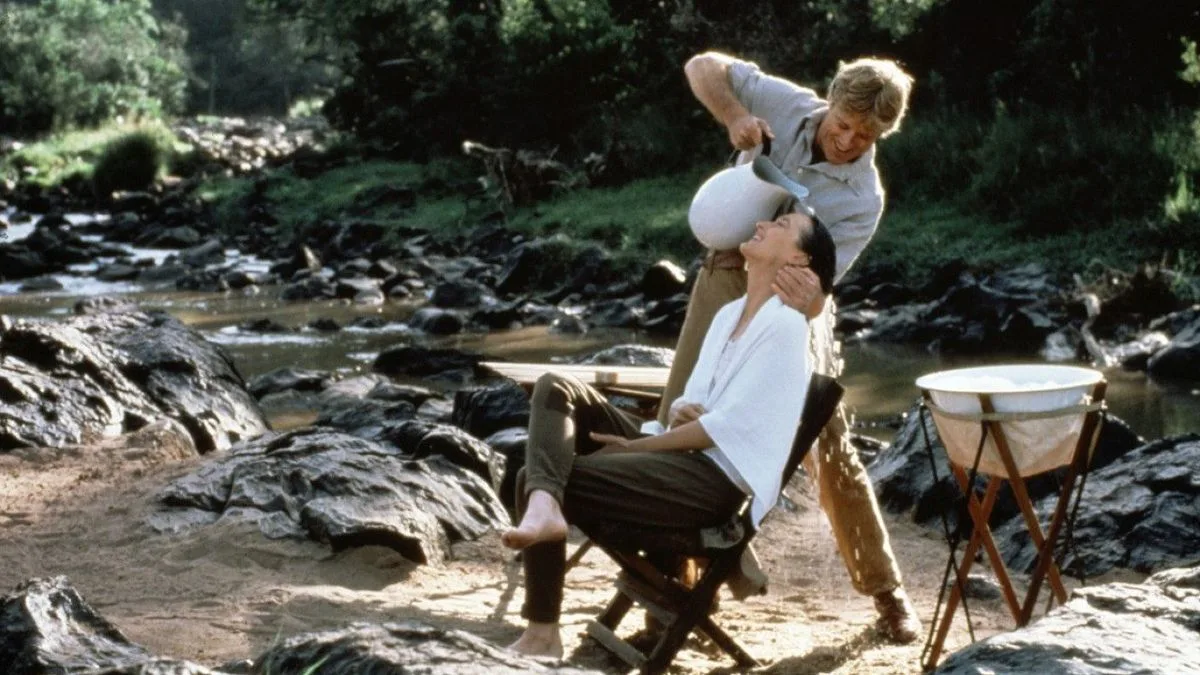
One afternoon at a camp by a river, he washes her hair for her, pouring water from a jug, while Mozart plays on the gramophone and he recites to her.
Bror Blixen asks for a divorce so he can marry another rich woman. Karen Blixen asks Denys Finch Hatton to formalize their relations. He refuses. He does not believe a marriage certificate would make him any more hers.
She learns he means to take Felicity Spurway up alone in the aeroplane. He tells her he wants no one else, and repeats that marriage is of no interest to him. She can get no further than that.
The first good harvest burns. The drying shed catches, and the crop goes with it. The farm is finished.
Karen Blixen has to sell everything: the furniture, the clocks, the china, even her own clothes, laid out on trestles for her neighbors to pick through.
She kneels on the floor before the new governor, Sir Joseph Aloysius Byrne, and his wife at Government House, asking for land for the Kikuyu who will be turned off her farm when it changes hands.
Denys Finch Hatton comes to the empty house. He tells her he no longer likes being alone, that he has changed, and asks to travel with her as far as Mombasa. He leaves to scout a safari, promising to fly back for her.
He does not. Bror Blixen brings the news. Denys Finch Hatton's Gipsy Moth biplane has come down at Tsavo and burned.
She buries him in the Ngong Hills, at a place they had chosen together, and reads over his grave the poem by A. E. Housman about the athlete dying young. On the marker she has cut a line from The Rime of the Ancient Mariner (1798): "He prayeth well, who loveth well both man and bird and beast."
At the Muthaiga Club, where a woman had never before been admitted to the men's bar, she stops to arrange for her letters to be forwarded. The members stand and ask her in for a drink.
She gives Farah Aden the compass Denys Finch Hatton gave her. She asks him to say her name once, to hear how he says it. He calls her Msabu. Then she leaves Africa.
Time passes. A letter from Farah Aden reaches her at her home in Denmark. He tells her that lions come to the grave of Denys Finch Hatton in the Ngong Hills, a male and a female, and lie on it in the morning.
Cast
- Meryl Streep as Karen Blixen
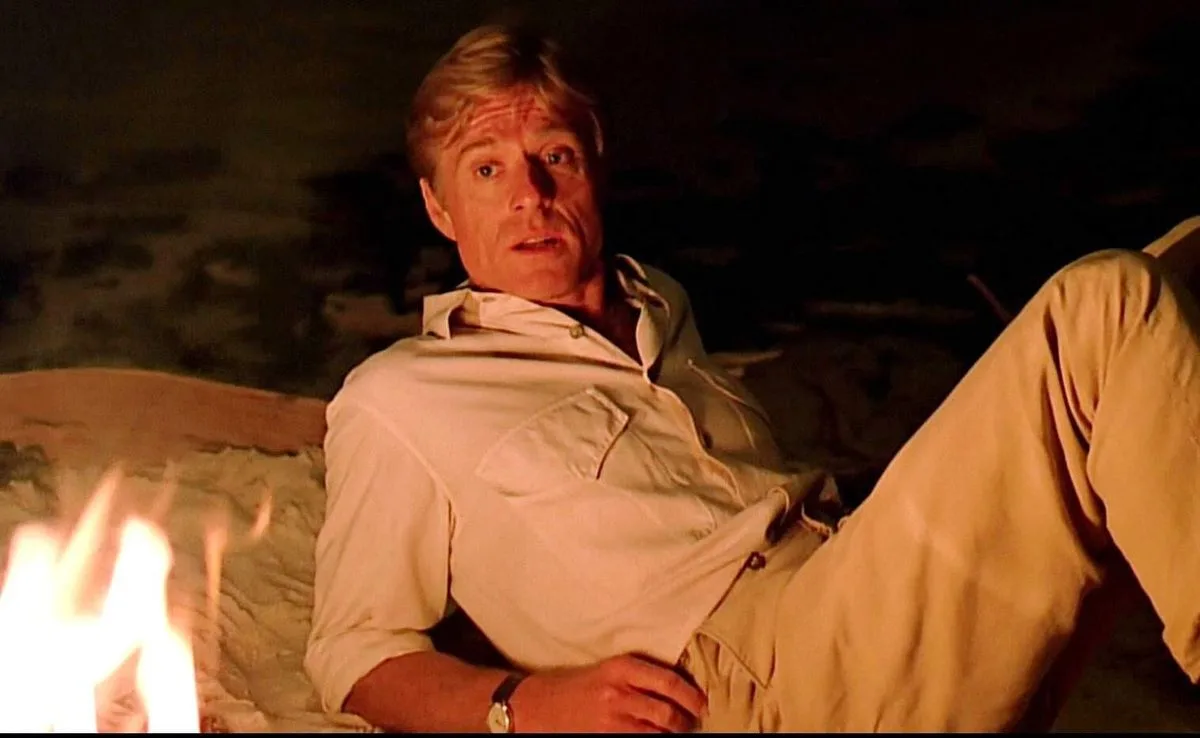
- Robert Redford as Denys Finch Hatton
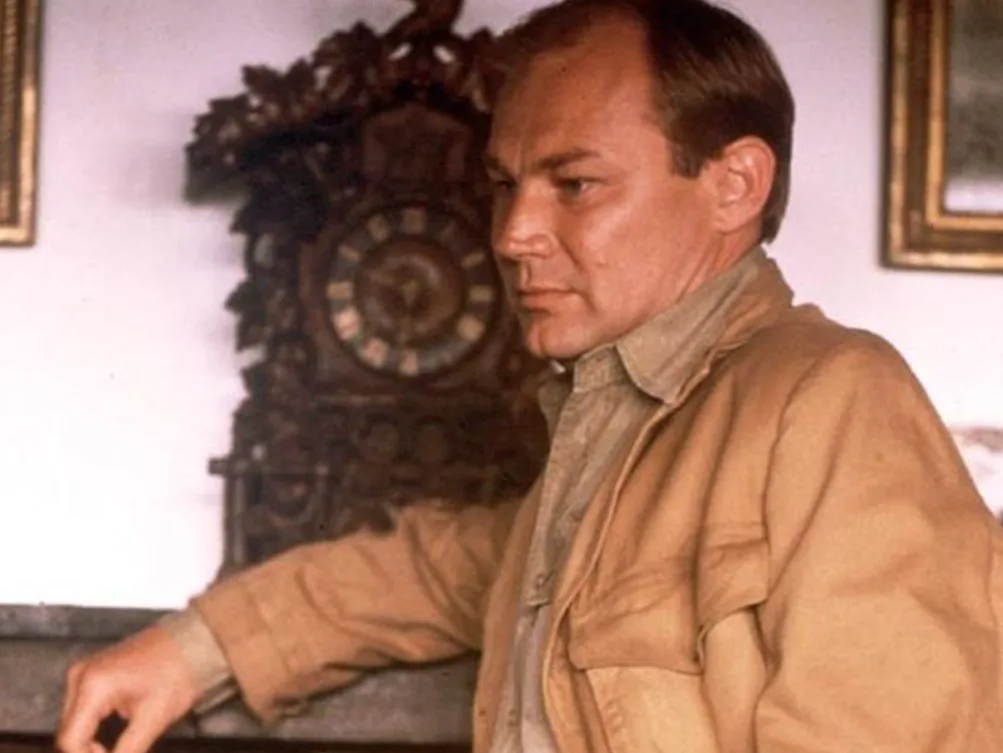
- Klaus Maria Brandauer as Baron Bror Blixen, and as Hans von Blixen-Finecke
- Michael Kitchen as Berkeley Cole
- Malick Bowens as Farah Aden
- Joseph Thiaka as Kamante
- Stephen Kinyanjui as Chief Kinanjui
- Michael Gough as Hugh Cholmondeley, Lord Delamere
- Suzanna Hamilton as Felicity Spurway
- Iman as Mariammo
- Leslie Phillips as Sir Joseph Aloysius Byrne
- Rachel Kempson as Sarah, Lady Belfield
- Graham Crowden as Henry, Lord Belfield
- Job Seda as Kanuthia
Meryl Streep built the whole performance on Karen Blixen's own voice, working from recordings of the writer late in life. The Danish accent is the spine of the characterization rather than decoration on it. The narration is delivered flat and low, the voice of someone describing a country from a long way off and a long time later.
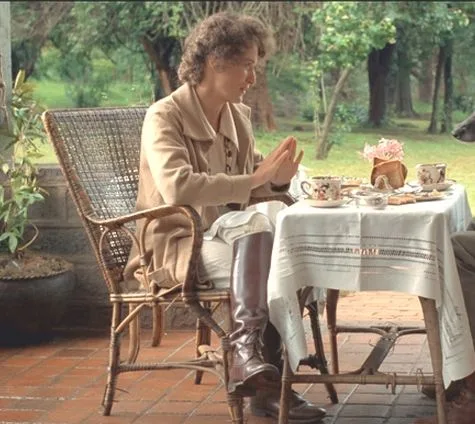
Her best playing is in the smallest transactions: kneeling in front of a governor she despises, watching her possessions being handled by strangers at the rummage sale, waiting at a table for an aeroplane that does not come.
Robert Redford plays Denys Finch Hatton with an American accent and an air of permanent departure. Reviewers divided sharply over the result. Gene Siskel wrote that he looked and acted as though he had just walked out of the safari fitting room at Abercrombie and Fitch. Variety, by contrast, found that the film rarely came to life except when Redford was in it.
Klaus Maria Brandauer has the least sympathetic part and makes the most of it. His Bror Blixen lies to his wife, infects her, and spends her money, yet remains disarming company. It is he who brings her the news of Finch Hatton's death, and stays to help.
Malick Bowens gives Farah Aden a formal dignity that the script never patronizes. The final exchange over her name is played by both actors almost without inflection.
Michael Kitchen's Berkeley Cole supplies the film's wit, drinking champagne in the middle of the morning because the alternative is Africa without champagne.
Production
Sydney Pollack had wanted Audrey Hepburn for Karen Blixen and did not think Meryl Streep had the sex appeal for it. Streep came to their meeting in a low-cut blouse and a push-up bra, and got the part.
Klaus Maria Brandauer was Pollack's only choice for Bror Blixen, and his availability nearly collapsed the casting. For Denys Finch Hatton, who was in fact an English aristocrat, a son of the thirteenth Earl of Winchilsea, Jeremy Irons was considered, but Pollack chose Robert Redford instead because he believed no British actor could carry that particular charm.
Redford accepted the role intending to play him as an Englishman. Pollack decided the accent would distract the audience and told him to use his own. Thus some early lines had to be rerecorded because a trace of British accent was still audible in them.
Filming took place in 1984, largely in the Karen and Lang'ata districts outside Nairobi, on and around the ground where Blixen had actually farmed. Her real house, Mbagathi, was by then a nursing school, so Stephen B. Grimes used her earlier house, Mbogani, which is now a dairy, while the original is the Karen Blixen Museum.
The less photogenic Ngong Hills were replaced in several sequences by the Chyulu Hills. A whole 1910s Nairobi was built on empty land at Langata, Government House was played by the administration block of Nairobi School, and rural Denmark was shot at Castle Rising in Norfolk, England.
The train was an assembly. The steam locomotive came off display at the Nairobi Railway Museum and could not move, so a diesel engine was concealed in a boxcar behind it and pushed, with steam and smoke added to the front. The passenger coach was the actual carriage from which a man was dragged and killed by a lioness during the building of the Uganda railway, as described in The Man-eaters of Tsavo (1907).
Descendants of the Kikuyu named in Blixen's book appear in the film, and Chief Kinanjui was played by his own grandson.
David Watkin lit the picture for distance and weather rather than spectacle, and shot it in 1.85:1 rather than the anamorphic format Pollack had used exclusively until then, a decision Pollack later regretted, saying it probably was one he should have had in widescreen. The aerial sequences over the Rift Valley were flown with a Gipsy Moth and photographed without process work, and they are the reason the film is remembered as a landscape picture.
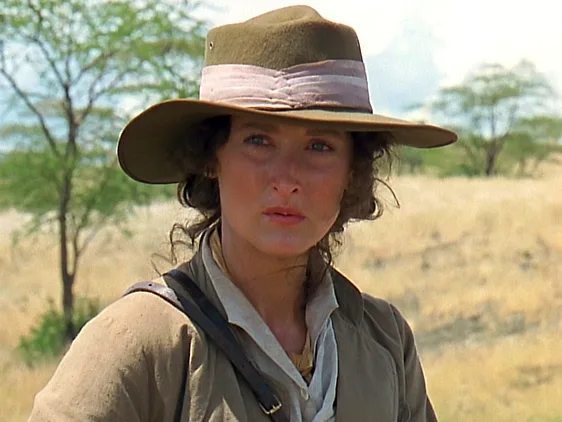
Milena Canonero dressed Karen Blixen in a wardrobe that starts in Copenhagen and slowly gives way to the farm: high-necked Edwardian lace and pale tussore silk on arrival, then softer cream and oatmeal linens that crease and stain, tailored jackets over jodhpurs and boots, a man's shirt with a knotted scarf, cardigans, wide leather belts, and always a hat, cloche, straw brim, or slouched felt. The colors stay within khaki, bone, cocoa, and dust, so that the one deep green silk evening dress Karen Blixen wore at the club carry as much weight as any line of dialogue.
John Barry wrote the score in long, unhurried string phrases, interleaved with African traditional songs and the second movement of Mozart's Clarinet Concerto in A major, which is the piece Denys Finch Hatton plays on the wind-up gramophone. Barry's main theme has outlived the film.
The screenplay left things out. The locust plague is gone, so is Blixen's writing about the German army, the farm's four thousand acres and eight hundred workers are scaled down, the two years Finch Hatton spent in Egypt on military service vanish, and the pregnancies she lost by him are never mentioned.
Release/Reception
Out of Africa opened in the United States on 18 December 1985, on a budget of about $31 million. It took $87 million in the United States and Canada, $23 million in Germany, where it was the year's second biggest release, and around $227.5 million worldwide, and audiences polled by CinemaScore gave it an A.
At the Academy Awards it won seven: best picture, best director for Sydney Pollack, best adapted screenplay for Kurt Luedtke, best cinematography for David Watkin, best art direction for Stephen B. Grimes and Josie MacAvin, best original score for John Barry, and best sound. Meryl Streep, Klaus Maria Brandauer, Milena Canonero, and the editors were nominated and did not win.
It also took the Golden Globe for best drama, with Brandauer winning supporting actor there and at the New York Film Critics Circle and the National Board of Review, and Streep named best actress by the Los Angeles and Kansas City critics. The British Academy gave it screenplay, cinematography, and sound.
The reviews were far less unanimous than the prizes. Roger Ebert gave it four stars and called it one of the great recent epic romances, while Vincent Canby of The New York Times called it a big, physically elaborate but wispy movie and wrote of Redford's part that there was no role for him to act. Pauline Kael found it unsatisfying, and Paul Attanasio of The Washington Post wrote that it rarely seemed more than an elevated form of tourism.
Its present standing sits between the two. It holds 62 percent on Rotten Tomatoes from 90 reviews, whose consensus praises the cinematography and the two leads and objects to the length and the pace, and 69 on Metacritic.
The American Film Institute later placed it thirteenth among screen romances and its score fifteenth among American film scores.
The other legacy was sartorial: within a year of the release, safari linens, jodhpurs, and bone-colored tailoring were everywhere in ready-to-wear, and a Danish coffee farmer who went bankrupt in 1931 had become a style reference.