People
Roger Federer (Born 8 August 1981)
Roger Federer (born 8 August 1981) is a Swiss former professional tennis player. He won 103 ATP singles titles, including twenty Grand Slam championships: eight at Wimbledon, six at the Australian Open, five at the US Open, and one at the French Open. He held the world No. 1 ranking for 310 weeks, including a then-record 237 consecutive weeks, and completed a career Grand Slam in 2009. Federer also won the 2008 Olympic doubles gold medal with Stan Wawrinka, the 2012 Olympic singles silver medal, and the 2014 Davis Cup with Switzerland. Celebrated for the fluency of his all-court game, he made athletic efficiency, tactical intelligence, and personal style part of the same unmistakable presence.
Biography
Roger Federer was born on 8 August 1981 in Basel, Switzerland, and grew up in nearby Münchenstein. The French and German borders were close enough to make several languages and identities part of ordinary life.
His father, Robert Federer, was Swiss. His mother, Lynette Federer, born Lynette Durand, came from South Africa and had played tennis and field hockey as a young woman.
Robert Federer and Lynette Federer met while working for the pharmaceutical company Ciba-Geigy. Their daughter, Diana Federer, was born in 1979, two years before Roger Federer.
The family spent weekends at the company’s sports facilities, where Federer experimented with tennis almost as soon as he could hold a racket. He also played soccer and supported FC Basel with the loyalty of a local boy.
Federer later said that tennis appealed to him because winning and losing were in his own hands. At twelve, he gave up soccer and chose the solitude of the court.
His early idol was Boris Becker, whose 1985 Wimbledon victory Federer watched repeatedly on television. Federer also admired the classical attack of Stefan Edberg, although the game he eventually built would be distinctly his own.
At eight, he joined the junior program at the Old Boys Tennis Club in Basel. His first regular coach, Adolf Kacovsky, recognized unusual hand-eye coordination and a capacity to learn by watching rather than through lengthy explanation.
Talent did not arrive with serenity. The young Federer cried after defeats, shouted at himself, flung rackets, and could spend more energy protesting a mistake than preparing for the next point.
One outburst at the national training center sent a racket spinning through a newly installed curtain. As punishment, he was made to clean toilets and vacuum offices, an inelegant episode in the education of a player later treated as composure itself.
At thirteen, Federer left home for the Swiss National Tennis Center in Écublens, in the French-speaking part of the country. He was homesick, struggled at first with French, and returned to Basel whenever training allowed.
The move gradually widened him. Swiss German remained the language of home, but Standard German, French, and English became natural tools, later allowing him to address crowds in their own language with unusual ease.
The Australian coach Peter Carter became the decisive technical influence of Federer’s youth. He refined the boy’s compact preparation, continental instincts, and willingness to move forward.
Federer’s mature game would be built upon economy. The feet made many small adjustment steps, but the upper body remained loose, disguising effort beneath clean lines.
In 1998, at sixteen, Federer finished the year as the International Tennis Federation’s junior world champion and turned professional that summer. The ponytail, impulsive shot selection, and intermittent concentration still belonged to adolescence, but the range of possibilities was already visible.
At the 2000 Olympic Games in Sydney, Federer met the Slovak-born Swiss player Miroslava Vavrinec, known as Mirka Vavrinec, in the Olympic Village. They spent two weeks together and kissed on the final day of the Games.
A persistent foot injury soon ended Mirka Vavrinec’s playing career. She became Federer’s closest companion.
Federer won his first ATP singles title in Milan in February 2001. That summer, he arrived at Wimbledon as a gifted nineteen-year-old and met seven-time champion Pete Sampras in the fourth round.
Federer defeated him in five sets, finishing the match at the net after three hours and forty-one minutes. It was the only official match the two men ever played.
In 2002, he won his first Masters title in Hamburg. On 1 August, Peter Carter died in a car accident while on honeymoon in South Africa.
Federer was devastated. He later called Carter’s death a wake-up call and said, "I guess he didn’t want me to be a wasted talent."
The loss did not magically create discipline, but it hardened Federer’s sense of obligation to his gift. Training became more purposeful, and the theatrical anger receded from view.
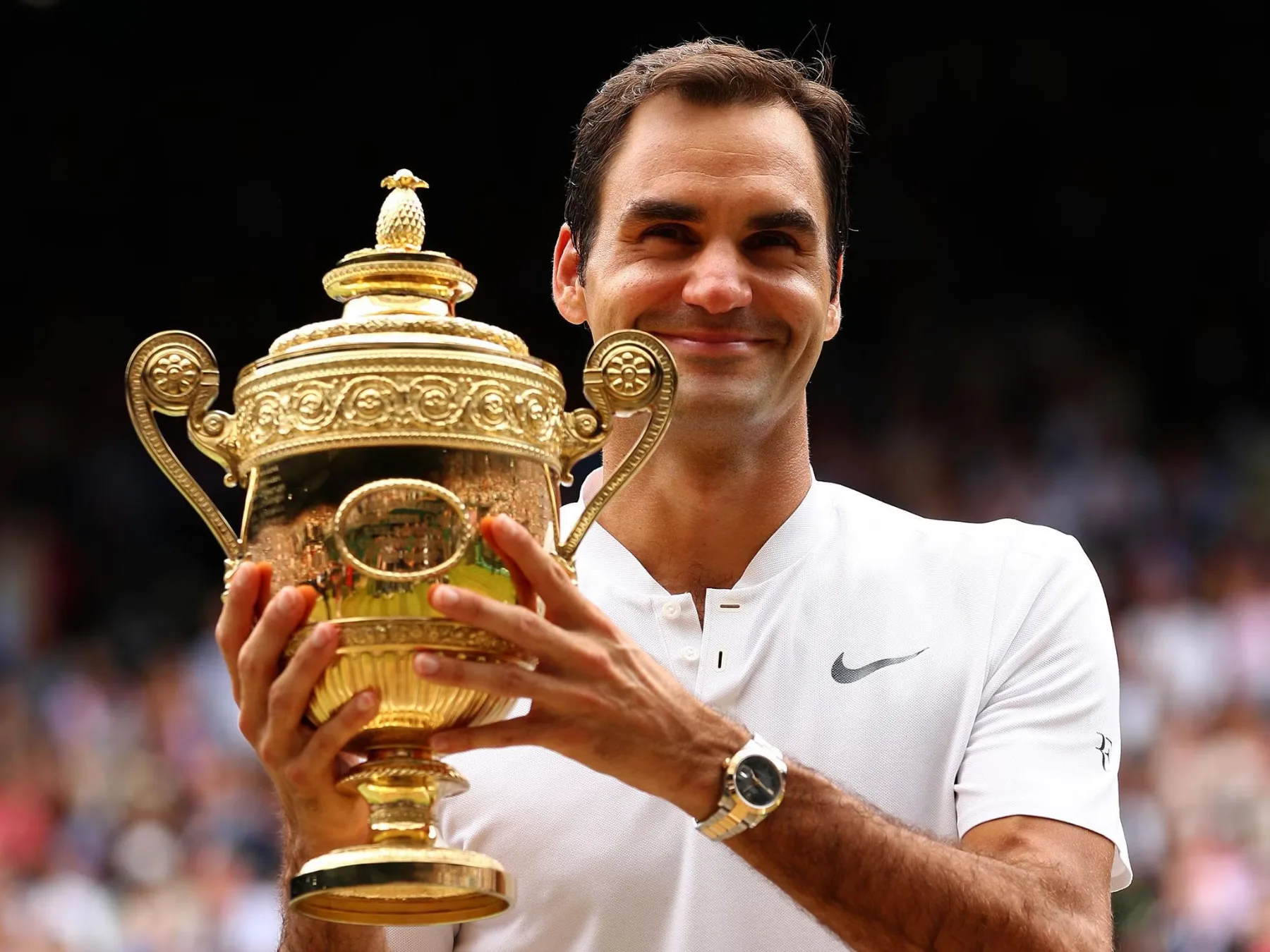
Under the Swedish coach Peter Lundgren, Federer entered Wimbledon in 2003 with growing confidence. On 6 July, after defeating Mark Philippoussis in three sets, Federer dropped to his knees on Centre Court, then sobbed through the trophy ceremony, the first Swiss man to win a Grand Slam singles title.
The victory established the public image that would follow him: white clothes, fluid movement, restrained celebration, with occasional sudden tears.
Later in 2003 he established the Roger Federer Foundation, directing its work toward early education in Switzerland and southern Africa, the region that had shaped Lynette Federer’s childhood and Federer’s own family visits.
Federer won the Australian Open in February 2004 and became world No. 1 for the first time. He remained there for 237 consecutive weeks, a reign whose steadiness was as remarkable as its length.
That year he won three of the four Grand Slam titles, taking the Australian Open, Wimbledon, and the US Open. On hard courts he could shorten the exchange with the serve and forehand; on grass he stayed low, took the ball early, and denied opponents time.
By 2006 he had become the sport’s central figure. He reached all four Grand Slam finals, won the Australian Open, Wimbledon, and the US Open, and lost the French Open final to Rafael Nadal.
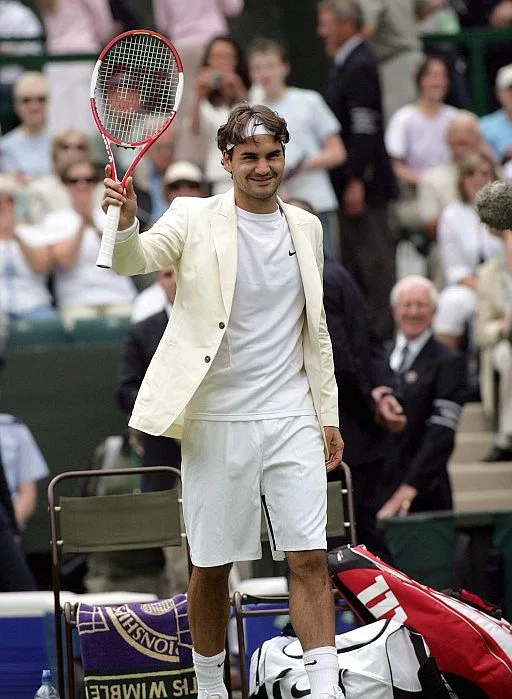
Federer also began to treat clothing as part of the theater of arrival. At Wimbledon in 2006 he walked onto Centre Court in a fitted cream Nike blazer, its structured shoulders and narrow lapels worn over his white tennis shirt and shorts, provoking a bygone world of lawn tennis.
At the 2006 US Open trophy ceremony he wore a Rolex Datejust with his dark tennis kit. The polished watch and immaculate clothes reinforced a public identity in which sport, ceremony, and luxury met without visible strain.
In 2007 he again won the Australian Open, Wimbledon, and the US Open. At Wimbledon, He wore a white blazer with a pair of long white trousers, as if he were on the runway of Milan.
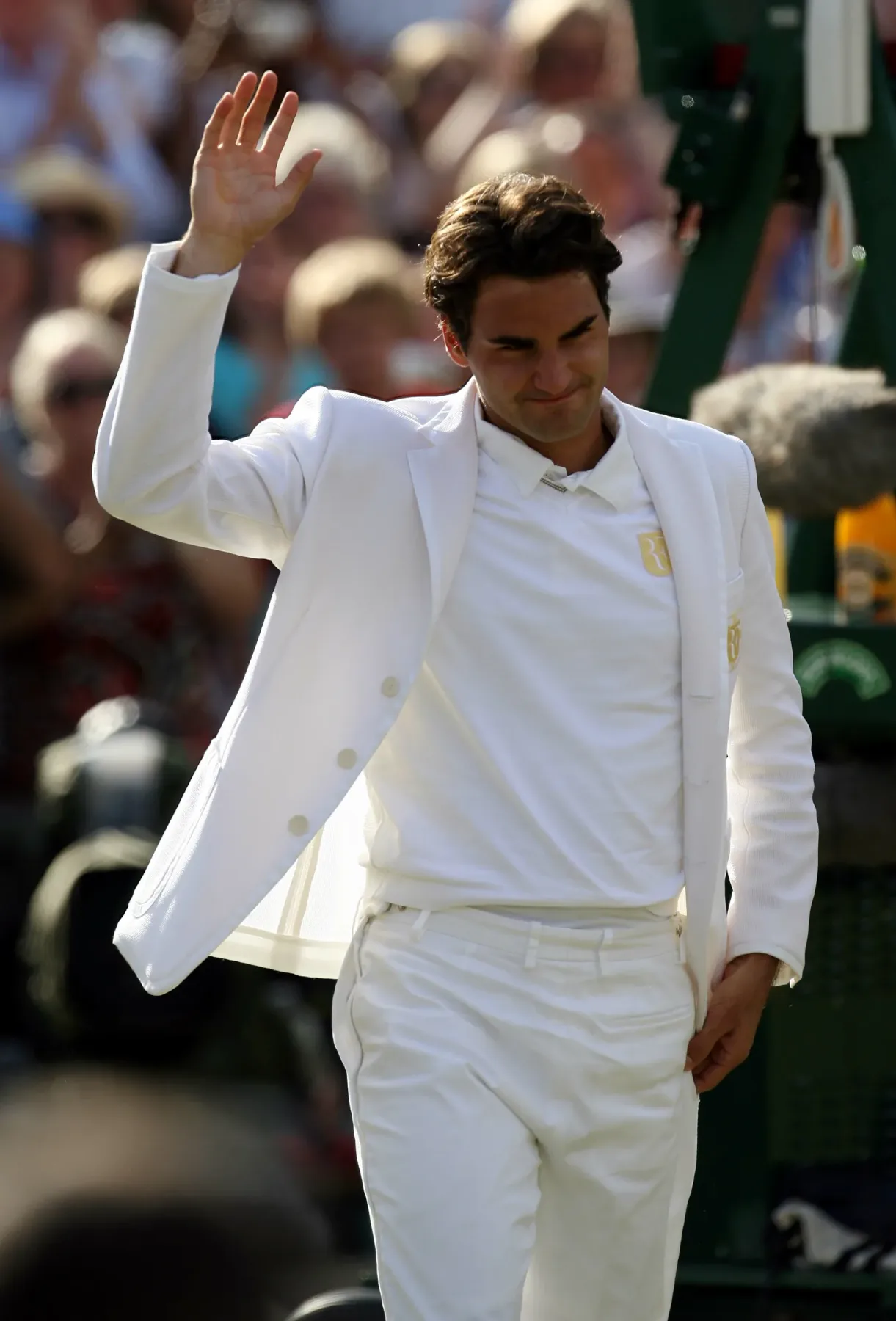
And the next year, Federer arrived in Wimbledon in a fine cream cardigan edged in navy, with a gold monogram on the chest. Inspired by the sportswear traditions associated with René Lacoste and Fred Perry, the cardigan softened the formality of the blazer while preserving the sense of occasion.
And it was in that cream cardigan that Roger Federer accepted his defeat against Rafael Nadal and the end of his sixty-five consecutive victories on grass.
On 11 April 2009, Federer and Mirka Vavrinec married in a small ceremony near Basel. She thereafter became known as Mirka Federer.
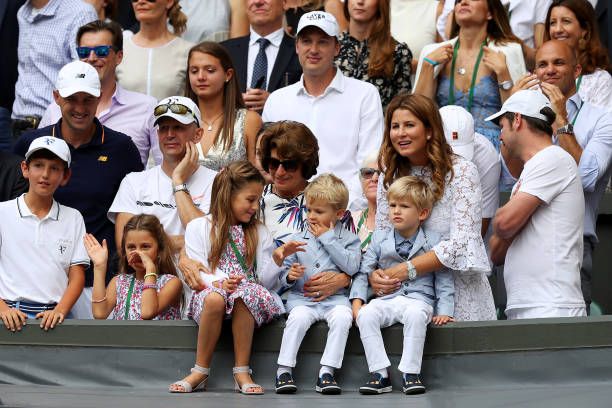
In July Federer received two gifts: a victory in Wimbledon, and Twin daughters Myla Rose Federer and Charlene Riva Federer, born on 23 July.
Another pair of twin followed a few years later, and this time two baby boys: Leo Federer and Lenny Federer were born on 6 May 2014.
In 2015, Federer developed an aggressive return in which he rushed forward to strike a second serve almost at the service line. The audacious tactic became known as SABR, for “Sneak Attack by Roger.”
It captured an essential quality of his late career. Instead of accepting that age must make tennis more cautious, he looked for ways to make points shorter, stranger, and more uncomfortable for younger opponents.
In 2016, Federer injured his left knee while preparing a bath for one of his daughters and underwent the first operation of his career.
But he won at Wimbledon the next summer, and at the 2018 Australian Open, Federer defeated Marin Čilić to become the first man to win twenty major singles titles. A month later, he returned to world No. 1 at thirty-six, then the oldest man to hold the ranking.
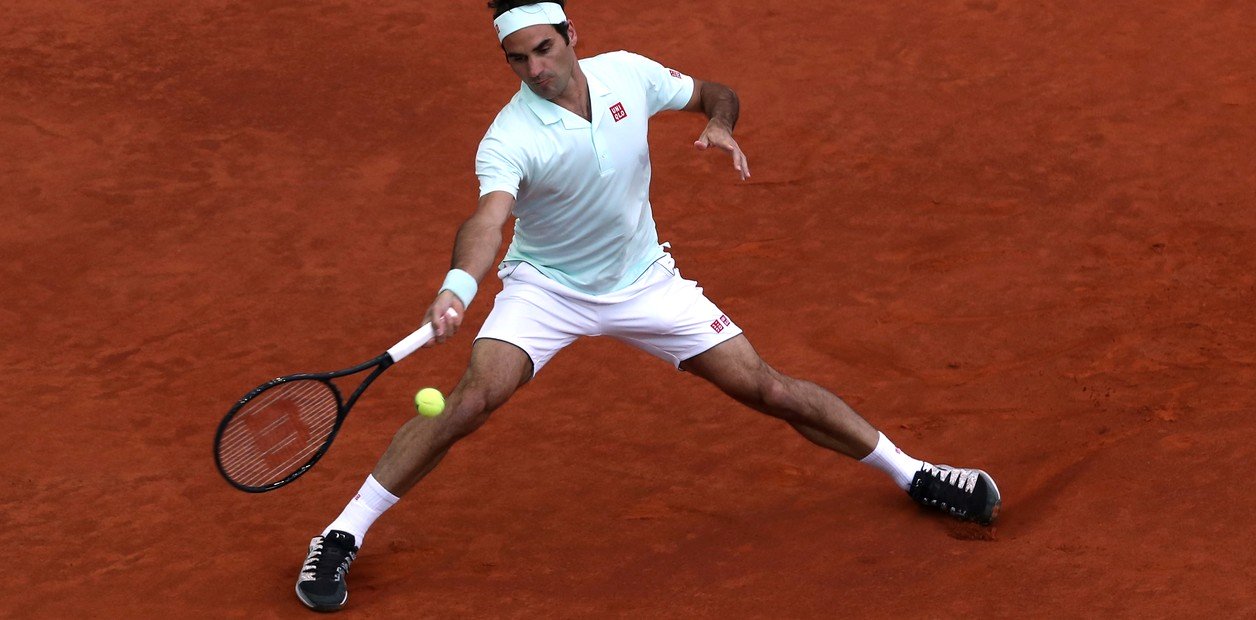
That summer he ended his long clothing partnership with Nike and appeared at Wimbledon in Uniqlo. The Japanese company gave him a simpler visual language: clean blocks of color, precise collars, discreet trim, and little surface ornament.
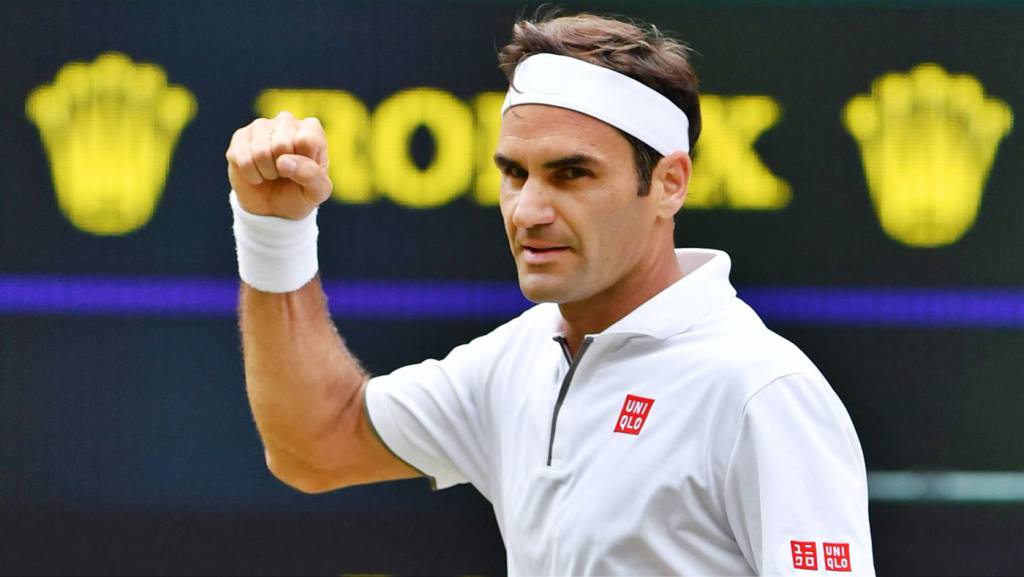
The initials “RF” remained temporarily with Nike, an unusually visible sign that Federer’s identity had become an asset distinct from any sponsor. When the monogram returned to him, it appeared on caps and accessories rather than overwhelming the clothes.
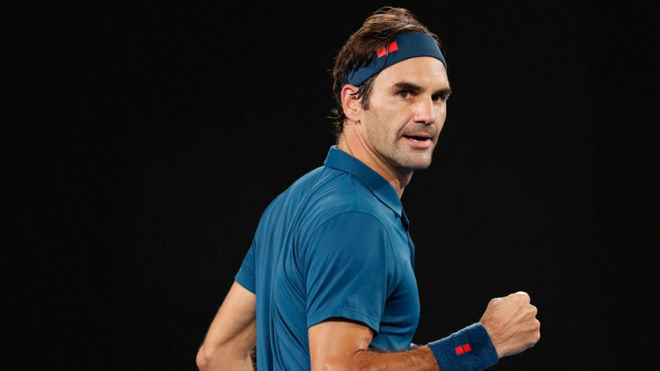
His on-court wardrobe had always worked through silhouette more than novelty. A close polo framed the shoulders, shorts fell in a clean line above the knee, and headbands controlled the hair without disturbing the face; cream, white, navy, black, and saturated jewel tones replaced noisy patterns.
Off court he favored dark suits cut close but not tight, white shirts, narrow ties, polished shoes, and watches chosen with the same interest in proportion. Even formal clothes retained enough ease for him to look like himself rather than a player temporarily placed inside tailoring.
Federer’s style occasionally risked self-consciousness, particularly during the monogram-heavy Wimbledon years. Yet the best looks succeeded because they extended qualities already present in his tennis: clarity, respect for tradition, and one unexpected flourish.
In 2019, at thirty-seven, he reached a twelfth Wimbledon final. That October he won the Swiss Indoors in Basel for the tenth time. It was his 103rd and final ATP singles title, achieved in the city where he had once worked as a ball boy.
Two operations on his right knee kept him out for most of 2020. He returned intermittently in 2021, reaching the Wimbledon quarterfinal. It would be his last singles match.
A third knee operation could not restore the body required for professional competition. On 15 September 2022, Federer announced that the Laver Cup in London would be his final ATP event.
"The Laver Cup next week in London will be my final ATP event," he wrote. "I will play more tennis in the future, of course, but just not in Grand Slams or on the tour."
On 23 September, he played his final match, partnering Rafael Nadal in doubles. They lost to Jack Sock and Frances Tiafoe, but the score quickly became incidental.
Federer sat beside Rafael Nadal afterward, both men crying as the ceremony unfolded around them. Their joined hands offered a last image of a rivalry that had sharpened each career without diminishing either man.
Retirement released Federer from athletic uniform without removing him from fashion. In 2023 he served as a co-chair of the Met Gala, wearing a sharply tailored black tuxedo, white evening shirt, bow tie, and sunglasses, with a Rolex at the cuff.
His partnership with the Swiss company On also moved beyond endorsement. Federer participated in the development of tennis and lifestyle shoes whose restrained profiles joined performance materials to the clean visual order long associated with him.
The documentary Federer: Twelve Final Days (2024), directed by Asif Kapadia and Joe Sabia, followed the private interval between his retirement announcement and his final match. What began as a home record became a portrait of an athlete trying to leave the structure that had shaped almost every day of his adult life.
In 2024 Dartmouth College awarded Federer an honorary doctorate. Addressing the graduating class, he challenged the language that had pursued him throughout his career: "Effortless is a myth."
The remark clarified the paradox of his elegance. Ease was not the absence of labor; it was labor refined until preparation, balance, and decision could no longer be seen separately.
By the end of his professional career, Federer had won twenty major singles titles, 103 ATP singles titles, and six year-end championships. He had spent 310 weeks at world No. 1 and played 1,526 tour-level singles matches.
The numbers describe mastery but not its texture. Federer made the interval between anticipation and execution seem unusually spacious, as though there were time to arrange the body, select the stroke, and finish in balance before anyone else had fully understood the ball.
In August 2026, Federer was inducted into the International Tennis Hall of Fame in Newport, Rhode Island. Mirka Federer introduced him, and Federer again struggled through tears while calling the honor one of the greatest of his life.
The volatile child had not vanished so much as learned form. Emotion remained close to the surface, but discipline gave it timing, and timing gave it grace.
Federer’s elegance was never simply the beauty of a one-handed backhand or a cream jacket at Wimbledon. It was the conversion of effort into clarity, rivalry into regard, and competition into an art that could appear generous even when its purpose was to win.