People
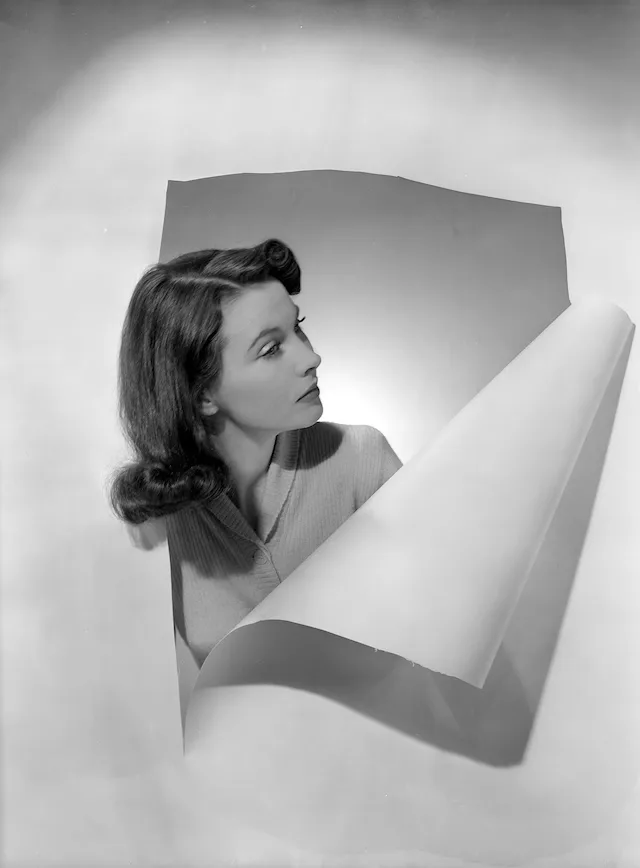
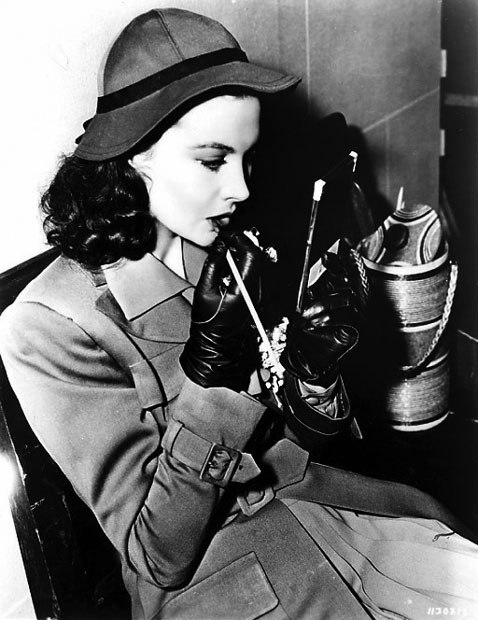
Vivien Leigh (born Vivian Mary Hartley; 5 November 1913 – 8 July 1967)
Biography
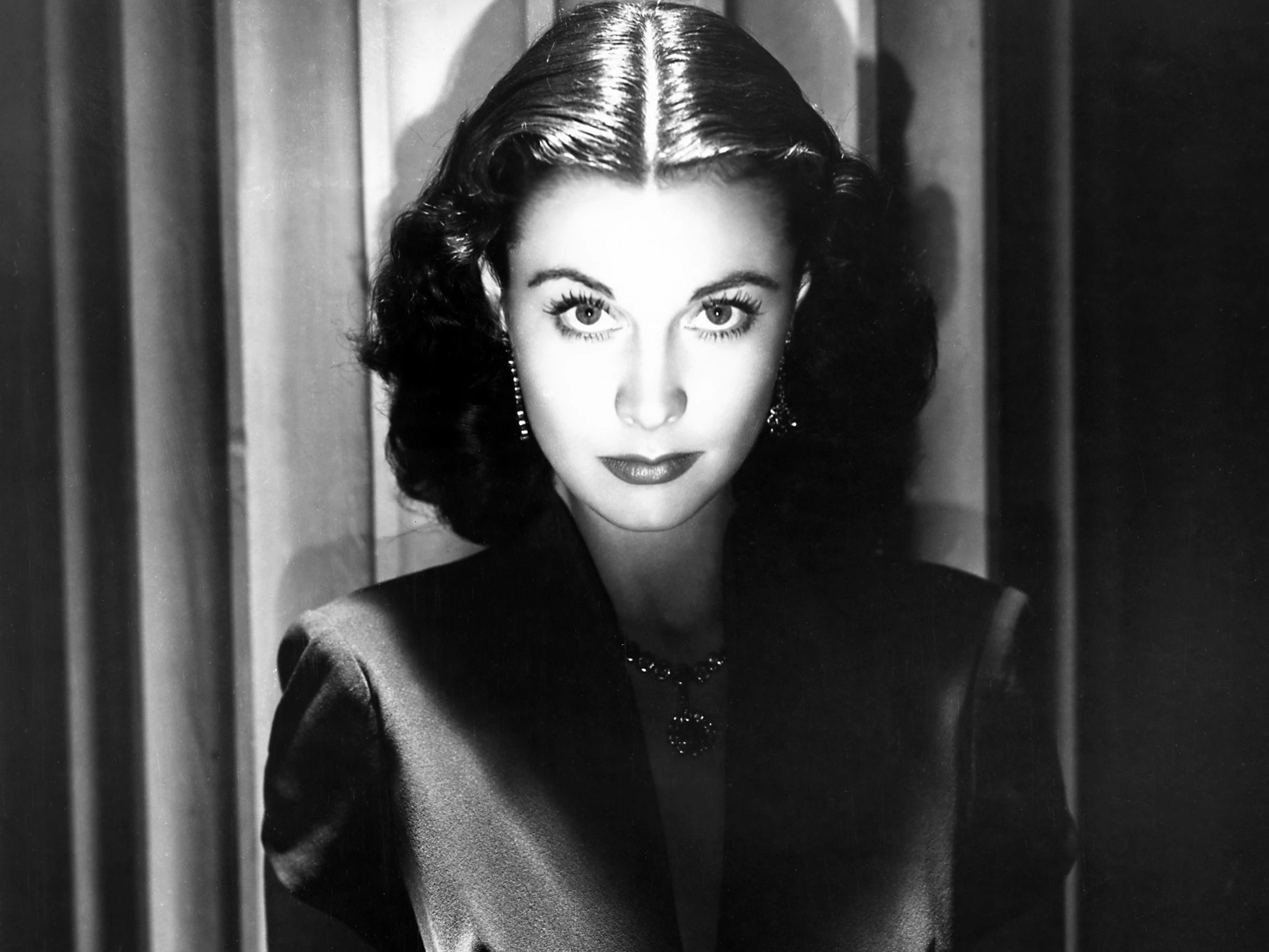
Vivian Mary Hartley was born on 5 November 1913 in Darjeeling, in the Bengal Presidency of British India.
Her father, Ernest Richard Hartley, was a British stockbroker. Her mother, Gertrude Mary Frances Yackjee Hartley, had been born in India and had Irish and Armenian ancestry.
Vivian was their only surviving child.
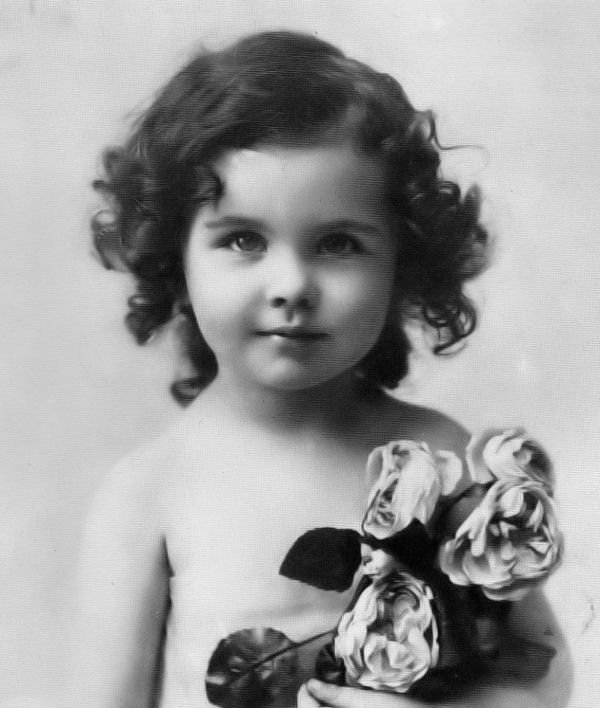
Her mother introduced her to literature from a very young age. When she made her first stage appearance by reciting "Little Bo Peep" for her mother's amateur theater group, she was only three years old.
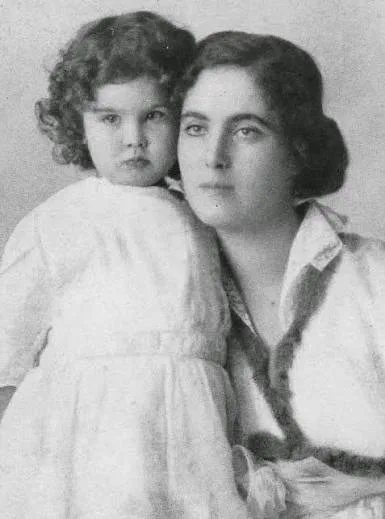
In 1920, when she was six, her parents sent her to the Convent of the Sacred Heart in Roehampton, southwest London. She was younger than most of the pupils and separated from her parents, who returned to India.
At school, she studied ballet, piano, cello, and elocution. She appeared in student productions of A Midsummer Night's Dream and The Tempest, and told her school friend, the future Irish-American actress Maureen O'Sullivan, that she intended to become a great actress.
Then her father came to London to fetch her. For the next four years, she traveled across Europe with her parents, continuing her education at schools in France, Italy, and Germany. She learned French and Italian, studied German, and developed the precise ear for accents that later became an important part of her acting.
The convent girl already understood the theater of clothes. She loved dressing up and was drawn to color, fabric, gesture, and the way an outfit could alter the person wearing it.
The family returned to Britain in 1931. After seeing Maureen O'Sullivan on screen in A Connecticut Yankee (film, 1931), Vivian again told her parents that she wanted to act.
Ernest Richard Hartley enrolled his daughter at the Royal Academy of Dramatic Art in London in 1932. Her early voice was high and thin, a weakness she would attack with the same determination she later brought to difficult roles.
That year, she met the barrister Herbert Leigh Holman, who was thirteen years older than her. They married on 20 December 1932. Vivian became Vivian Holman and interrupted her studies.
Their daughter, Suzanne Mary Holman, was born on 12 October 1933. Domestic life did not quiet Vivian's ambition, and before long she began seeking film work.


Leigh appeared briefly as an uncredited extra in Things Are Looking Up (film, 1935), starring the English actress and comedian Cicely Courtneidge. Several small screen parts followed in quick succession.
Her agent, John Gliddon, did not think the name Vivian Holman sounded good for her career and suggested several stage names. Vivian rejected them all. Finally she took her husband's middle name and changed one letter of her own, becoming Vivien Leigh.
The new name marked a shift. She was becoming someone quite different from the conventional young wife Herbert Leigh Holman had married.

Her first important stage opportunity came as Henriette Duquesnoy in The Mask of Virtue (play, 1935), adapted from a work by the German playwright Carl Sternheim. The role was small, but Leigh's poise and beauty drew immediate attention when the production opened in May.
The English producer Sydney Carroll enlarged her part and moved the play to a larger theater. The move exposed the weakness of her voice, and critics urged her to improve it.
Leigh did not dismiss the criticism. She began serious vocal training, working on breath, resonance, and projection until the light, uncertain voice became one of her most flexible instruments.
The Hungarian-born British film producer Alexander Korda, who had initially shown little interest in her, signed her to a contract. Leigh was not yet a finished actress, but she already possessed an uncommon ability to make stillness look powerful.
In 1935, she saw the English actor Laurence Kerr Olivier perform in Theatre Royal (play, 1934). She was captivated and reportedly told a friend that she would marry him one day.
Both were already married. Laurence Olivier's wife was the English actress Jill Esmond, with whom he had a son, Simon Tarquin Olivier.
In the autumn of that year, Vivien Leigh asked someone to introduce her to Laurence Olivier in a restaurant where he and his wife dined. Olivier recognized her from the play The Mask of Virtue and congratulated her on her performance.
Leigh and Olivier worked together in Fire Over England (film, 1937), a historical drama directed by the American filmmaker William K. Howard. Their screen romance became a private one during production.
Leigh was also chosen to play Ophelia opposite Olivier's Prince Hamlet in Hamlet (play, 1937) for an Old Vic company production, although she was not yet an experienced stage actress.
She also played Titania in A Midsummer Night's Dream (play, 1937), wearing the elaborate velvet, tinsel, and jeweled fantasy created by the English stage designer Oliver Messel.
The affair could not remain hidden. Leigh left Herbert Leigh Holman, while Olivier separated from Jill Esmond, but their spouses refused to grant divorces, so Leigh and Olivier began living together discreetly.
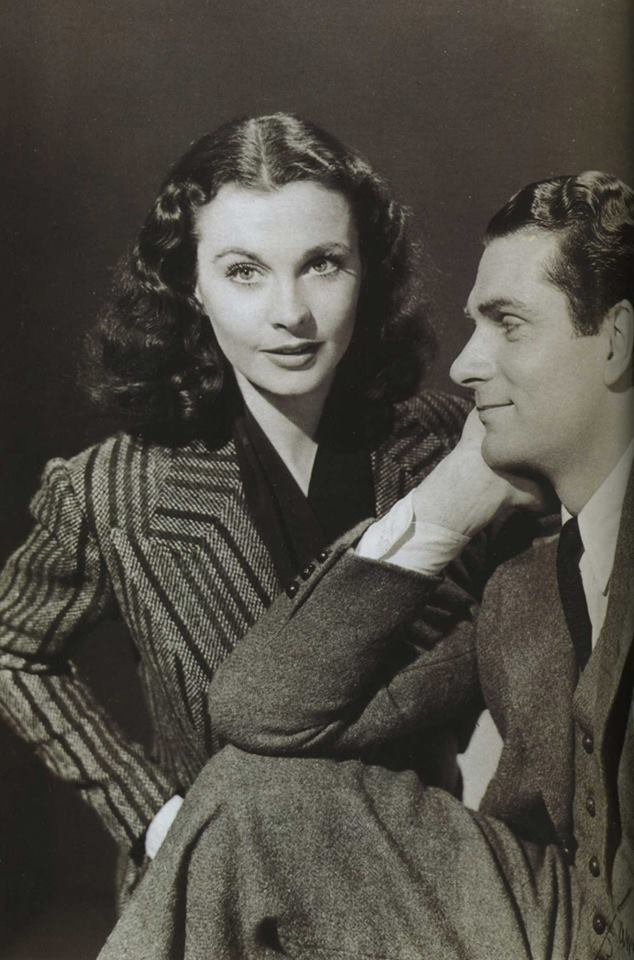
Leigh's early screen career developed beside the relationship. In Dark Journey (film, 1937), she played a double agent opposite the German actor Conrad Veidt. In Storm in a Teacup (film, 1937), her lightness and timing balanced the sharper comedy of the British actor Rex Harrison.
She appeared with Olivier again in 21 Days (film, 1940), filmed in 1937 but released later. Their private intensity gave even the uneven melodrama a sense of urgency.
By 1938, Leigh had fixed upon the role she believed should be hers. She had read the American writer Margaret Mitchell's novel Gone with the Wind (novel, 1936) and became convinced that she was Scarlett O'Hara.

The idea seemed improbable. The American producer David O. Selznick had launched a famous search for Scarlett, and Leigh remained little known in the United States.
Olivier traveled to Hollywood to play Heathcliff in Wuthering Heights (film, 1939). Leigh followed, officially to be near him, but she also pursued Scarlett with single-minded purpose.
In December 1938, the American talent agent Myron Selznick, brother of David O. Selznick, brought Leigh to the burning-of-Atlanta set and introduced her to his brother with the words, "I want you to meet your Scarlett O'Hara."
Leigh tested for the part the next day. The American director George Cukor recognized what he called her "incredible wildness," and David O. Selznick cast her after a search that had considered hundreds of actresses.
The role required a transformation. Leigh refined a Southern accent and adjusted her movements to chart Scarlett from a spoiled young woman in floating muslin to a hardened survivor in severe postwar clothes.
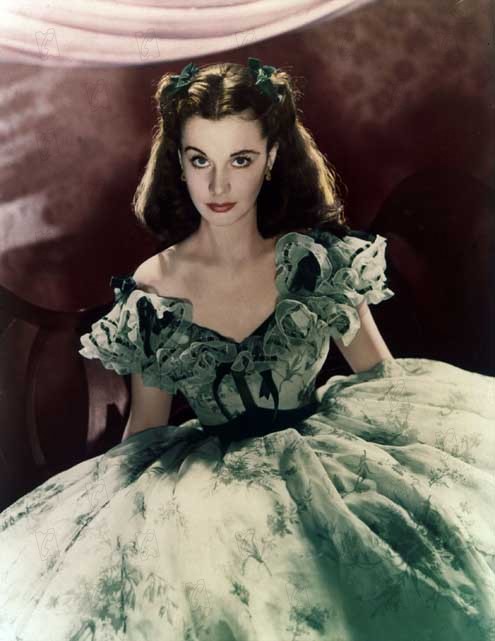
The American costume designer Walter Plunkett used clothing to tell that story. White ruffles, green sprigged cotton, velvet, taffeta, mourning crepe, and the famous green curtain dress marked successive stages of Scarlett's will and invention.
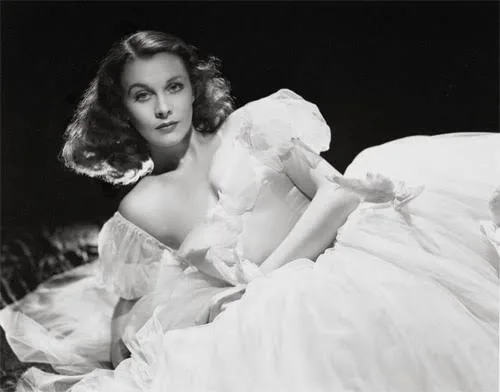
Leigh understood every visual detail. Her small waist and delicate frame gave Plunkett's wide skirts dramatic proportion, while her dark hair, sharply arched brows, and pale complexion held their own against saturated Technicolor.
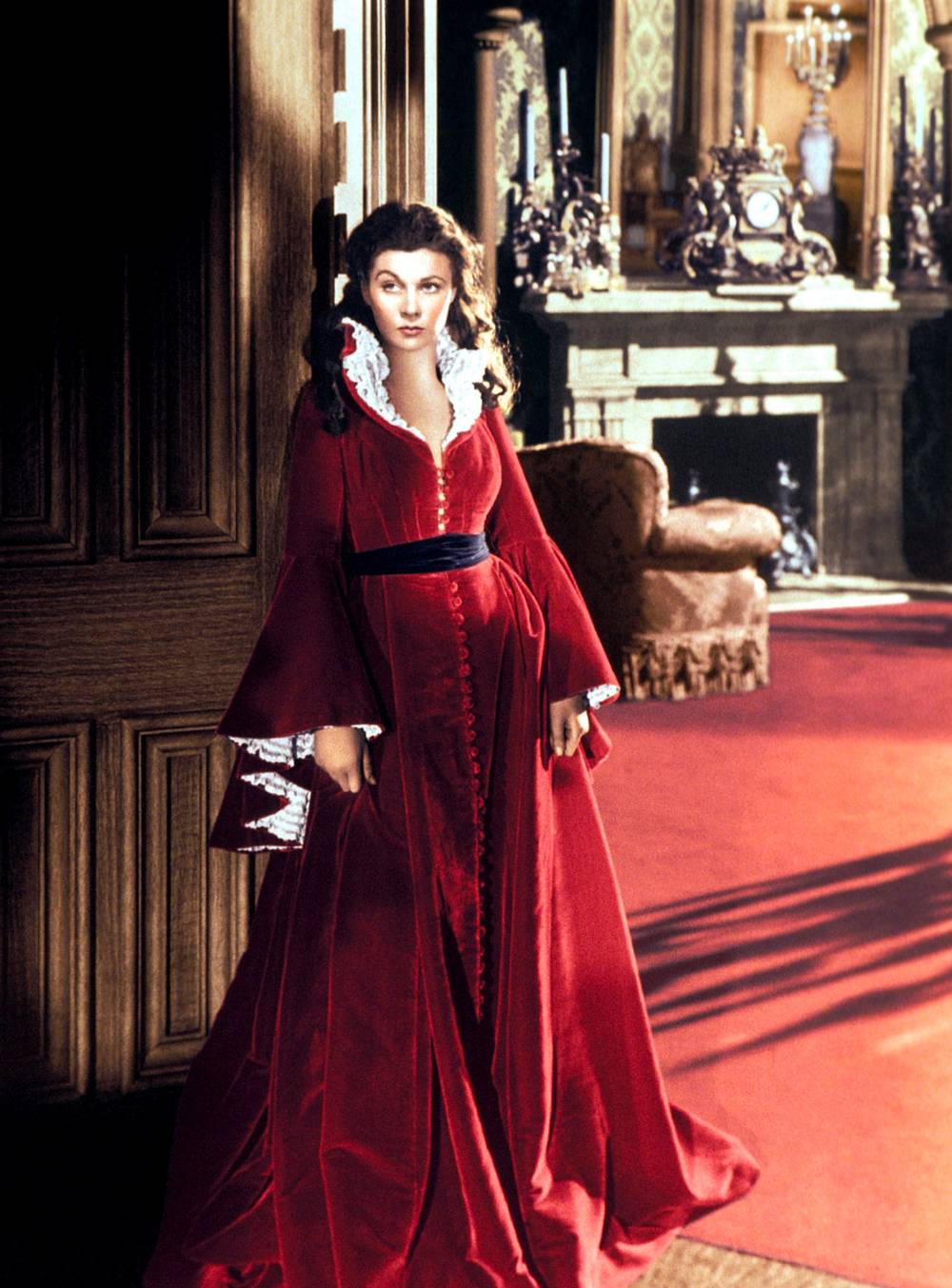
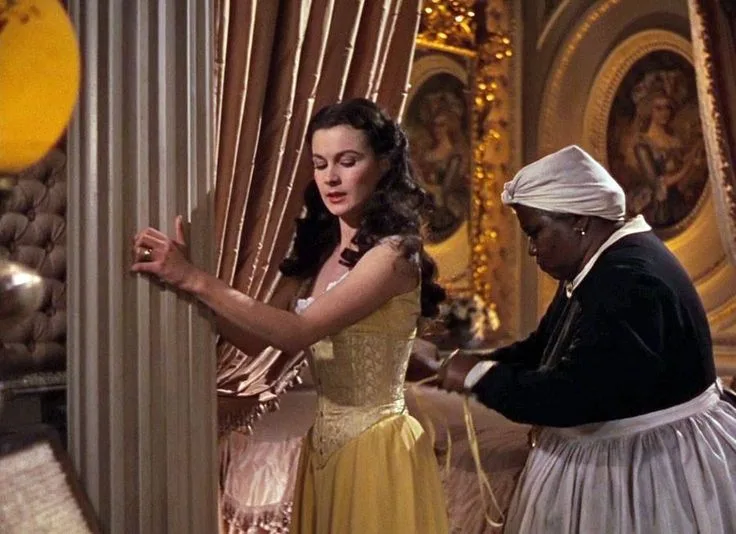
Filming was punishing. Leigh appeared in nearly every sequence and worked long days for months while the production changed directors and wrestled with an enormous script.
The American actor Clark Gable played Rhett Butler with relaxed authority. Leigh's performance was built on a different energy: quick turns of the head, flashing changes of expression, sudden stillness, and a voice that could move from girlish sweetness to cold command.
The film also featured the British actor Leslie Howard as Ashley Wilkes, the British-American actress Olivia de Havilland as Melanie Hamilton, and the American actress Hattie McDaniel as Mammy. Leigh's Scarlett dominated the story without reducing the strength of the performers around her.
Gone with the Wind premiered in Atlanta in December 1939. It made the twenty-six-year-old Leigh an international star.
"Miss Leigh's Scarlett has vindicated the absurd talent quest that indirectly turned her up. She is so perfectly designed for the part by art and nature that any other actress in the role would be inconceivable". Film critic Frank Nugent on Vivien Leigh in film Gone with the Wind for The New York Times, 1939
At the Academy Awards in February 1940, the film won ten Academy Awards, and Leigh became the first British woman to win Best Actress. She accepted the prize in a dark, flower-patterned evening gown with a sheer cape-like overlay, a more restrained image than Scarlett's operatic splendor.
In 1940, Vivien Leigh's husband Herbert Leigh Holman agreed to divorce her, and Jill Esmond finally agreed to divorce Laurence Olivier. Each of the spouses left behind was granted custody of their own child.
On 31 August 1940, Vivien Leigh and Laurence Olivier married at the San Ysidro Ranch in Santa Barbara, California.
The ceremony was private. The American actress Katharine Hepburn and the American writer and director Garson Kanin served as witnesses.
Leigh's first marriage had given her the name the world knew. Her second made her half of the most celebrated acting couple in the English-speaking theater.
In Waterloo Bridge (film, 1940), directed by the American filmmaker Mervyn LeRoy, Leigh played the ballerina Myra Lester opposite the American actor Robert Taylor. The performance replaced Scarlett's survival instinct with fragility and quiet despair.
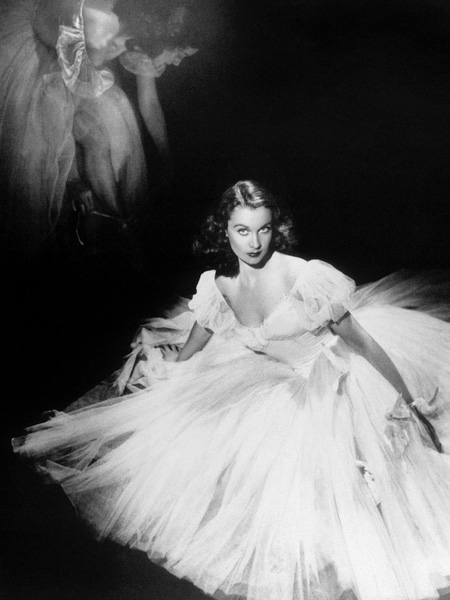
The film's costumes softened her into pale fur, narrow hats, delicate veils, and flowing dresses. Leigh could look richly dressed without allowing the clothes to smother the emotional line of a scene.
Leigh and Olivier together produced a play, Romeo and Juliet, for Broadway, but it failed badly. The couple lost $40,000 they invested in the project, almost all of their savings.
They then starred in That Hamilton Woman (film, 1941), directed by Alexander Korda. Olivier played Horatio Nelson and Leigh played Emma Hamilton.
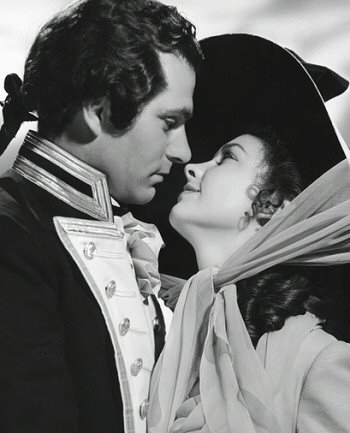
Leigh's Emma moved from youthful radiance to ruin. Gowns grew heavier and darker as the character's position collapsed, and Leigh used costume, posture, and voice as parts of one continuous decline.
The wartime film turned a famous love affair into an argument for British courage against tyranny. It was a success in the United States and an even bigger success in the Soviet Union. Leigh and Olivier won not only the applause of audiences but also the friendship of the British prime minister Winston Churchill, who liked the couple for the rest of his life.
The couple returned to wartime Britain. Olivier joined the Fleet Air Arm, while Leigh acted, raised funds, visited hospitals, and performed for troops. It was said that she even turned down a studio contract worth $5,000 a week in order to volunteer as part of the war effort.
She fell ill while touring North Africa with a wartime entertainment company in 1943. She developed a persistent cough and fever. The next year, doctors diagnosed tuberculosis in her left lung.
Leigh spent weeks in the hospital and was ordered to rest. The illness would recur throughout the rest of her life, weakening a body she repeatedly drove beyond its limits.
She then starred in Caesar and Cleopatra (film, 1945), adapted from the play by the Irish dramatist George Bernard Shaw. As Cleopatra, she wore ornate costumes designed by the English artist and photographer Cecil Beaton. Gold, turquoise, scarlet, pleated linen, elaborate headdresses, and Egyptian motifs turned her small frame into a figure of ceremonial scale.
Leigh approached the role through voice as well as appearance. She trained to keep her voice lighter for the young Cleopatra, then deepen it as the queen matured.
But off screen, she was suffering privately: first a miscarriage, then a severe depression that left her sobbing on the floor one moment and raging the next. Afterward, she would remember none of it.
She returned to the stage in The Skin of Our Teeth (play, 1945), written by the American playwright Thornton Wilder and directed by Olivier. The production demonstrated her refusal to let illness end her career.
That year, Leigh and Olivier acquired Notley Abbey in Buckinghamshire. The medieval property became both a home and a setting for an elegant theatrical life.
Leigh arranged rooms with antique furniture, paintings, flowers, books, and carefully chosen fabrics. She approached a house almost as she approached a set, building atmosphere through proportion, color, and the placement of objects.
Her own clothes followed the same instinct. She could wear magnificently elaborate costumes, but her private style was measured. Clean lines, exact fit, rich texture, and a controlled palette mattered more to her than novelty.
In 1947, Olivier was knighted and Leigh became Lady Olivier.
The next year, the Oliviers toured Australia and New Zealand with the Old Vic company to raise funds for the theater. They performed plays including Richard III, The School for Scandal, and The Skin of Our Teeth before audiences who received them with the excitement usually reserved for royalty.
But it was also demanding. By the end of the six-month tour, both were ill. The tour also hinted at the beginning of the end. Years later, Olivier would comment that he "lost Vivien" in Australia.
That year, Leigh starred in Anna Karenina (film, 1948), directed by the French filmmaker Julien Duvivier. Cecil Beaton designed for Leigh a succession of fitted bodices, sweeping skirts, fur-trimmed outerwear, veils, and dark velvet gowns that framed Anna's movement from social command to isolation.
The film divided critics, but the role revealed Leigh's attraction to women who maintained beautiful surfaces while living near emotional collapse.
In 1949, Leigh was cast as Blanche DuBois, the lead role in A Streetcar Named Desire (play, 1949), written by the American playwright Tennessee Williams. Olivier was chosen as director of the play for this first London production. The part exposed Leigh to a modern language of desire, shame, delusion, and violence far removed from the polish of period drama.
Onstage, Blanche arrived in delicate clothes that tried to preserve the manners of a vanished world. Pale fabrics, lace, artificial flowers, costume jewelry, and a blond wig made femininity itself look like a defense.
Leigh performed Blanche for more than three hundred performances. She later said that the role had tipped her into madness, yet the experience also deepened her art.
In 1951, Leigh played Blanche DuBois again for the film version of the play. The American actor Marlon Brando returned as Stanley Kowalski, bringing the natural force of his stage performance opposite Leigh's more constructed Blanche.
That difference served the story. Brando seemed rooted in the physical present. Leigh's Blanche appeared to have assembled herself from memory, perfume, dim light, and phrases polished through repeated use.
The American costume designer Lucinda Ballard made Blanche's wardrobe increasingly fragile. Soft dresses, faded florals, fluttering details, and cheap finery carried the character's claim to gentility even as it came apart.
Leigh won her second Academy Award for Best Actress, as well as the British Academy Film Award and the Volpi Cup at the Venice Film Festival. Scarlett had conquered reality. Blanche survived by replacing reality with illusion.
Tennessee Williams himself said that Leigh brought to the role "everything that I intended, and much that I had never dreamed of".
Leigh's skill was sometimes obscured by her face. She disliked the assumption that beauty had made acting easy and worked with almost military discipline.
She learned a role before rehearsals began, arrived at the theater early, reviewed the entire part before every performance, and trained her voice and body for each demanding production. "I find it essential to know my part before I start rehearsing," she once explained.

Her stage acting could be exact and carefully fixed. On film, the camera captured another of her gifts: Leigh listened with complete attention, and the smallest reaction could transform her face before she spoke.
In 1951, Leigh and Olivier performed together in alternating productions of Antony and Cleopatra and Caesar and Cleopatra. For the older Cleopatra, Leigh lowered and weighted her voice. For Shaw's younger queen, she raised it and restored its speed.
The costumes for the paired productions turned comparison into spectacle. Regal robes, jeweled headdresses, and strong color gave Leigh grandeur, but her changes in carriage and tone separated the two Cleopatras more clearly than ornament could.
In 1953, while filming Elephant Walk (film, 1954) with the Australian actor Peter Finch in Ceylon, Leigh suffered a serious mental breakdown. She was unable to continue and was replaced by the British-American actress Elizabeth Taylor. Olivier came to take her home.
Back in Britain, Leigh received hospital treatment, including electroconvulsive therapy. At the time, her illness was called manic depression. It is now known as bipolar disorder.
Her episodes could include insomnia, agitation, sexual disinhibition, paranoia, and deep depression. The illness placed enormous strain on Leigh, Olivier, their families, and the people who worked with them. During one of those periods, Leigh confessed her affair with Peter Finch, which had in fact begun in 1948 and continued on and off ever since.
Yet periods of illness did not erase her professionalism. When well enough, Leigh returned to rehearsal, retrained her body and voice, and resumed work with a determination that colleagues often found astonishing.
She starred with Olivier in The Sleeping Prince (play, 1953), written by the English playwright Terence Rattigan. Olivier directed, and Leigh played the actress Elsie Marina with a mixture of calculation and warmth.
The Oliviers' marriage had by then begun to fracture. Publicly, they remained theatrical royalty. Privately, illness, exhaustion, resentment, and other relationships were pulling them apart.
Leigh appeared in The Deep Blue Sea (film, 1955), adapted from Terence Rattigan's play and directed by the Russian-born British filmmaker Anatole Litvak. Her character, Hester Collyer, leaves a respectable marriage for a destructive affair.
Leigh's restrained suits, narrow dresses, gloves, and small hats defined a woman trying to preserve order while losing control of her life. The clothes were proper, but never restful.
During the 1950s, Leigh's personal wardrobe became one of the clearest expressions of her taste. She favored black, fine jersey, silk and wool, velvet, hopsacking, tailored suits, trousers, fur jackets, and brimmed hats by the French-born British milliner Simone Mirman.
She admired the French couturier houses Balmain, Dior, and Lanvin-Castillo, as well as the British designers Victor Stiebel, Hardy Amies, John Cavanagh, and Michael Donnellan. She cared for her clothes and wore them repeatedly rather than treating couture as disposable.
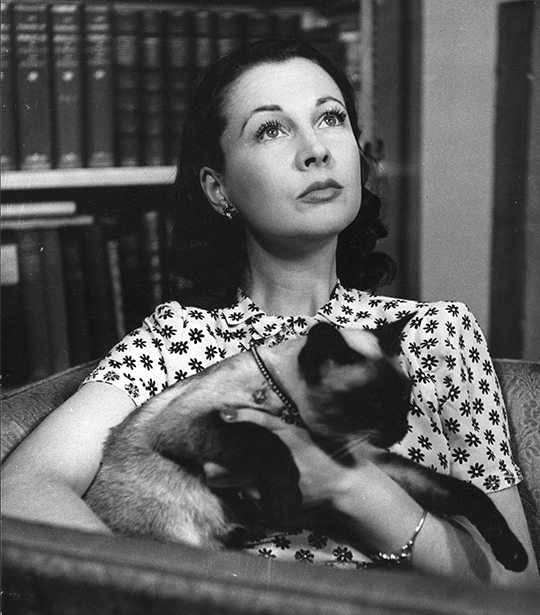
Victor Stiebel understood her particularly well. His clothes balanced a narrow, controlled bodice with graceful volume, giving Leigh's petite frame presence without overwhelming it.
She preferred simplicity in daily dress, often relying on black as a background for her face, hands, and jewelry. For evening, she accepted richer color and embroidery, but proportion remained exact.
Leigh also understood that elegance included practicality. She disliked fabrics that creased and chose clothes that could survive travel, rehearsal, dinners, and public appearances without losing their line.
In 1955, the English director Peter Brook cast Leigh as Lavinia opposite Olivier's Titus in Titus Andronicus (play, 1955). The production turned one of the English playwright William Shakespeare's most violent tragedies into a severe ritual of movement, cloth, and color.
Leigh's Lavinia suffered mutilation and silence. With speech removed, she had to communicate through balance, eyes, breath, and the controlled positioning of her body.
The production toured Europe, and Leigh again proved that her beauty could serve horror as powerfully as romance. A still figure in blood-stained drapery became more disturbing than any uncontrolled display.
On 6 December 1957, Leigh's daughter Suzanne Mary Holman married the insurance broker Robin Neville Farrington. Leigh attended with her ex-husband Herbert Leigh Holman and Laurence Olivier, bringing the two parts of her life into the same church. Leigh retained warm ties with Herbert throughout her life.
By then, Olivier had formed a relationship with the English actress Joan Ann Plowright. Leigh's marriage was nearing its end, though the public image of the Oliviers remained difficult to separate.
In 1958, Leigh began a relationship with the English actor John Herman Merivale, known as Jack Merivale. He understood the severity of her illness and became her steady companion for the rest of her life.
Leigh returned to the stage in Duel of Angels (play, 1958), written by the French playwright Jean Giraudoux. She played Paola, an aristocratic woman driven by desire, opposite the Mexican-American actor and director Anthony Quinn.
The French couturier Christian Dior created costumes for an earlier production of the play, combining the full skirts and sculpted waists of the New Look with the drama's nineteenth-century setting. Scarlet gave Paola's passion an immediate visual force.
Leigh toured successfully with the production and later took it to Broadway. Stage work remained her chosen center even when the world continued to identify her most strongly with two films.
The marriage of Vivien Leigh and Laurence Olivier ended in divorce in December 1960. Olivier married Joan Ann Plowright the following year.
Years later, Olivier wrote about Leigh's illness: "Throughout her possession by that uncannily evil monster, manic depression, with its deadly ever-tightening spirals, she retained her own individual canniness—an ability to disguise her true mental condition from almost all except me, for whom she could hardly be expected to take the trouble."
In The Roman Spring of Mrs. Stone (film, 1961), adapted from the novella by Tennessee Williams and directed by the Panamanian-American filmmaker José Quintero, Leigh played Karen Stone, an aging actress alone in Rome after her husband's death.
The role allowed her to confront beauty, age, loneliness, and desire without disguise. Pierre Balmain dressed Karen in tidy suits, draped dresses, fine coats, and subdued luxury, creating a wardrobe elegant enough to make the character's vulnerability more painful.
Leigh's own style was becoming more stately. Structured suits, silk blouses, jeweled brooches, fur coats, and carefully shaped hats gave her public appearances composure, even when her private life remained uncertain.
A rose-pink Victor Stiebel evening gown from this period captured the balance she preferred. Its fitted embroidered bodice opened into a full skirt like a flower, dramatic in effect but disciplined in construction.
In 1961 and 1962, Leigh toured internationally with the Old Vic. She also carried a stereoscopic camera and photographed fellow actors, sets, landscapes, and friends, creating hundreds of color images of the theatrical life around her.
The camera revealed another side of her eye. Leigh did not simply enjoy being photographed. She understood framing, atmosphere, costume, and the private moment behind a public performance.
In 1963, she starred on Broadway as the Grand Duchess Tatiana Petrovna in Tovarich (musical, 1963), opposite the French actor Jean-Pierre Aumont. The role required her to sing, dance, and sustain a demanding performance schedule.
Illness forced her to miss performances, but she returned and completed the run. She won the Tony Award for Best Actress in a Musical.
At celebrations for the production, Leigh wore a white silk Lanvin-Castillo evening gown embroidered with amethyst chenille, colored stones, and faux pearls. A deep purple stole completed the look, and she had already worn the gown on other important evenings.
The repetition was characteristic. Leigh did not need a new dress for every appearance. A beautiful garment became more personal through use.
She made her final film, Ship of Fools (film, 1965), directed by the American filmmaker Stanley Kramer. The ensemble included the French actress Simone Signoret, the German actor Oskar Werner, the American actor Lee Marvin, and the Spanish dancer José Greco.
Leigh played Mary Treadwell, a divorced American woman clinging to glamour during an Atlantic crossing in 1933. The role echoed parts of her screen image while stripping away its protection.
Mary's bias-cut gowns, fur, jewels, and carefully maintained face could not conceal loneliness. Leigh allowed elegance to remain visible while showing the cost of using it as armor.
Her performance won the Étoile de Cristal for Best Foreign Actress. It was a strong final screen role, bitter, intelligent, and free of sentimentality.
In 1966, Leigh appeared in Ivanov (play, 1966) by the Russian playwright Anton Chekhov, opposite the English actor John Gielgud. The production opened in London and moved to Broadway.
Her last stage role was Anna Petrovna, a woman weakened by illness and by a marriage that had become emotionally barren. Leigh brought precision and restraint to a character whose suffering required neither glamour nor display.
In May 1967, she was preparing to appear with the English actor Michael Scudamore Redgrave in A Delicate Balance (play, 1966), written by the American playwright Edward Albee. A recurrence of tuberculosis forced her to withdraw and remain at her home at 54 Eaton Square in Belgravia.
Jack Merivale cared for her while continuing his own stage work. For several weeks she appeared to improve.
On the night of 7 July, Merivale left for the theater and returned shortly before midnight. In the early hours of 8 July 1967, he found Leigh's body on the floor of her bedroom.
According to the doctors, Leigh had suffered a fatal pulmonary hemorrhage caused by chronic tuberculosis. She was fifty-three.

Laurence Olivier, who was receiving treatment for prostate cancer at the time, came to the apartment after learning of her death. In his 1983 autobiography, Olivier wrote that he "stood and prayed for forgiveness for all the evils that had sprung up between us", and stayed there until Leigh's body was removed from her home.
The following evening, the lights of London's West End theaters were dimmed for an hour in tribute.
A Catholic service was held at St. Mary's Church, Cadogan Street, London for Leigh. After the funeral, she was cremated as she had wished, and her ashes were scattered on the lake at Tickerage Mill, her home in East Sussex.
In 1968, Leigh became the first actress honored in the United States by "The Friends of the Libraries at the University of Southern California".
Her archive later revealed the scale of the work behind the image: annotated scripts, appointment books, diaries, photographs, and thousands of letters carefully preserved across decades.
Vivien Leigh's beauty opened doors for her, but it also encouraged people to underestimate the labor beneath it. She built characters through voice, costume, rhythm, posture, and an exact understanding of what the camera could see.
Scarlett O'Hara and Blanche DuBois gave her immortality because each transformed fragility into a different kind of force. Beyond them stood the actress herself, small in stature, fierce in purpose, and never willing to be merely looked at.