Music
Piano Concerto No. 5 in F major, Op. 103, "Egyptian" by Camille Saint-Saëns (1835–1921)
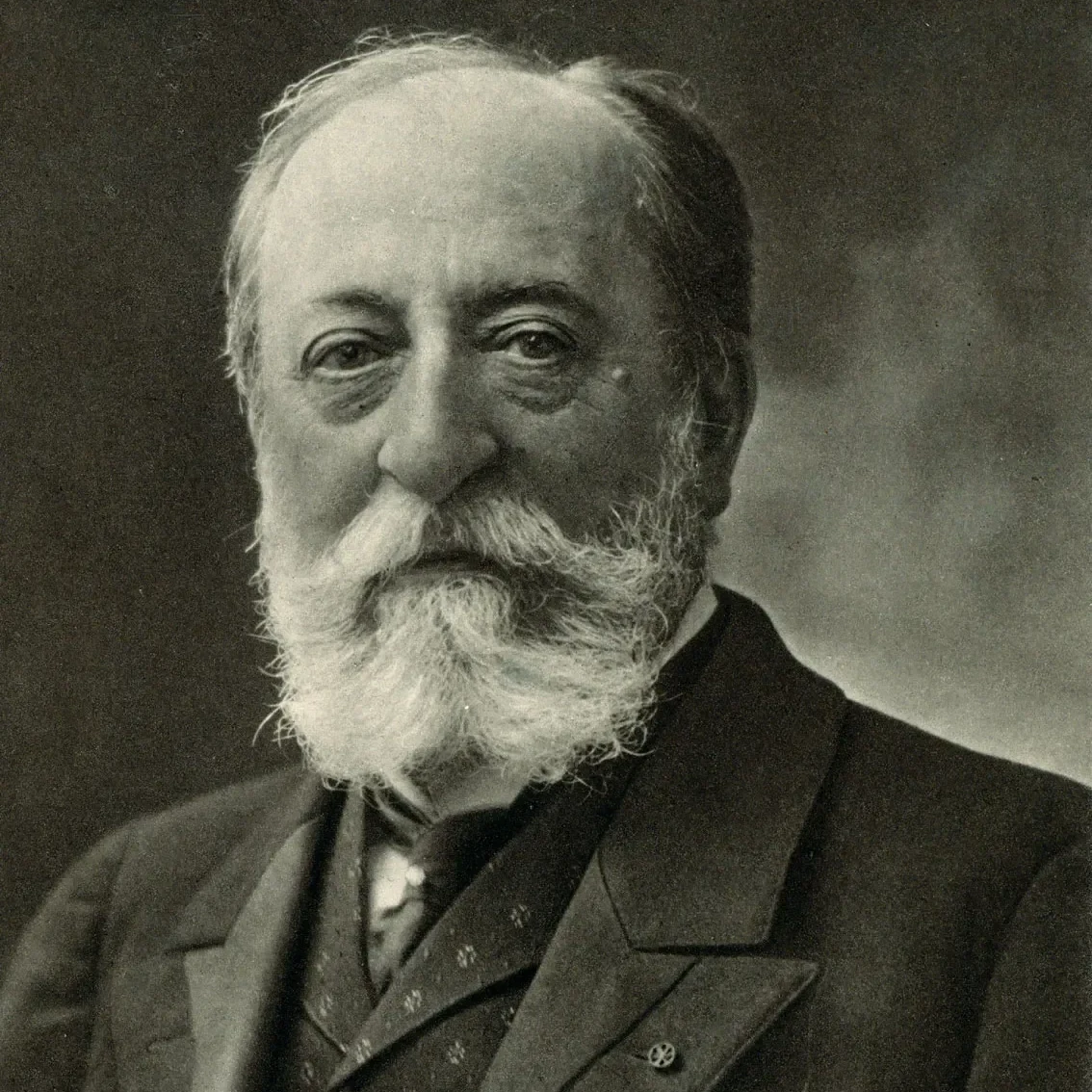
Camille Saint-Saëns wrote Piano Concerto No. 5 in F major, Op. 103 in Cairo in 1896. It was his last piano concerto and one of the final major works he composed for his own instrument. The popular nickname "Egyptian" was attached to the work after its creation, reflecting its setting and the unusual color of its central movement.
The music
The music is usually associated with Egypt because Camille Saint-Saëns wrote much of it in Cairo and incorporated material he said he had heard during his travels along the Nile. Yet the concerto is not an attempt to reproduce Egyptian music. Its character remains unmistakably that of Camille Saint-Saëns: refined, agile, and carefully shaped.
The second movement is the work's most distinctive section. Camille Saint-Saëns described it as a journey toward the East. The piano moves through quiet passages, sudden flashes of sound, and music drawn from the composer's memories of travel. In one passage, the piano plays a melody that Camille Saint-Saëns said he had heard sung by Nubian boatmen on the Nile.
The history
In January 1896, Camille Saint-Saëns traveled from Milan to Cairo after attending the Italian premiere of his opera Henry VIII (1883). Egypt had become a regular winter destination for the composer, offering distance from Paris and the freedom to work without its social demands.
Camille Saint-Saëns had planned a longer journey to India and Vietnam, but those plans fell through. He instead traveled along the Nile and then settled in a Cairo hotel, where he completed the concerto in a little more than three weeks.
Some ideas had already been noted during a holiday in the Canary Islands two years earlier. The main work, however, was done in Cairo during March and April 1896.
The concerto was written for a concert of special personal importance. On 2 June 1896, Camille Saint-Saëns performed the solo part at the Salle Pleyel in Paris, marking fifty years since his first public appearance there as a ten-year-old pianist.
Paul Taffanel conducted the Orchestra of the Société des Concerts du Conservatoire. Spanish violinist Pablo de Sarasate, a longtime friend of Camille Saint-Saëns, also appeared on the program.
The score was published later that year by Durand & Fils. Camille Saint-Saëns dedicated it to French pianist Louis Diémer, who performed the concerto repeatedly, although Camille Saint-Saëns himself gave its first performance and continued to play it late in life.
The structure
First movement: Allegro animato
The first movement follows the broad pattern of a classical concerto. The orchestra presents its material, and the piano enters to develop it with increasingly elaborate writing.
The two main ideas are clearly contrasted. The first has a composed, transparent character. The second, in D minor, is broader and more unsettled.
Second movement: Andante
The second movement begins in D minor and moves through a sequence of contrasting episodes. It does not unfold as a single long melody. Instead, it leads the listener through changing scenes and colors.
Camille Saint-Saëns connected one G-major episode with a Nubian love song he had heard on the Nile. He also described the F-sharp-major passage as carrying the journey farther east, toward the Far East.
The movement's final pages use the tam-tam softly beneath the piano and orchestra. This sound is one reason the concerto has often been heard as more unusual in color than Camille Saint-Saëns's earlier piano concertos.
Third movement: Molto allegro
The finale changes the atmosphere at once. It begins without a long pause. The melody is restless, sparkling, and full of motion.
The concerto ends with the piano and orchestra in rapid conversation, giving the work the bright, controlled finish that was one of Camille Saint-Saëns's special gifts.
The performance
For a French perspective on the concerto, Bertrand Chamayou's recording with the Orchestre National de France conducted by Cristian Măcelaru is an excellent starting point. Bertrand Chamayou brings clarity to the piano writing, while the French orchestra keeps the changing colors of the second movement in focus.
Jean-Yves Thibaudet's recording with the Bergen Philharmonic Orchestra under Edward Gardner offers a more expansive approach. It is especially rewarding in the second movement, where the music's many episodes need both contrast and continuity.
For a classic interpretation, Artur Rubinstein's recording with the Philadelphia Orchestra conducted by Eugene Ormandy remains a compelling choice. Artur Rubinstein gives the concerto warmth and buoyancy while preserving the precision that its quick passages require.