People
Rita Hayworth (born Margarita Carmen Cansino; 17 October 1918 – 14 May 1987)
Perhaps if we thought for a second of the classic, simple elegance of the Spanish lady it might help us to be "simply" ourselves. — Rita Hayworth
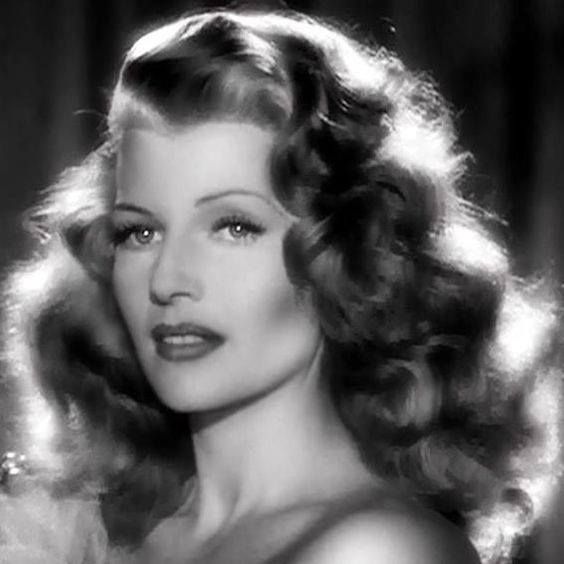
Rita Hayworth (born Margarita Carmen Cansino; 17 October 1918 – 14 May 1987) was an American actress, dancer, and producer whose warmth, rhythmic precision, and extraordinary screen presence made her one of the defining stars of Hollywood's golden age. Trained as a dancer from childhood, she rose to fame opposite Fred Astaire before becoming an international symbol of glamour in Gilda (film, 1946). Her long red hair, sculpted evening gowns, and controlled sensuality created an image so powerful that it often obscured the shy woman and disciplined performer behind it. Across a screen career of more than three decades, she appeared in sixty-one films, including Cover Girl (film, 1944), The Lady from Shanghai (film, 1947), Pal Joey (film, 1957), and Separate Tables (film, 1958). Her final years with Alzheimer's disease brought early public attention to an illness that was still widely misunderstood.

Biography
Rita Hayworth was born Margarita Carmen Cansino on 17 October 1918 in Brooklyn, New York City.
Her father, Eduardo Cansino Reina, was a Spanish dancer originally from a small town near Seville, Spain. Her mother, Volga Margaret Hayworth, was an American dancer of Irish and English ancestry who had performed with the Ziegfeld Follies.
Her father Eduardo Cansino came from a celebrated theatrical family. His father, Antonio Cansino, was a classical Spanish dancer who made the bolero popular, and owned a dancing school in Madrid that was famous around the world.
Margarita was the eldest of three children. Her brothers were Eduardo Cansino Jr., born in 1919, and Vernon Cansino, born in 1922.
Dance was the family language. Margarita began lessons before she was five and learned Spanish dance from her father and uncle, Angel Cansino.
While her father wanted Margarita to become a professional dancer, her mother hoped she would become an actress.
The Cansinos moved to Los Angeles in 1927, when motion pictures seemed likely to create new opportunities for dancers. Eduardo Cansino opened a studio and taught Hollywood performers and stars including James Cagney and Jean Harlow, but the arrival of talking pictures reduced the demand for the family's specialty.
During the Depression, Eduardo revived a dancing act called Dancing Cansinos with his daughter as his partner. Margarita was still in her early teens, but makeup, darkened hair, and adult costumes made her appear older.
Father and daughter performed in clubs and casinos in Tijuana, Mexico as well as along the California coast. The work was exhausting and left little room for ordinary schooling, friendships, or childhood.
Biographical accounts describe this period as deeply traumatic. Eduardo Cansino controlled his daughter through fear and physical violence, and Rita later told Orson Welles that her father had sexually abused her.
Yet the training gave her remarkable command of movement. She learned to hold the upper body with poise while the feet worked rapidly below, and she could absorb complicated choreography with unusual speed.
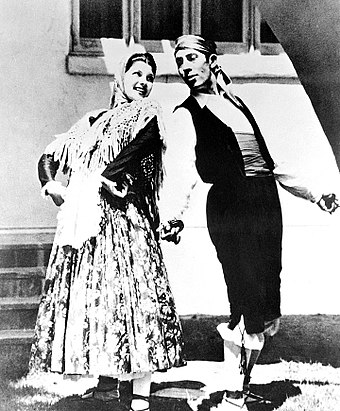
Mexico changed her life. It was in a place called the Caliente Clubs in Tijuana, a Fox Film Corporation executive noticed the young girl of the Dancing Cansinos. Margarita was given screen test and a short-term contract after the test. She entered Fox Studio under the name Rita Cansino.
Her earliest screen work emphasized an artificial idea of exoticism. She was repeatedly cast as a dancer or as a vaguely Latin woman, often in minor parts that gave her little dialogue.
She appeared in the Spanish-language adventure Cruz Diablo (film, 1934), followed by In Caliente (film, 1935) featuring the Mexican actress Dolores del Río, Under the Pampas Moon (film, 1935), and Dante's Inferno (film, 1935).
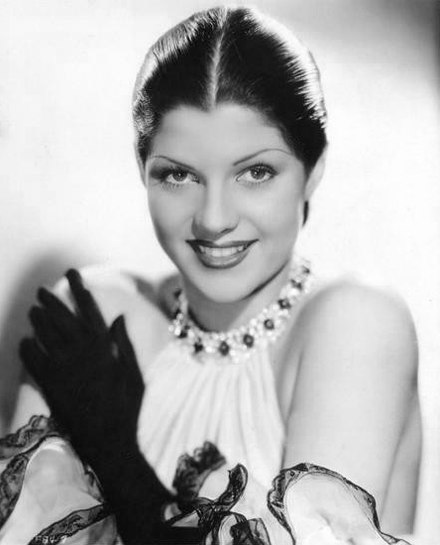
After six months, Fox, now 20th Century Fox did not renew her contract. Columbia Picture took her. The studio head Harry Cohn gave her a seven-year contract, and, a new name: Rita Hayworth, thinking her last name Casinos too Spanish.
The new surname "Hayworth" was suggested by Rita Hayworth's boyfriend Edward Charles Judson, a businessman and promoter more than twice her age. Judson recognized her potential and began managing her career with an intensity that was often controlling.
It was him who worked with Columbia Picture to remake the appearance of Rita Hayworth to match the new name.
Electrolysis raised her low hairline in a long and painful process. Her naturally dark hair was lightened and eventually dyed the luminous red and auburn shades that became inseparable from her public image.
The transformation was presented as glamour, but it also concealed her Spanish identity at a time when Hollywood favored an Anglo-American ideal of beauty. Hayworth later said that becoming a redhead changed her life.
In 1937, at eighteen, she married him.
Judson arranged meetings, publicity appearances, photographs, and introductions. Hayworth later said, "I married him for love, but he married me for an investment."
Harry Cohn initially placed Rita Hayworth in low-budget westerns, crime stories, and supporting roles while deciding what kind of star she might become.

Her breakthrough came when the director Howard Hawks cast her opposite Cary Grant and Jean Arthur in Only Angels Have Wings (film, 1939). As the unfaithful wife of a pilot, she brought an unexpected mixture of confidence and vulnerability to a relatively small role.
In The Strawberry Blonde (film, 1941), directed by Raoul Walsh, her newly lightened hair supported the image promised by the title. James Cagney played a man who confuses romantic fantasy with happiness, while Hayworth embodied the dazzling object of his youthful infatuation.
The same year, the director Rouben Mamoulian cast her as the seductive Doña Sol in Blood and Sand (film, 1941). The film's saturated Technicolor, jeweled costumes, veils, flowers, and low necklines turned her red hair and pale skin into part of the visual drama.
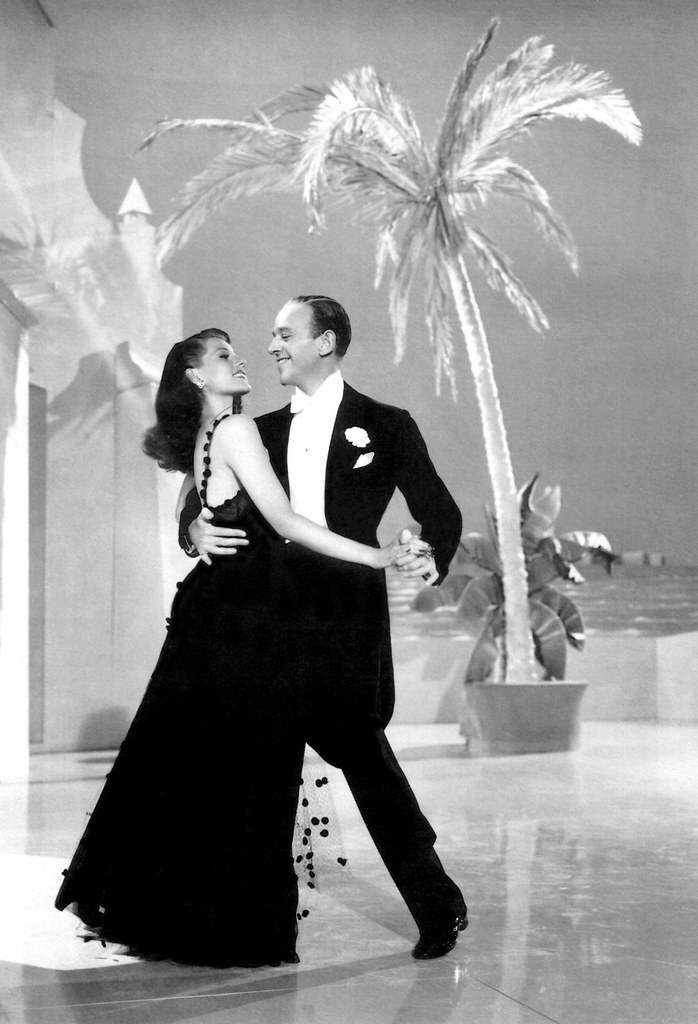
In 1941, Columbia cast Rita Hayworth opposite Fred Astaire in one of its high budget films, the musical You'll Never Get Rich.
That film revealed the foundation of Hayworth beneath her beauty. she danced with a clean line, exact timing, and an ease that made technically demanding steps appear spontaneous.
Astaire admired how quickly she learned. He recalled that he could show her a routine before lunch and find that she had mastered it by the time she returned.
The film so successful that the studio paired the two together the following year in 1942 for another musical: You Were Never Lovelier. Hayworth's dancing moved from buoyant swing to smooth ballroom phrasing without losing its natural warmth.
In the dance "The Shorty George," she answered Astaire's rhythm rather than merely following it. Her shoulders, hips, hands, and gaze all participated in the musical punctuation.
Hayworth later said, "I guess the only jewels of my life were the pictures I made with Fred Astaire." The two films established her as far more than a photographed beauty.
A 1941 portrait by the photographer Robert Landry also changed her public image. Wearing a black lace and satin negligee, she knelt on her own satin-covered bed for a photograph published in Life magazine.
Millions of copies circulated among servicemen during the Second World War. Its appeal came from the contrast between the intimate setting, the dark lace, and Hayworth's open, almost unguarded smile.
The pinup made her one of the most recognizable women of the war years. It also fixed the distance between Rita Hayworth the fantasy and Rita Hayworth the private person.
Rita Hayworth divorced Edward Charles Judson in 1942, citing cruelty. By then, her career had become too valuable for either her husband or Columbia to control without resistance.
On 7 September 1943, Hayworth married the actor and filmmaker Orson Welles during her lunch break from filming Cover Girl (film, 1944). Joseph Cotten served as best man, and Hayworth returned to the studio after the ceremony.
Welles had first become fascinated by Landry's photograph. When he met Hayworth, he found someone very different from the voluptuous confidence of the pinup: shy, gentle, and uncertain of her own intelligence.
The marriage briefly opened a wider social and intellectual world to her. Welles encouraged Hayworth to read, discuss politics, and imagine a life beyond the studio's publicity machine.
Cover Girl paired Hayworth with Gene Kelly and became one of the great Technicolor musicals of the 1940s. She played Rusty Parker, a nightclub dancer offered fame as a model, a story that echoed her own transformation into a manufactured star.
The film surrounded her with ruffled taffeta, tiered skirts, fitted waists, bows, flowers, and gleaming evening clothes. Its color design made her hair a dramatic element in almost every frame.
Hayworth was by then a model of wartime glamour. Padded shoulders and shaped waists gave her daytime clothes authority, while strapless or off-the-shoulder gowns emphasized her long neck, dancer's posture, and expressive arms.
She was also one of the biggest Hollwood starrs in the whole world.
Away from formal publicity, she could appear far less theatrical. Photographs from the period show her in trousers, roomy jackets, open-necked shirts, and simple skirt suits, clothes that allowed the dancer's body to move without display.
Hayworth and Welles had a daughter, Rebecca Welles, on 17 December 1944. Motherhood did not slow the studio's determination to turn her next film into a major event.
In Tonight and Every Night (film, 1945), Hayworth played an American dancer performing in a London music hall during the Blitz. The role gave her musical polish, romantic feeling, and a touch of wartime heroism.
Columbia's head designer, Jean Louis Berthault, professionally known as Jean Louis, began shaping the mature Hayworth image. His costumes used sculpted bodices, fluid drapery, exposed shoulders, and strategic shine to make movement itself look luxurious.
That image reached its height in Gilda (film, 1946), directed by Charles Vidor. Hayworth's first entrance is one of cinema's most famous: a toss of red hair, a luminous face, and a greeting that seems both playful and dangerous.
Gilda was not simply a seductress. Hayworth played her as a woman performing confidence while hurt, anger, and fear remained visible beneath it.
Her dance training gave the performance its physical precision. Every turn of the head, lifted shoulder, held pause, and sudden smile looked casual while remaining completely controlled.
For her singing number "Put the Blame on Mame," Jean Louis created a strapless black satin column with a straight neckline, a side slit, and long matching gloves. Hidden internal stays and a molded structure held the bodice securely while Hayworth raised her arms and danced.
The dress left the shoulders bare but otherwise relied on line rather than ornament. Its dark satin, close fit, long gloves, and large bow made a single glove removed in mock striptease feel more provocative than nudity.
The scene was choreographed by Jack Cole. Anita Ellis supplied the principal singing voice, but Hayworth made the number her own through exact lip synchronization and a body that moved with every accent in the music.
Jean Louis based the dress partly on the black gown in John Singer Sargent's Portrait of Madame X (painting, 1883–1884). Hayworth's version became one of the most recognizable costumes in film history.
Gilda made Hayworth "The Love Goddess.". Her red hair, black satin, full mouth, and knowing smile became a global shorthand for dangerous glamour.
The image traveled farther than she could control. A nuclear bomb used in the 1946 Operation Crossroads test at Bikini Atoll was nicknamed "Gilda" and decorated with her photograph.
Hayworth understood better than anyone that Gilda was a construction. She later summarized the disappointment surrounding her private self in a sentence that became inseparable from her story: "Men go to bed with Gilda, but they wake up with me."

In Down to Earth (film, 1947), she played the muse Terpsichore descending to modern Broadway. Jean Louis dressed her in diaphanous drapery, metallic embroidery, fitted stage costumes, and vivid color, joining classical fantasy to the sleek modernity of a nightclub star.
The same year, Orson Welles directed her in The Lady from Shanghai (film, 1947). He cut her famous hair short and dyed it platinum blonde, deliberately dismantling the red-haired image that Columbia had spent years creating.
As Elsa Bannister, Hayworth wore pale gowns, swimsuits, and sharply defined resort clothes. The final hall-of-mirrors sequence fractured her face and body into multiple reflections, turning the manufactured star image into something unstable and threatening.
Columbia delayed the film and presented the blonde transformation as an act of destruction. Hayworth's marriage to Welles was also ending, and the couple divorced in November 1947.
They remained emotionally connected. Hayworth called Welles the great love of her life, while Welles continued to insist that the ruthless screen goddess bore little resemblance to the woman he had known.
Hayworth formed her own production company and co-produced The Loves of Carmen (film, 1948), again opposite Glenn Ford. The project gave her a measure of business independence and returned her to Spanish dance, dark hair, mantillas, and richly colored costume.
Her Carmen wore tight bodices, full skirts, shawls, earrings, flowers, and layered fabrics designed for dramatic movement. The role joined the Spanish identity Hollywood had once tried to erase with the star image it had built in its place.
In 1948, while traveling in Cannes, France, Rita Hayworth met Prince Aly Salman Aga Khan, the son of Sultan Mahomed Shah Aga Khan III. Their courtship became international news. Hayworth broke her contract with Columbia.
Hayworth married Aly Khan on 27 May 1949 at the Château de l'Horizon on the French Riviera. She arrived in a pale blue, long-sleeved, tea-length dress with a V-neckline, a narrow belt, and a finely pleated full skirt.
A wide-brimmed hat with a soft veil completed the outfit. The choice was restrained, fresh, and modern rather than ceremonially grand, even as the marriage turned a Hollywood star into a princess in the public imagination.
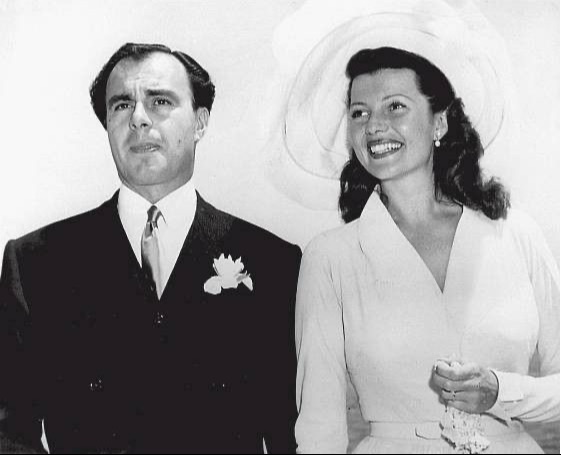
The couple's daughter, Princess Yasmin Aga Khan, was born on 28 December 1949. Hayworth hoped marriage would provide the secure private life that fame had denied her.
Instead, Aly Khan's flamboyant lifestyle, constant travel, various social obligations, and countless infidelities made domestic peace impossible. French was a difficult language for her. Hayworth wanted to go back to the United States. She separated from Aly Khan in 1951 and leave France with Yasmin.
She had to work again.
Columbia announced her return with the slogan "She's back!" for Affair in Trinidad (film, 1952). The film tried to recreate the dangerous atmosphere of Gilda, pairing her once more with Glenn Ford.
Jean Louis again used costume as controlled revelation. Black, white, and metallic gowns were cut close to the body, while halter necks and bare shoulders emphasized the dramatic geometry of Hayworth's dancing.
Affair in Trinidad was a huge commercial success, grossing $1 million more than Gilda, but it did not bring Gilda back.
Rita Hayword's marriage to Aly Khan ended in divorce in 1953. That year, she appeared in Salome (film, 1953), performing the Dance of the Seven Veils in embroidered, translucent layers that changed color and volume as they were removed.
In Miss Sadie Thompson (film, 1953), adapted from a story by William Somerset Maugham, she played a nightclub entertainer stranded on a rain-soaked Pacific island. Her fitted blouses, shorts, large earrings, and tropical colors created a tougher, more informal sensuality than the satin perfection of Gilda.

On 24 September 1953, Hayworth married the Argentine-born singer Richard Benjamin Haymes, professionally known as Dick Haymes. The marriage unfolded amid his financial troubles, immigration difficulties, and volatile behavior.
Hayworth's public wardrobe during these years often combined Hollywood polish with increasing simplicity. She favored narrow-waisted suits, full skirts, dark gloves, fur wraps, and cleanly cut evening gowns, while her softly waved red hair remained the most recognizable element of her appearance.
She divorced Dick Haymes in 1955 after a marriage marked by conflict. By then, her long struggle with Harry Cohn and Columbia had made each new production a negotiation over control.
Fire Down Below (film, 1957) placed her opposite Robert Mitchum and Jack Lemmon in a Caribbean drama. In Pal Joey (film, 1957), she received top billing over Frank Sinatra and Kim Novak, although Sinatra played the title role.
As the wealthy Vera Simpson in Pal Joey, Hayworth brought mature authority to the kind of nightclub world that had once displayed her as its young attraction. Jean Louis dressed her in sleek cocktail dresses, evening wraps, diamonds, and black gowns that announced wealth without the feverish vulnerability of Gilda.
Her performance of "Bewitched, Bothered and Bewildered" used stillness rather than spectacle. The scene allowed the glamorous woman to reveal loneliness without abandoning composure.
Pal Joey was Hayworth's last film for Columbia. It closed a relationship that had created her image, made her internationally famous, and repeatedly denied her control over the terms of that fame.
Both partner in the relationship moved on. Columbia turned its attention to its new top female star Kim Novak, and Rita Hayward moved on to her life and more films.
In Separate Tables (film, 1958), Hayworth joined Burt Lancaster, Deborah Kerr, David Niven, and Wendy Hiller in an ensemble drama set in a quiet English hotel. As Ann Shankland, an aging fashion model confronting lost love, she gave one of her most restrained performances.
Her clothes in the film were elegant but defensive. Dark fitted dresses, gloves, fur, and precise tailoring became armor for a woman whose beauty no longer protected her from regret.
On 2 February 1958, Hayworth married the producer James Hill. The couple worked together on The Story on Page One (film, 1959), in which she played a woman accused of murder.
The marriage ended in 1961. Hayworth later described emotional cruelty during the relationship, and she never married again.
During the 1960s, she moved between American and European productions. Her roles grew smaller, but they often carried traces of the mature, wounded elegance she had developed in Separate Tables.
She appeared in The Happy Thieves (film, 1961), Circus World (film, 1964), and The Money Trap (film, 1965). In the last of these, she reunited with Glenn Ford, two decades after Gilda.
Her appearance changed naturally with age, but the public continued to compare her with the young woman in black satin. This made later performances especially poignant: Hayworth was asked to inhabit the afterlife of an image that had never truly described her.
By the late 1960s, she was showing signs of serious cognitive decline. She forgot lines, became confused, and sometimes appeared volatile in public.
Because Alzheimer's disease was poorly understood, her behavior was often attributed to alcohol. The misunderstanding damaged her reputation and delayed appropriate care.
Hayworth continued working in films like The Rover (film, 1967), The Bastards (film, 1968), Road to Salina (film, 1970), and The Naked Zoo (film, 1971).
Then she made her last film The Wrath of God (film, 1972) with Robert Mitchum. Director Ralph Nelson accommodated her memory problems by filming her dialogue one line at a time.
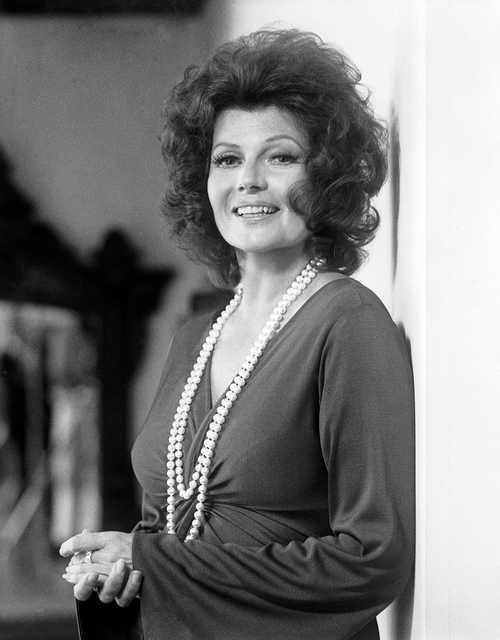
Hayworth retired after the film. The woman who had once learned Fred Astaire's choreography between morning and afternoon could no longer reliably remember a sentence.
A neurologist diagnosed her with Alzheimer's disease in 1981. The diagnosis finally gave a name to symptoms that had been misread for years.
Princess Yasmin Aga Khan became her mother's principal caregiver and spoke publicly about the disease. Hayworth's fame helped bring Alzheimer's into public conversation at a time when dementia was still surrounded by confusion and silence.
The first Rita Hayworth Gala was held in New York in 1984 to raise money for the Alzheimer's Association. The events continued under Yasmin Aga Khan's leadership and became an enduring part of Hayworth's legacy.
Rita Hayworth died at her daughter's Manhattan home on 14 May 1987. She was 68.
A funeral Mass was held at the Church of the Good Shepherd in Beverly Hills. Her daughters, Rebecca Welles and Princess Yasmin Aga Khan, walked behind the coffin.
Hayworth was buried at Holy Cross Cemetery in Culver City, California. The inscription chosen by Yasmin reads: "To yesterday's companionship and tomorrow's reunion."

Rita Hayword's screen image remains magnificent: red hair released in a sudden toss, black satin catching the light, and a dancer's body answering every note. Her deeper elegance lay elsewhere, in the discipline that made the illusion effortless and in the vulnerable humanity that continued to show through it.