Film & TV
Ludwig (film, 1973) Starring Helmut Berger, Romy Schneider, Trevor Howard and Silvana Mangano
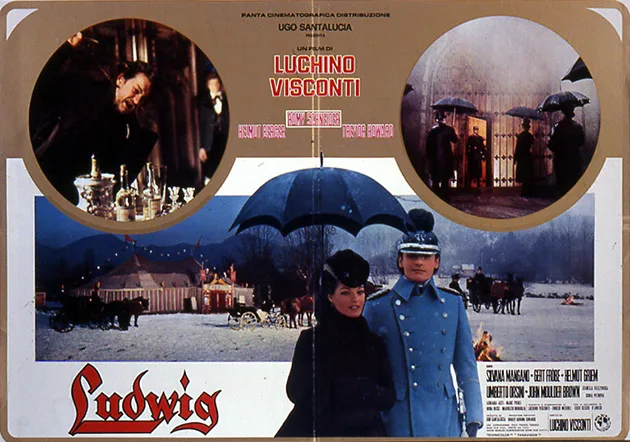
Ludwig (1973) is an epic biographical drama directed by Luchino Visconti, written with Enrico Medioli and Suso Cecchi d'Amico, covering the twenty-two-year reign of Ludwig II of Bavaria from his accession in 1864 to his death in 1886. Helmut Berger plays the king, Romy Schneider returns to play Empress Elisabeth of Austria almost twenty years after making the role famous in Sissi (1955), and Trevor Howard plays Richard Wagner.
Shot in the palaces Ludwig II actually built and inhabited, the film runs 238 minutes in the version Visconti intended, and it is structured around the testimony of the men who declared him insane. It was the last of Visconti's grand historical films, and the production nearly killed him.
Plot
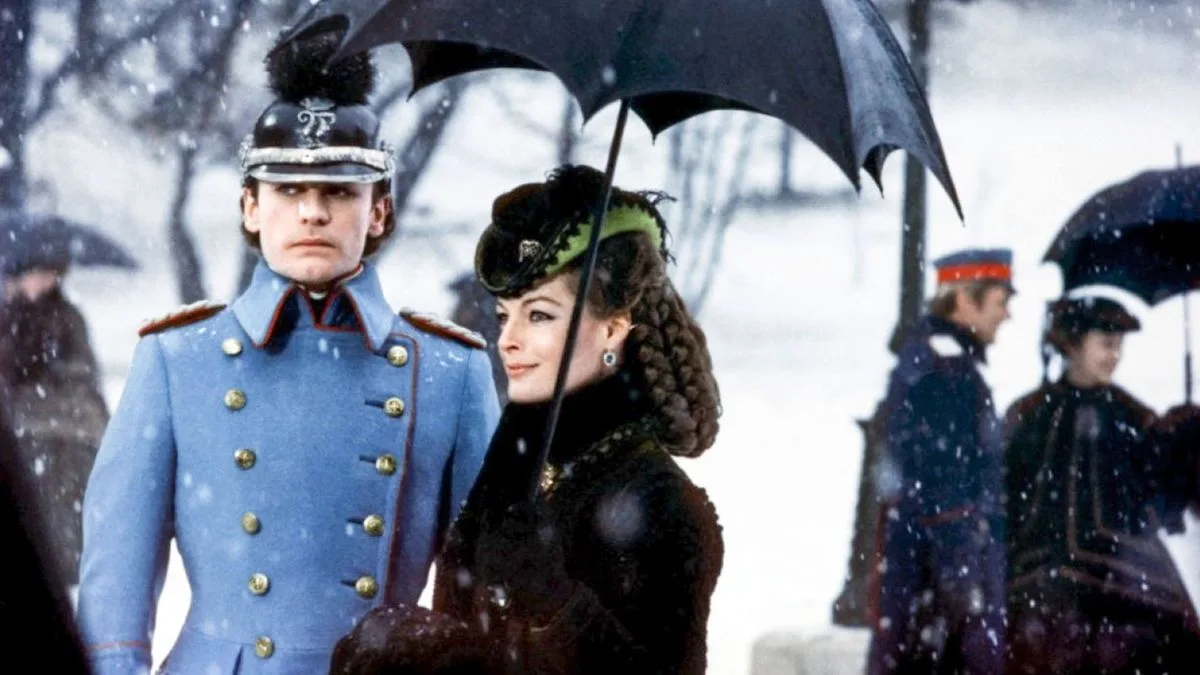
Munich, 1864. A young man of eighteen is dressed for his coronation while courtiers fuss at his sleeves, and Ludwig II becomes King of Bavaria with the air of someone attending a performance rather than assuming a throne.
His first act as monarch is to summon Richard Wagner, whose debts he assumes and whose work he intends to fund without limit. The composer arrives with Cosima von Bülow, who is married to the conductor Hans von Bülow and is bearing Wagner's children.
Tristan und Isolde (1865) is staged in Munich at the king's expense. His ministers calculate what the enthusiasm is costing, and Bavaria's public turns against the composer, who eventually leaves for Switzerland.
Ludwig II is in love with his cousin, Elisabeth of Austria, who treats him with amused tenderness and keeps her distance. She suggests he marry her younger sister, Sophie Charlotte in Bavaria, instead.
The engagement is announced. Ludwig II delays the wedding, delays it again, and finally breaks it off, and Sophie Charlotte in Bavaria is dispatched from the story with a few polite sentences.
Prussia defeats Austria in 1866 and Bavaria, on the losing side, begins to shrink into the German Empire. Count Dürckheim urges the king to take his duties seriously. Ludwig II signs what is put in front of him and thinks about architecture.
He begins to build. Neuschwanstein rises on a crag, Linderhof fills with gilded excess, and Herrenchiemsee is conceived as a private Versailles for a man who will dine alone in it.
His brother, Prince Otto of Bavaria, collapses into a madness nobody can disguise, and is confined. Ludwig II watches the family disease arrive and understands what it means for him.
He reverses his days, sleeping through the light and holding suppers and sleigh rides at three in the morning. He takes up with grooms, cavalrymen, and the actor Josef Kainz, and he hosts nights at Linderhof that his ministers file away for later use.
His teeth rot, his figure thickens, and he refuses to be seen. Richard Wagner dies in 1883, and the one friendship that justified everything is gone.
In June 1886 a government commission travels to Neuschwanstein with a certificate of insanity signed by Professor Bernhard von Gudden, who has never examined him. Ludwig II is taken to Berg on Lake Starnberg, and the following evening he and the professor are found drowned in shallow water at the edge of the lake.
Cast
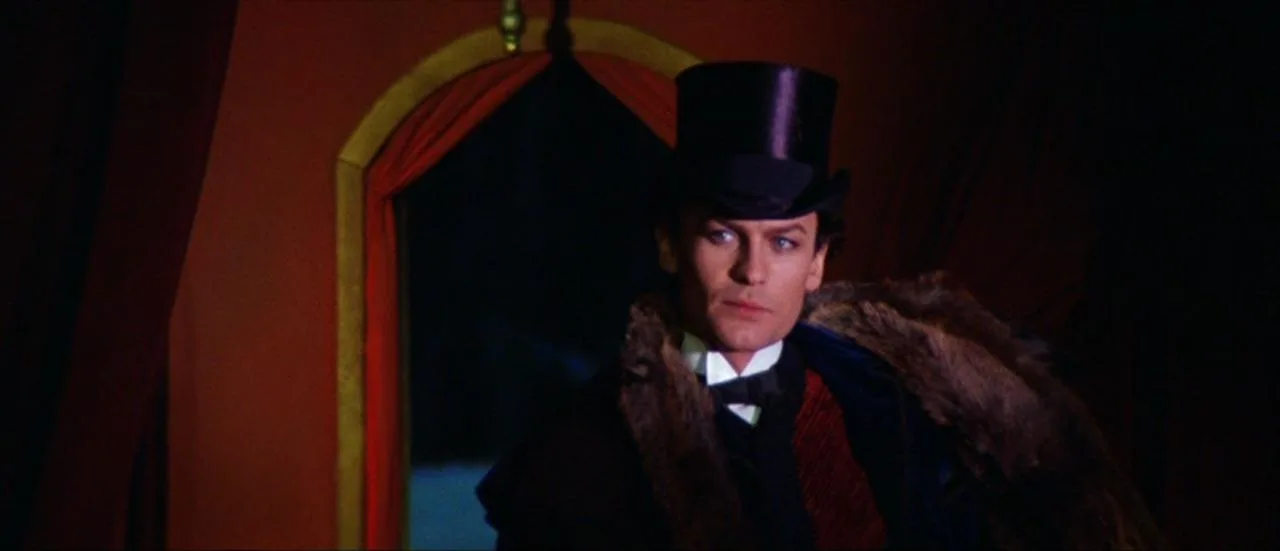
- Helmut Berger as Ludwig II of Bavaria
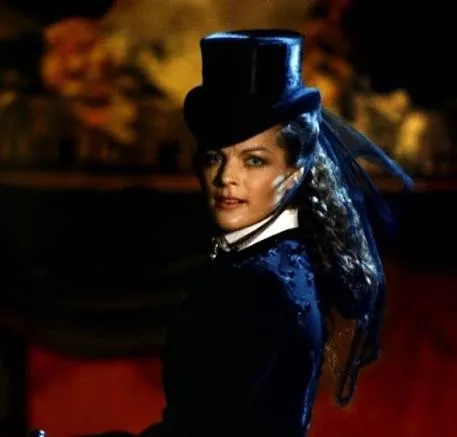
Helmut Berger as Ludwig II of Bavaria in film Ludwig (1973) - Romy Schneider as Empress Elisabeth of Austria
Romy Schneider as Empress Elisabeth of Austria in film Ludwig (1973) - Trevor Howard as Richard Wagner
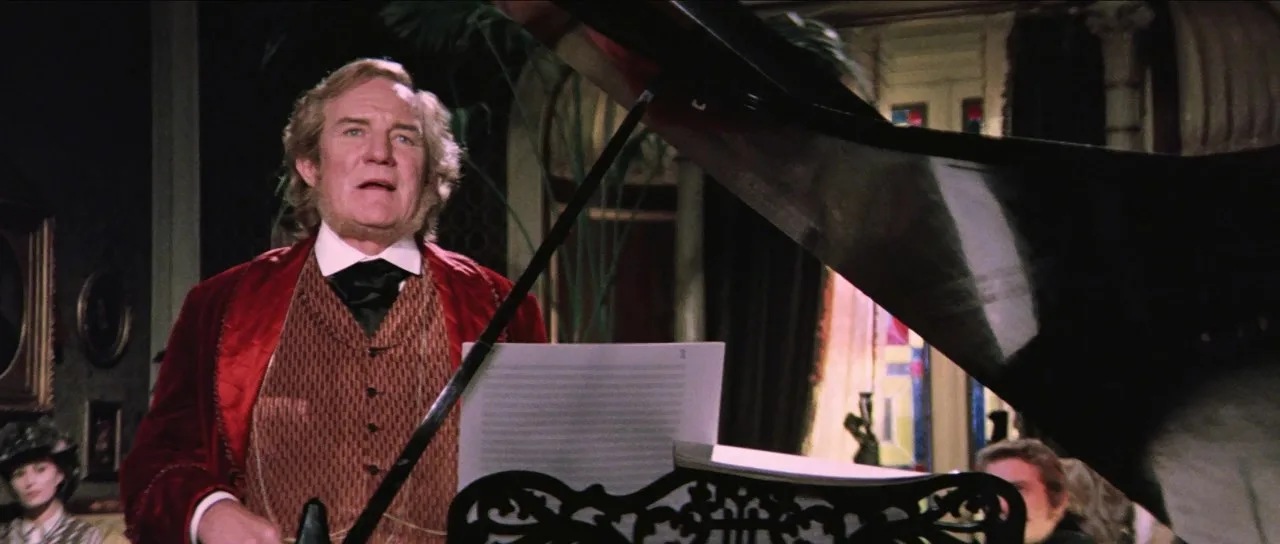
Trevor Howard as Richard Wagner in film Ludwig (1973) - Silvana Mangano as Cosima von Bülow
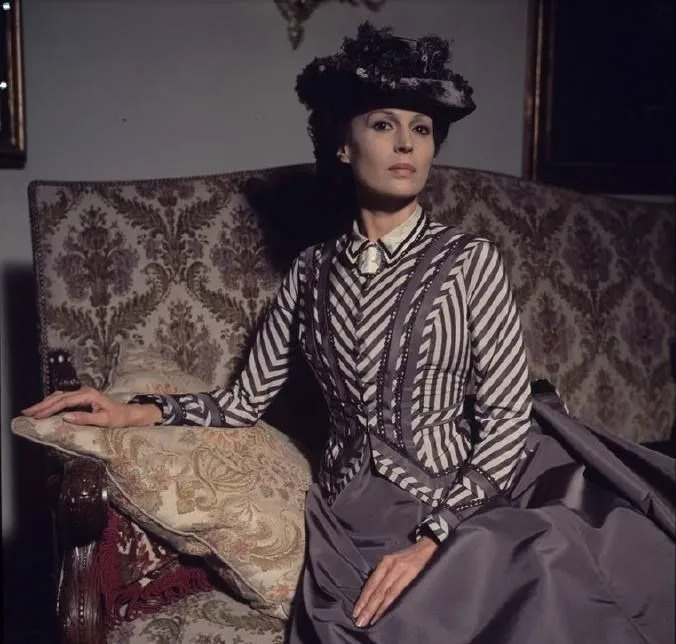
Silvana Mangano as Cosima von Bülow in film Ludwig (1973) - Helmut Griem as Count Dürckheim
- Gert Fröbe as Father Hoffmann
- John Moulder-Brown as Prince Otto of Bavaria
- Sonia Petrovna as Sophie Charlotte in Bavaria
- Marc Porel as Richard Hornig
- Umberto Orsini as Count von Holnstein
- Heinz Moog as Professor Bernhard von Gudden
Helmut Berger carries the film from eighteen to forty, and the performance is built as a physical ruin. The slender, luminous boy of the coronation becomes a heavy, rotting, whispering figure who hides his mouth behind his hand, and the transformation is gradual enough to be genuinely distressing.
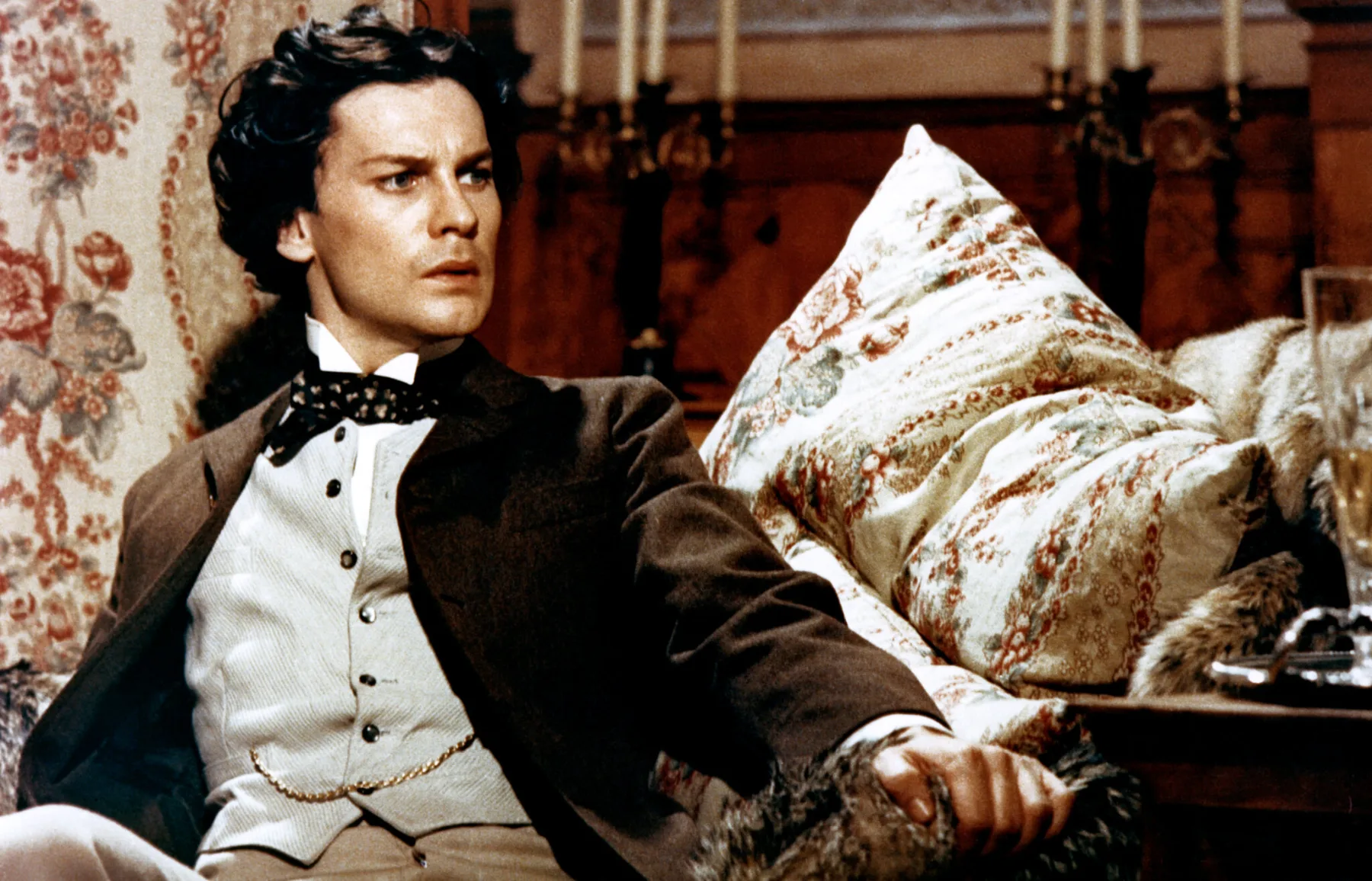
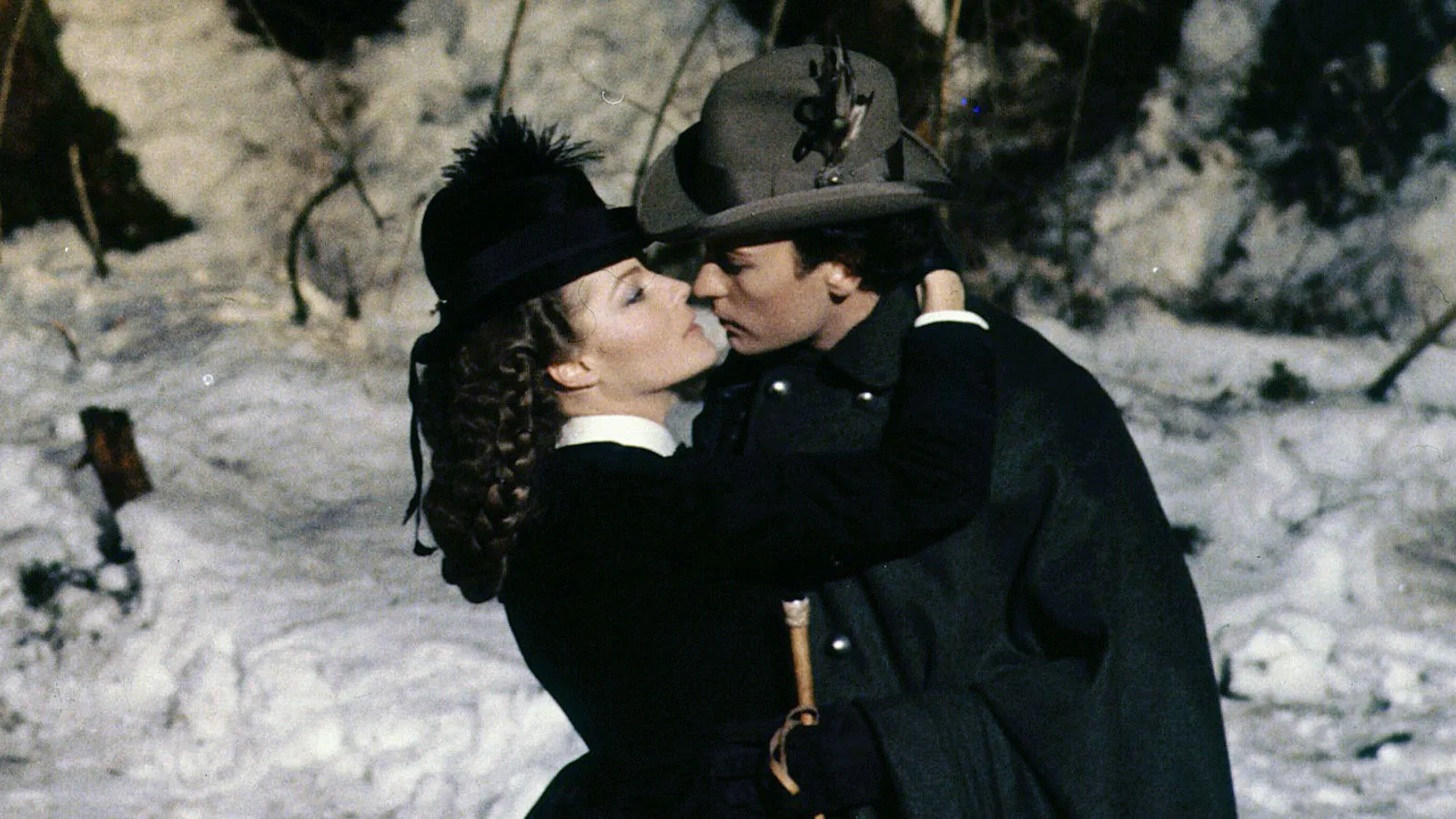
Romy Schneider plays Elisabeth of Austria as the woman the Sissi films were not allowed to show: restless, ironic, vain about her hair, bored by court, kind to her cousin in a way that never quite becomes commitment. It is the performance that freed her from the role that had made her.
Trevor Howard's Richard Wagner is charming, insatiable, and quietly contemptuous of the boy funding him. Silvana Mangano gives Cosima von Bülow a cool managerial hardness, and John Moulder-Brown makes Prince Otto of Bavaria's few scenes into the film's most frightening ones.
Production
The film was an Italian, French, and West German co-production, assembled by Ugo Santalucia and Dieter Geissler with Mega Film, Cinétel, Divina Film, and RAI. Costs ran to roughly twelve million Deutsche Marks, making it one of the most expensive European films of its day.
The story is not told straight. Visconti built the film around sworn testimony, so that ministers, a priest, servants, and physicians turn to the camera at intervals to deliver their objective assessments of the king's sanity, and the drama of each statement lies in what the speaker stands to gain from the verdict. The device also lets the narrative move by memory and anticipation rather than by calendar, and it was the first thing distributors removed when they wanted a shorter, tidier, more linear film.
Shooting began in late January 1972 and lasted six months. Interiors were built at Cinecittà in Rome, but Visconti insisted on the real buildings wherever he could get them: Neuschwanstein, Hohenschwangau, Linderhof, Herrenchiemsee, Nymphenburg, the Cuvilliés Theatre, the Kaiservilla at Bad Ischl, Lake Starnberg, and the casino on the Roseninsel.
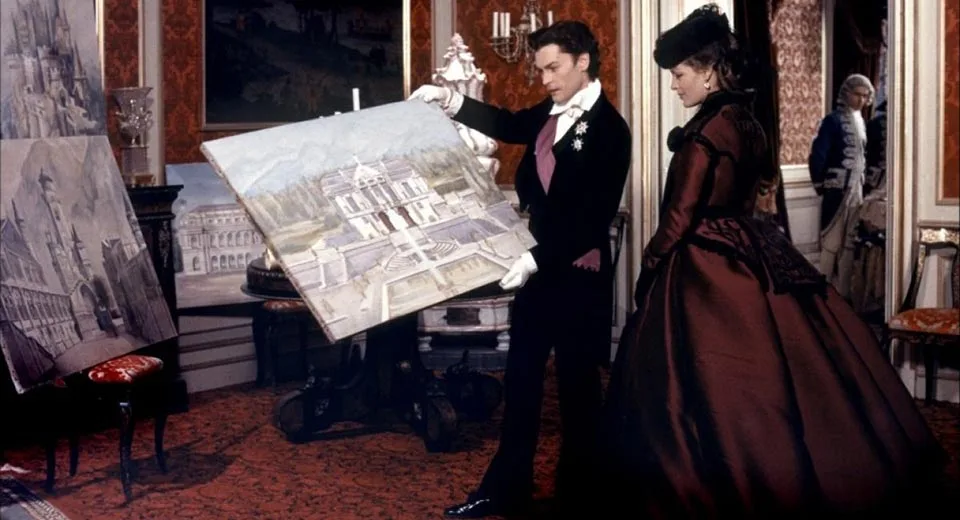
To match the king's inverted hours, much of the film was shot at dawn, at dusk, and through the night. The cast worked in candlelight and cold, and Armando Nannuzzi's photography turns the palaces into caverns of amber and blue where faces emerge from the dark for a moment and then withdraw.
The Wittelsbach family refused permission to film at Berg Castle, so the nearby Possenhofen was used in its place. To reach the Roseninsel, army engineers of the Bundeswehr laid a pontoon bridge across the lake for the production and logged it as a maneuver exercise. The royal steamer Tristan was played by a passenger boat called the Leoni, rebuilt for the part.
Piero Tosi designed the costumes across two decades of nineteenth-century fashion, from the blue and silver of the coronation to the crinolines and bustles of the Austrian court, the Bavarian cavalry uniforms, the ermine, the hunting loden, and the swan motifs Ludwig II stitched into his private world. Romy Schneider's riding habits and her black mourning veils were cut to make her look, as the real empress wished to look, like the most elegant woman in Europe on horseback.
The score is almost entirely borrowed. Richard Wagner dominates, with Lohengrin (1850), Tristan und Isolde (1865), and Die Walküre (1870) recurring as the king's inner weather, and music by Robert Schumann and Jacques Offenbach set against it. Franco Mannino conducted the Orchestra dell'Accademia Nazionale di Santa Cecilia and played piano.
Visconti shot in English because his cast was German, British, and Italian, with much of it recorded silent and looped afterward. That decision later caused real damage: when the full version was reconstructed, Romy Schneider and Helmut Griem were dead, and portions of the English track had to be taken from the rough guide recordings.
Ludwig II's sexual life is treated plainly, in the encounters with grooms and soldiers and in the orgy staged among the branches of the ash tree inside Hunding's hut at Linderhof, rebuilt in the studio. Helmut Berger and Visconti were lovers, and the director's scrutiny of him here is merciless in a way that has been read ever since as partly self-portrait: an aging aesthete building beautiful, ruinously expensive things while the world calls it folly.
On 27 July 1972, days after shooting ended, Luchino Visconti suffered a stroke that paralyzed his left side. He rehabilitated in Switzerland and then at the family house at Cernobbio, where a gym and a Moviola were installed, and where Ruggero Mastroianni came with his assistants. The whole of Ludwig was cut there, by a man relearning how to move, and the sound was mixed in Rome at the end of the year.
Enrico Medioli blamed the collapse on the shuttling between the freezing Bavarian and Austrian locations and the heat of the Cinecittà stages.
Release/reception
The finished four-hour film alarmed its backers, who feared both the length and the censors and demanded severe cuts. Visconti fought, lost, and gave in, and the version that opened in West Germany on 18 January 1973 was around three hours, with its editing altered as well.
It went out in Italy on 7 March 1973 and in France on 15 March. Every territory produced its own mutilation. American distribution began at 177 minutes in New York, was withdrawn, and returned in a 137-minute cut rerated for general release with the king's sexuality largely removed. British audiences did not see it at all until 1978, and then in the short version.
Reviews of these fragments were poor. Roger Ebert wrote in the Chicago Sun-Times that perhaps only Visconti could have made Ludwig II of Bavaria seem boring, and Vincent Canby in The New York Times found it difficult to believe the film could be quite so bereft of ideas.
It still won the David di Donatello awards for best film and best director, with a special acting prize for Helmut Berger's king, took the Nastro d'Argento for cinematography, sets, and Piero Tosi's costumes, and brought Tosi an Academy Award nomination for costume design in 1974.
Visconti never watched any of the shortened versions. He referred to them as commercials and died on 17 March 1976 without having seen his film in a cinema as he made it.
In 1980, four years after his death, Ruggero Mastroianni and Suso Cecchi d'Amico reassembled the 238-minute cut, a salvage operation that took three years and drew on material scattered across several countries and in poor condition. Caterina d'Amico arranged its first showing in four parts on television, which is why the restored film now carries a four-chapter structure.
The reputation of the complete version has risen steadily, helped by a 4K restoration from StudioCanal, the Cinémathèque française, and the Cineteca di Bologna. What looked in 1973 like an expensive folly about a foolish king now looks like Visconti's most personal film: a portrait of a man who spent everything he had on beauty, was declared mad for it, and left behind the buildings that millions of people now travel to see.