People
Gian Lorenzo Bernini Le Bernini
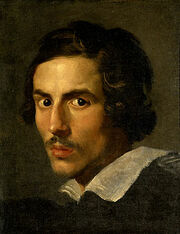
Gian Lorenzo Bernini self portrait
name: Gianlorenzo Bernini
original name: Cavaliere Bernini
birth place: Naples
birth date: 7 December 1598
zodiac sign: Sagittarius
death place: Rome
death date: 28 November 1680
original name: Cavaliere Bernini
birth place: Naples
birth date: 7 December 1598
zodiac sign: Sagittarius
death place: Rome
death date: 28 November 1680
Biography of Gian Lorenzo Bernini
Gian Lorenzo Bernini, is an Italian artist, painter, sculptor, architector, inventor, he is credited to have created the Baroque style of sculpture.
While a major figure in the world of architecture, he was, also and even more prominently, the leading sculptor of his age, credited with creating the Baroque style of sculpture.
As one scholar has commented, "What Shakespeare is to drama, Bernini may be to sculpture: the first pan-European sculptor whose name is instantaneously identifiable with a particular manner and vision, and whose influence was inordinately powerful...."In addition, he was a painter (mostly small canvases in oil) and a man of the theater: he wrote, directed and acted in plays (mostly Carnival satires), for which he designed stage sets and theatrical machinery. He produced designs as well for a wide variety of decorative art objects including lamps, tables, mirrors, and even coaches.
As architect and city planner, he designed secular buildings, churches, chapels, and public squares, as well as massive works combining both architecture and sculpture, especially elaborate public fountains and funerary monuments and a whole series of temporary structures (in stucco and wood) for funerals and festivals. His broad technical versatility, boundless compositional inventiveness and sheer skill in manipulating marble ensured that he would be considered a worthy successor of Michelangelo, far outshining other sculptors of his generation. His talent extended beyond the confines of sculpture to a consideration of the setting in which it would be situated; his ability to synthesize sculpture, painting, and architecture into a coherent conceptual and visual whole has been termed by the late art historian Irving Lavin the "unity of the visual arts".
While a major figure in the world of architecture, he was, also and even more prominently, the leading sculptor of his age, credited with creating the Baroque style of sculpture.
As one scholar has commented, "What Shakespeare is to drama, Bernini may be to sculpture: the first pan-European sculptor whose name is instantaneously identifiable with a particular manner and vision, and whose influence was inordinately powerful...."In addition, he was a painter (mostly small canvases in oil) and a man of the theater: he wrote, directed and acted in plays (mostly Carnival satires), for which he designed stage sets and theatrical machinery. He produced designs as well for a wide variety of decorative art objects including lamps, tables, mirrors, and even coaches.
As architect and city planner, he designed secular buildings, churches, chapels, and public squares, as well as massive works combining both architecture and sculpture, especially elaborate public fountains and funerary monuments and a whole series of temporary structures (in stucco and wood) for funerals and festivals. His broad technical versatility, boundless compositional inventiveness and sheer skill in manipulating marble ensured that he would be considered a worthy successor of Michelangelo, far outshining other sculptors of his generation. His talent extended beyond the confines of sculpture to a consideration of the setting in which it would be situated; his ability to synthesize sculpture, painting, and architecture into a coherent conceptual and visual whole has been termed by the late art historian Irving Lavin the "unity of the visual arts".
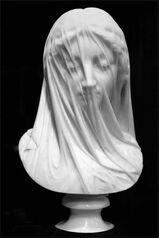
1620s: David and Apollo
Gianlorenzo Bernini sculpted this life-sized sculpture of David for Pope Paul V’s nephew during the Counter-Reformation, when the Catholic religion was being challenged by Protestantism.
Portrayed at the moment of battle, David infringes forcefully on the viewer’s space. The sculpture captures David as he launches the stone at the giant Goliath. There is a lot of movement in this sculpture with David bending at the waist and his arms twisted to one side. David’s clothing twists dramatically around his body accentuating the power David is putting behind the stone. At his feet lays his discarded armor. His face is full of emotion and he seems more human-like, more relatable. David shows intense determination with his clenched jaw and furrowed brow. The energy and tension of David’s body activates the space around him implying the existence of an opponent.
Gianlorenzo Bernini sculpted this life-sized sculpture of David for Pope Paul V’s nephew during the Counter-Reformation, when the Catholic religion was being challenged by Protestantism.
Portrayed at the moment of battle, David infringes forcefully on the viewer’s space. The sculpture captures David as he launches the stone at the giant Goliath. There is a lot of movement in this sculpture with David bending at the waist and his arms twisted to one side. David’s clothing twists dramatically around his body accentuating the power David is putting behind the stone. At his feet lays his discarded armor. His face is full of emotion and he seems more human-like, more relatable. David shows intense determination with his clenched jaw and furrowed brow. The energy and tension of David’s body activates the space around him implying the existence of an opponent.
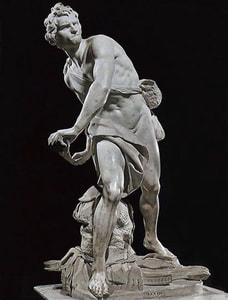
David by Gian Lorenzo Bernini, 1623-1624, Borghese Gallery, Rome
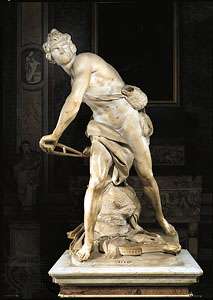
David by Gian Lorenzo Bernini, 1623-1624, Borghese Gallery, Rome
The sculpture of Apollo and Daphne is the last of Bernini's work commissioned by the Borghese family, and remains one of his most popular sculptures. The influence of antique sculptures (Apollo of Belvedere) and of contemporary paintings (such as those by Guido Reni) are clearly seen in this masterpiece.
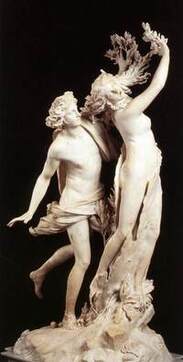
Apollo and Daphne(243 cm) by Gian Lorenzo Bernini, 1622-25, Galleria Borghese, Rome
1647-1652: Ecstasy of Saint Teresa

The Ecstasy of Saint Teresa by Gian Lorenzo Bernini, 1647-1652

The Ecstasy of Saint Teresa by Gian Lorenzo Bernini, 1647-1652

The Ecstasy of Saint Teresa by Gian Lorenzo Bernini, 1647-1652
« Le Bernin, ah ! le délicieux Bernin [...]. Il est puissant et exquis, une verve toujours prête, une ingéniosité sans cesse en éveil, une fécondité pleine de grâce et de magnificence ! ... »
- Émile Zola dans Les Trois Villes, publié en 1898.
(Bernini, ah! The delicious Bernini... he is powerful and exquisite, an imagination always ready, an ingenuity never asleep, a productivity full of grace and magnificence!...
-Émile Zola in The Three Cities, published in 1898
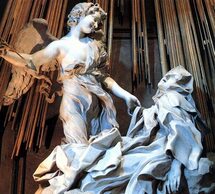
The Ecstasy of Saint Teresa by Gian Lorenzo Bernini, 1647-1652
| "It pleased our Lord that I would sometimes see this vision: very close to me, on my left, an angel appeared in human form... In his hands I saw a golden spear and at the end of the iron tip I seemed to see a point of fire. With this he seemed to pierce my heart several times so that it penetrated to my entrails. When he drew it out, I thought he was drawing them out with it, and he left me utterly consumed by the great love of God. "The pain was so sharp that it made me utter several moans; and so excessive was the sweetness caused me by this intense pain that one can never wish it to cease, nor will one's soul be content with anything less than God." - autobiography of Saint Teresa of Avila |
1648-1651: Fontana dei Quatro Fiumi (Fountain of Four Rivers)
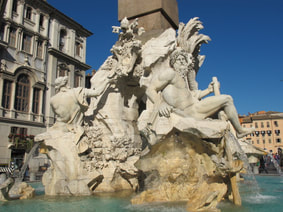
Fontana dei Quattro Fiumi(Fountain of Four Rivers) by Gian Lorenzo Bernini, Piazza Navona, Rome, Italy
Public fountains in Rome served multiple purposes: first, they were highly needed sources of water for neighbors in the centuries prior to home plumbing. Second, they were monuments to the papal patrons.

Fontana dei Quattro Fiumi(Fountain of Four Rivers) by Gian Lorenzo Bernini, Piazza Navona, Rome, Italy
The circumstances of how Bernini won the commission of this public moment are described as follows in Filippo Baldinucci's The life of Cavaliere Bernini (1682):
| So strong was the sinister influence of the rivals of Bernini on the mind of Innocent that when he planned to set up in Piazza Navona the great obelisk brought to Rome by the Emperor Caracalla, which had been buried for a long time at Capo di Bove for the adornment of a magnificent fountain, the Pope had designs made by the leading architects of Rome without an order for one to Bernini. Prince Niccolò Ludovisi, whose wife was niece to the pope, persuaded Bernini to prepare a model, and arrange for it to be secretly installed in a room in the Palazzo Pamphili that the Pope had to pass. When the meal was finished, seeing such a noble creation, he stopped almost in ecstasy. Being prince of the keenest judgment and the loftiest ideas, after admiring it, said: "This is a trick … It will be necessary to employ Bernini in spite of those who do not wish it, for he who desires not to use Bernini’s designs, must take care not to see them." |

Fontana dei Quattro Fiumi(Fountain of Four Rivers) by Gian Lorenzo Bernini, Piazza Navona, Rome, Italy
1665: King Louis XIV

Gianlorenzo Bernini self portrait, 1665
According to French diarist, a steward at the court of Louis XIV Paul Fréart de Chantelou's diary, the process of selecting suitable marble block took several days to accomplish, and the bust took just over three months to carve.
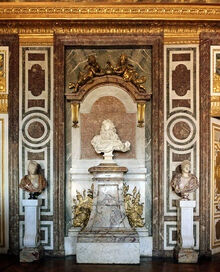
Bust of Louis XIV by Antonio Canova, 1665, Salon de Diane Palace of Versailles
While searching for a block of marble there was some discussion with members of the court about whether or not Bernini would make a full body statue or a bust. Bernini began drawing after the marble block had been selected.
However, it seems that once he had done this initial work, Bernini chose to work only during sittings with the king. His pupil, Giulio Cartari, began work on carving down the chosen block of marble (and would later do much of the drapery work), and then Bernini took over, taking forty days to complete the work. He had hoped to have twenty sittings with the king during the final carving process, but in fact there were thirteen of around one hour each.
The bust is modelled heavily after an earlier bust that Bernini made almost a decade ago of Francesco d'Este, the duke of Modena, and other than the fact that Louis' cloak was slightly longer horizontally a person would not be able to tell that one was of higher nobility.
However, it seems that once he had done this initial work, Bernini chose to work only during sittings with the king. His pupil, Giulio Cartari, began work on carving down the chosen block of marble (and would later do much of the drapery work), and then Bernini took over, taking forty days to complete the work. He had hoped to have twenty sittings with the king during the final carving process, but in fact there were thirteen of around one hour each.
The bust is modelled heavily after an earlier bust that Bernini made almost a decade ago of Francesco d'Este, the duke of Modena, and other than the fact that Louis' cloak was slightly longer horizontally a person would not be able to tell that one was of higher nobility.

Bust of Francesco I d'Este, duke of Modena by Antonio Canova, 1650-1651
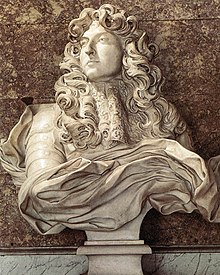
Bust of Louis XIV by Antonio Canova, 1665, Palace of Versailles
Bernini's son and biographer, Domenico Bernini, noted the artistic arguments of his father as to why the King agreed to sit for such a length of time, explaining that the artist preferred to work from Truth rather than rely on the unnecessary imaginative extras that would creep into working from sketches. Equally, Bernini wanted to see the king, as he did many of this other sitters, not remaining immobile, but sitting and talking in such ways that Bernini could capture all his characteristics.
Such an approach, with Bernini wishing to capture the figure in physical and psychological motion, was a common element of Bernini’s work: “mere resemblance is inadequate. One must express what goes on in the heads of heroes,” Bernini is recorded as saying. Bernini also observed the king in other locations - playing tennis, resting after lunch, or simply walking around court.
Art historian and biographer of artists Filippo Baldinucci records numerous events that advertise Bernini’s supposed influence on French culture, including one incident where Bernini rearranged the King’s hair to give greater exposure to the King’s brow - the new stye was apparently followed by all at the French court, and became known as the Bernini modification. Contemporary art historians are sceptical of this however; Jeanne Zarucchi claims that the alteration was deliberate, altering the shape of the King's head in an unflattering manner.
Such an approach, with Bernini wishing to capture the figure in physical and psychological motion, was a common element of Bernini’s work: “mere resemblance is inadequate. One must express what goes on in the heads of heroes,” Bernini is recorded as saying. Bernini also observed the king in other locations - playing tennis, resting after lunch, or simply walking around court.
Art historian and biographer of artists Filippo Baldinucci records numerous events that advertise Bernini’s supposed influence on French culture, including one incident where Bernini rearranged the King’s hair to give greater exposure to the King’s brow - the new stye was apparently followed by all at the French court, and became known as the Bernini modification. Contemporary art historians are sceptical of this however; Jeanne Zarucchi claims that the alteration was deliberate, altering the shape of the King's head in an unflattering manner.
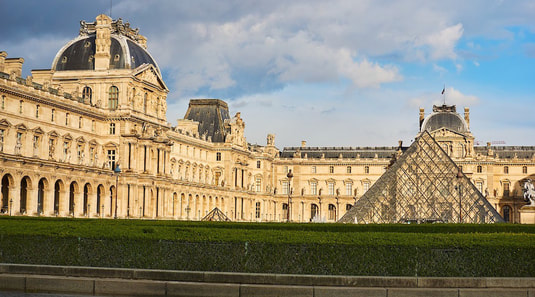
Musée du Louvre, Paris, France
But King Louis XIV's hairstyle apart, what if Gianlorenzo had tried harder to please the Sun King? What if the Great Bernini had designed Louvre?
0 Comments