People
Pauline, Baronesse de Rothschild (31 December 1908 - 8 March 1976)
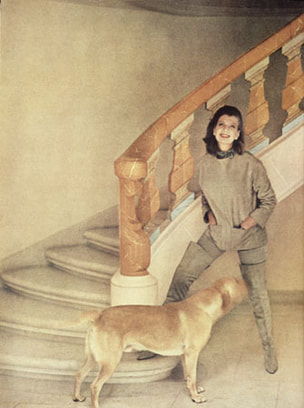
"The great danger for an American woman married to a Frenchman is to become too French. To assimilate too much of another nationality weakens you. Though on the surface I might not seem to be 100 percent American, I have tried to remain as shaggy inside as possible."
--Baronesse Pauline de Rothschild
Biography of Pauline de Rothschild
She was born Pauline Potter at 10 rue Octave Feuillet in the Paris neighborhood of Passy, to wealthy expatriate American parents of Protestant background. Her mother was Gwendolen Cary, a great-grand-niece of Thomas Jefferson, Potter was a member of several families that were prominent in the American South since the 17th century.
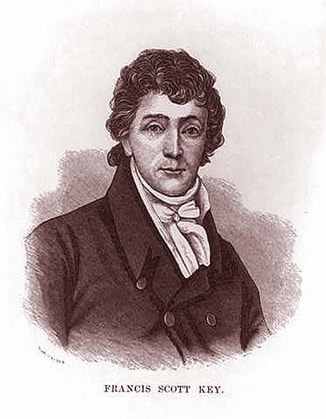
Francis Scott Key, great-great-grandfather of Pauline Potter
In 1930, in Baltimore, Maryland, Pauline Potter married Charles Carroll Fulton Leser (1900–1949), a grandson of one of the city's leading newspaper publishers. He was also an alcoholic and a homosexual. Soon after their marriage they moved to Majorca, Spain, but they separated in 1934, and divorced in 1939.
After she and Leser separated, Pauline Potter was romantically involved with a number of prominent men, including Paul-Henri Spaak (a Prime Minister of Belgium), American diplomat Elim O'Shaughnessy (1907-1966), French horticultural heir André Levesque de Vilmorin (1907-1987), Grand Duke Dmitri Pavlovitch Romanov of Russia, and producer-director Jed Harris. For a period of years she also was the lover of Isabelle Kemp, an heiress to a New York drug-store and real-estate fortune.
After she and Leser separated, Pauline Potter was romantically involved with a number of prominent men, including Paul-Henri Spaak (a Prime Minister of Belgium), American diplomat Elim O'Shaughnessy (1907-1966), French horticultural heir André Levesque de Vilmorin (1907-1987), Grand Duke Dmitri Pavlovitch Romanov of Russia, and producer-director Jed Harris. For a period of years she also was the lover of Isabelle Kemp, an heiress to a New York drug-store and real-estate fortune.

Grand Duke Dmitri Pavlovich of Russia with his wife Audrey Emery in the 1920s.
In the early 1930s, Pauline Potter worked as a personal shopper in New York City, acting as a fashion advisor to wealthy socialites too busy to shop or too unsure of their personal style. Later, after moving to Spain with her first husband, Pauline operated dress shops on Majorca. She also worked for the couturier Elsa Schiaparelli in London and Paris and often was seen in society columns dressed in the firm's latest creations.

In the early 1940s, Pauline Potter and a friend, Louise Macy, a former editor of Harper's Bazaar, opened Macy-Potter, a short-lived fashion house, in New York City. The firm was bankrolled by a monetary settlement from Macy's former lover, millionaire John Hay Whitney, who had left her to marry Betsey Cushing, a former daughter-in-law of President Franklin Roosevelt. Though Macy-Potter's first (and only) collection was a critical and financial disaster, Potter went on to design a collection for Marshall Field and later to direct the custom-fashion division of Hattie Carnegie, the New York fashion company, succeeding Jean Louis, who left in 1943 to become chief fashion designer for Columbia Pictures.
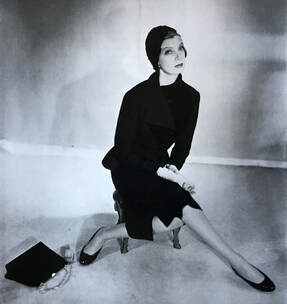
Pauline Potter modeling for Vogue, 1950, Photo by Horst P. Horst
Pauline remained at Hattie Carnegie for nearly a decade and was known professionally as Mrs. Fairfax Potter. Among her clients were the Duchess of Windsor, automotive heiress Thelma Chrysler Foy, actress Gertrude Lawrence, actress Ina Claire, and prominent others. She also designed the women's costumes for John Huston's Broadway 1946 production of No Exit by Jean-Paul Sartre, starring Ruth Ford and Annabella. The gown she designed for Ford is in the collection of the Museum of the City of New York.
Potter also worked briefly as an uncredited fashion model. One assignment for Harper's Bazaar had her posing in the latest Grecian-style gowns for the photographer Louise Dahl-Wolfe.
Potter also worked briefly as an uncredited fashion model. One assignment for Harper's Bazaar had her posing in the latest Grecian-style gowns for the photographer Louise Dahl-Wolfe.
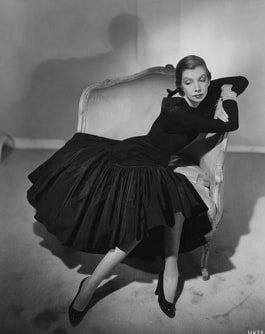
Pauline Potter modeling a short evening dress of black taffeta for Vogue, 1950, Photo by Horst P. Horst
On 8 April 1954, Pauline Potter became the second wife of Baron Philippe de Rothschild, the owner of the fabled French winery Château Mouton Rothschild.

Pauline with her husband Baron Philippe de Rothschild in Petit Mouton, 1956, photo by Cecil Beaton for Vogue

Pauline de Rothschild in Petit Mouton, 1956, photo by Cecil Beaton for Vogue
This second marriage transformed her, not only from Pauline Potter the stylish woman to Baronesse Pauline de Rothschild the style icon.
All of her early years of modelling, styling, selling and designing clothes had developed and nourished her sense of style, and now, as a Rothschild, she had the means to acquire and wrap herself in cloths of her style, the couturiers like Balenciaga, Courreges and Saint Laurent who are able to accommodate her needs, the venues to show, and the presses and photographers to immortalise "le style Pauline".
All of her early years of modelling, styling, selling and designing clothes had developed and nourished her sense of style, and now, as a Rothschild, she had the means to acquire and wrap herself in cloths of her style, the couturiers like Balenciaga, Courreges and Saint Laurent who are able to accommodate her needs, the venues to show, and the presses and photographers to immortalise "le style Pauline".

Pauline de Rothschild with her husband Baron Philippe de Rothschild, 1964, photo by Cecil Beaton

In more than a decade, she transformed herself into one of the most elegant women in the world, and in 1969, she achieved the highest honour a society lady could have: She was admitted to the International Best Dressed List Hall of Fame, the only woman that year, alongside elegant men like Douglas Fairbanks Jr., Cary Grant, and Prince Philip, Duke of Edinburgh.
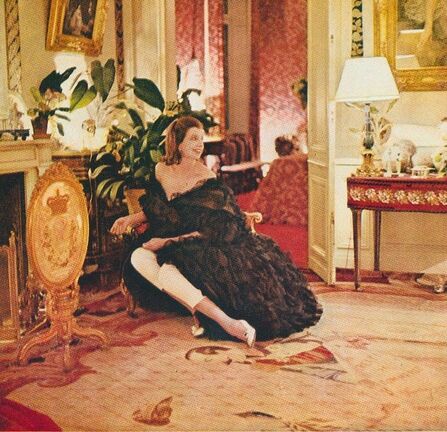
Pauline de Rothschild at home in Chateau de Mouton, 1969

Pauline de Rothschild at home in Chateau de Mouton, 1969
But "le style Pauline" was much more than how she dressed, or how she carried herself, it would increasingly mean the way how she decorated her houses in Paris, London, and Bordeaux, Chateau de Mouton.
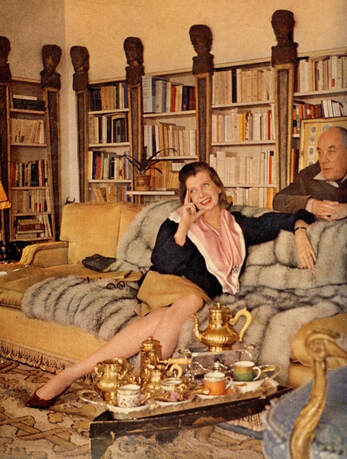
Pauline with her husband Baron Philippe de Rothschild at home in Chateau de Mouton, 1963
Baron Philippe de Rothschild, Pauline's second husband, a descendant of the Rothschild banking dynasty, was a race-car driver, a screenwriter, a playwright, a theatrical producer, a film producer, a poet, a wine maker, and a famed playboy. In fact, Pauline was only one of his mistresses for many years before their marriage, but after they got married, the Baron read, wrote and translated poetry with his wife, and provided her with a stage--Chateau de Mouton, for a woman of taste, energy and determination like Pauline, to act out the best role in her life.
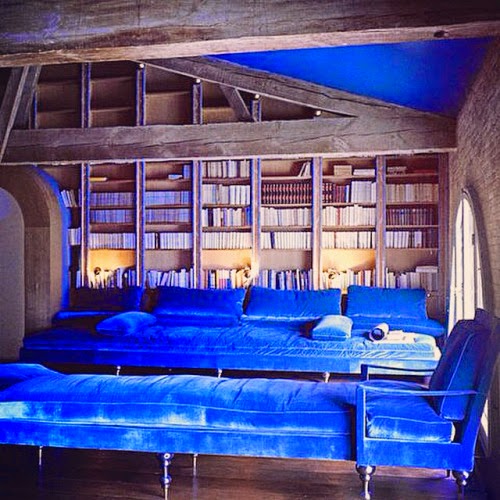
The blue velvet lounge chairs in library of Chateau de Moutou
With the help of her husband, Pauline de Rothschild renovated the war ruined estate of Rothschild in Bordeaux into one of the best wine museums in the world. A big project that took years, it showed her taste more than all the dresses she worn during those years.
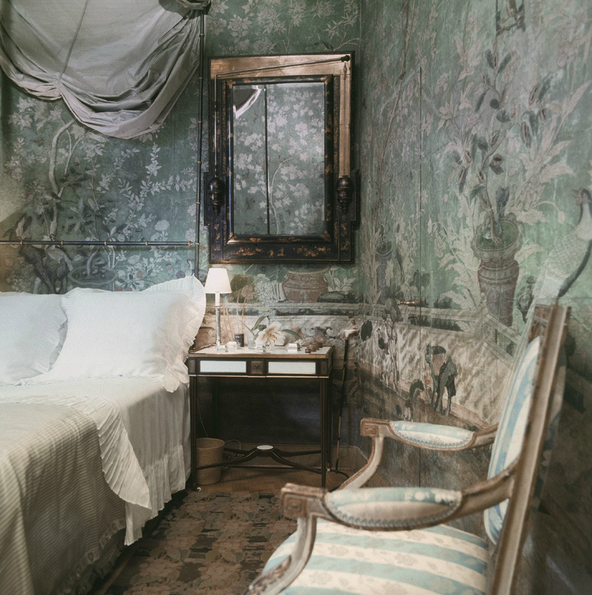
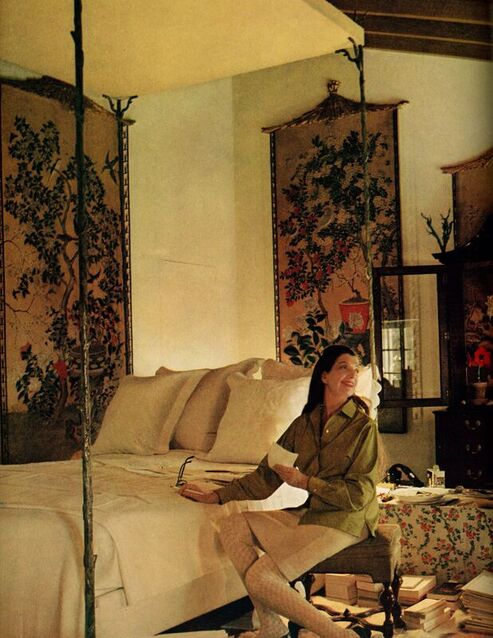
Baron and Baronesse de Rothschild's Paris appartment, bedroom with 18th century Chinese wall paper.
If Chateau de Mouton which was designed as museum was Pauline's grand stage given to her by her husband, where family history as well as culture heritage needed needed to be considered, then their apartment in Paris and flat in London were more like her playground, like Marie Antoinette's Petit Trianon, where she can indulge much more freely her intimate and personal taste.
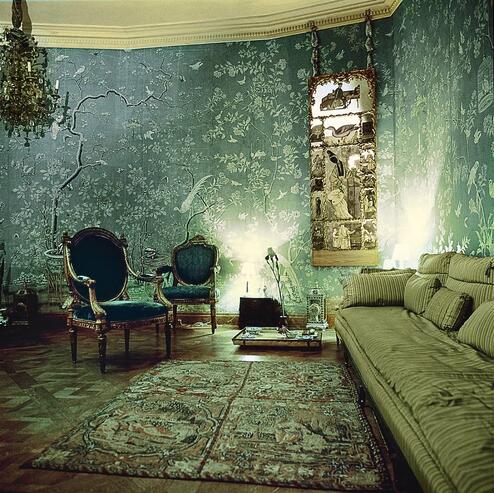
Baron and Baronesse de Rothschild's Paris appartment, salon with 18th century Chinese wall paper.

Baron and Baronesse de Rothschild's Paris appartment, oval salon with unique curtain treatment
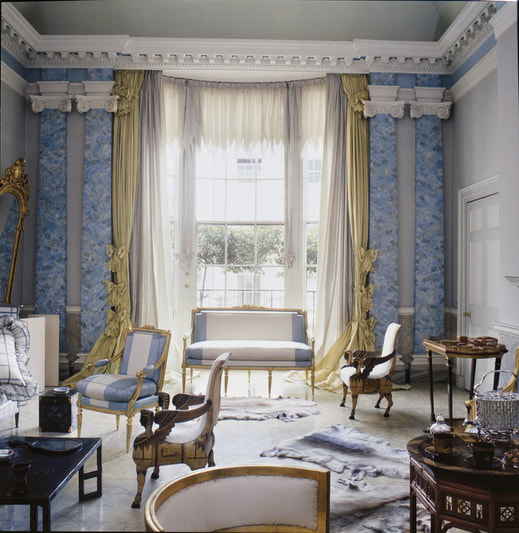
Baron and Baronesse de Rothschild's London flat, drawing room with similar curtain treatment, made by John Fowler, 1976
Pauline de Rothschild died on 8 March 1976, of a heart attack in the lobby of the Biltmore Hotel, in Santa Barbara, California. She previously had been diagnosed with breast cancer and had undergone open-heart surgery for a deteriorated valve in 1975. Rothschild's health problems were exacerbated by Marfan's syndrome, a genetic abnormality.

Baronesse Pauline de Rothschild, drawing by Barnaby Conrad
Further interest
Articles
Books
|
|
Vogue’s Book of Houses, Gardens, People (1968) was a landmark publication among decorating books, and it chronicles an important chapter in the history of Vogue. Vogue’s Horst P. Horst, a leading fashion photographer of his time, developed an intense interest in seeing the world’s great homes and meeting their owners; beginning in the early 1960s, he journeyed in an elite world that would soon be lost. With accompanying lyrical essays about homes and their occupants by the famed writer Valentine Lawford (Horst’s partner in work and life), the book is a virtual who’s who of society, politics, and the arts in the mid-20th century. Around That Time showcases much of the material featured in the original book, plus never-before-seen photographs from those homes as well as images from additional homes Horst shot well into the 1980s. This book introduces this work to a new generation of design, decorating, and visual art professionals, academics, and enthusiasts.
|
|
|
Gloria Vanderbilt cleverly noted, “Decorating is autobiography.” Reflecting that truism, the interiors in this book capture the individual approaches of these icons of style: Bunny Mellon’s spare all-American elegance; Hélène Rochas’s refined sophistication; Vanessa Bell’s colorful bohemianism; Mona von Bismarck’s breezy opulence; and Georgia O’Keeffe’s earthy chic. Author P. Gaye Tapp analyzes each of her subjects’ refined way of living, how she embellished her residences (or left them elegantly stark), and the long-lasting effects on today’s generation of designers and connoisseurs of beauty.
The book is presented in four sections that describe the aesthetic approaches that the ladies took in decorating their abodes: “The Fashionably Chic”, “The Unconventional Eye”, “In the Grand Manner”, and “Legacy Style”. Each interior illustrates the crucial aspect of the lady’s definitive taste. Some worked closely with decorating legends such as John Fowler, Albert Hadley, Billy Baldwin, Syrie Maugham, and Jean-Michel Frank. Others took to the task of decorating single-handedly—like Pauline Trigère, Sybil Connolly, Vita Sackville-West, and Fleur Cowles. The interiors of these trendsetting ladies defied their time and inspire and delight to this day. In How They Decorated, one can learn from the most notable style muses of the last century. |
|
|
One night in December, a man decided to leave his house and his vineyards, his work of translating Elizabethan poets into French, to spend two months in a country unfamiliar to him. He and his wife would leave for Russia the day after Christmas, and return in March. They were in the habit of taking long trips together, to Turkey, or Persia, or Denmark, but not to a half-Arctic country, in midwinter. They chose winter because of all the seasons it is the most Russian. Winter is a season for Russians alone, several renowned captains had noted in passing. We took all the advice that was offered us and even greater quantities of warm clothing. Just before leaving, we were thoughtfully given a straw picnic basket with an alcohol lamp, not for picnics but to make tea in our rooms, if needed. We also took a military tin trunk, filled with books. “What will we do in the evenings?” said Philippe. “We’ll see. There will be theater, or something to read. Or perhaps, with luck, people.” Every traveler feels larger than life. In some countries this makes the visitor seem in the way. Not there, not in Russia. We squandered time. We returned to the places we liked, saw again and again people we admired. There was the sharing of some strange excitement. — Pauline de Rothschild, The Irrational Journey, 1968. . .
|
0 Comments