People
Uemura Shoen(上村 松園, April 23, 1875 – August 27, 1949)

the artist's self portrait at 16
Uemura Shōen (上村 松園, April 23, 1875 – August 27, 1949) was the pseudonym of an important artist in Meiji, Taishō and early Shōwa period Japanese painting.
Her real name was Uemura Tsune. Shōen was known primarily for her bijin-ga paintings of beautiful women in the nihonga style, although she produced numerous works on historical themes and traditional subjects.
Her real name was Uemura Tsune. Shōen was known primarily for her bijin-ga paintings of beautiful women in the nihonga style, although she produced numerous works on historical themes and traditional subjects.

Springtime of life, 1899
Shōen was born in Shimogyō-ku, Kyoto, as the second daughter of a tea merchant. She was born two months after the death of her father and, thus, grew up with her mother and aunts in an all-female household.
Her mother's tea shop attracted a refined, cultured clientele for the art of Japanese tea ceremony. As a child at age 12 (1887), Shōen drew pictures and exhibited considerable skill at drawing human figures. By the age of 15 (1890) she was exhibiting her work and winning awards in official art contests as well as commissioning work for private patrons.
Shōen became obsessed with the ukiyo-e, Japanese woodblock print, works of Hokusai. Her mother supported her decision to pursue an artistic career. This was quite unusual for the time, and although Shōen did have successful contemporaries who were female, such as Ito Shoba (1877-1968) and Kajiwara Hisako (1896-1988), women were largely still not part of the Japanese public art scene outside of Tokyo.
Her mother's tea shop attracted a refined, cultured clientele for the art of Japanese tea ceremony. As a child at age 12 (1887), Shōen drew pictures and exhibited considerable skill at drawing human figures. By the age of 15 (1890) she was exhibiting her work and winning awards in official art contests as well as commissioning work for private patrons.
Shōen became obsessed with the ukiyo-e, Japanese woodblock print, works of Hokusai. Her mother supported her decision to pursue an artistic career. This was quite unusual for the time, and although Shōen did have successful contemporaries who were female, such as Ito Shoba (1877-1968) and Kajiwara Hisako (1896-1988), women were largely still not part of the Japanese public art scene outside of Tokyo.
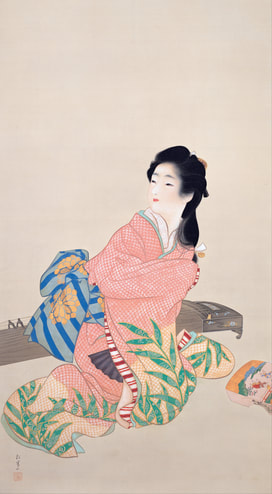
Daughter Miyuki, 1914
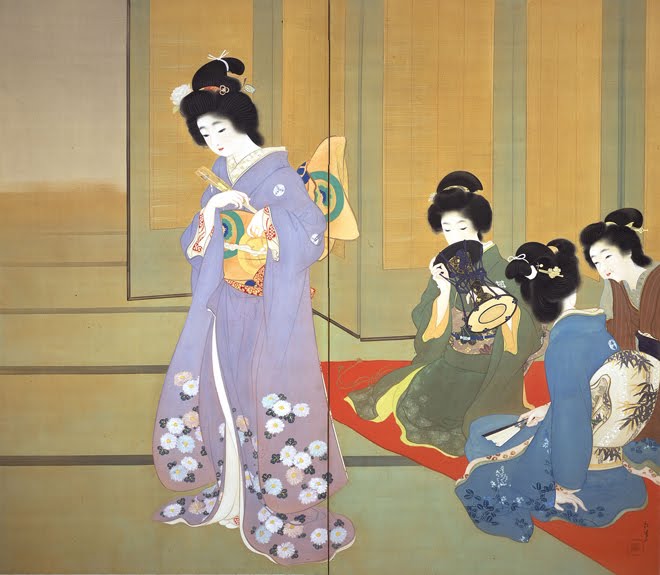
Preparing for dance, 1914
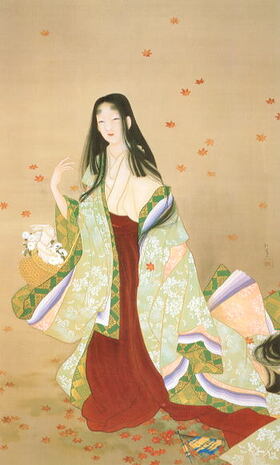 Flower basket 1915 |  Cherry blossom viewing 1915 |  Flames 1918 |

Yang gui fei 1922
Shōen is considered a major innovator in the bijin-ga genre despite the fact she often still used it to depict the traditional beauty standards of women.
Bijin-ga gained criticism during the Taisho era while Shōen worked due to its lack of evolution to reflect the more modern statuses of women in Japan. During bijin-ga's conception in the Tokugawa, or Edo, period, women were regarded as lower class citizens and the genre often reflected this implication onto its female subjects. Within the Taisho era, women had made several advancements into the Japanese workforce, and artistry specifically was becoming more popular, which opened way for Shōen's success.
Bijin-ga gained criticism during the Taisho era while Shōen worked due to its lack of evolution to reflect the more modern statuses of women in Japan. During bijin-ga's conception in the Tokugawa, or Edo, period, women were regarded as lower class citizens and the genre often reflected this implication onto its female subjects. Within the Taisho era, women had made several advancements into the Japanese workforce, and artistry specifically was becoming more popular, which opened way for Shōen's success.
 Spring Garden, 1935 |  Mother and child, 1935 |

Coiffure (Oshidori-mage), 1935
 Noh dance prelude, 1936 | 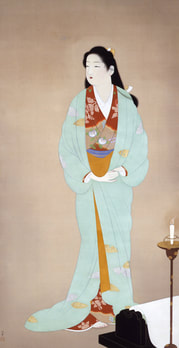 Kinuta,1938 |
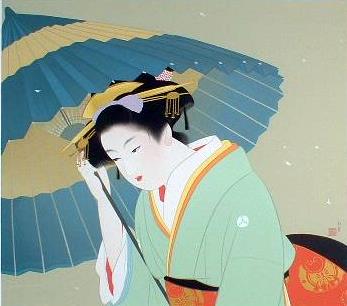
Snow, 1939

Young leaves, 1940

Sound of Tsuzumi, 1940
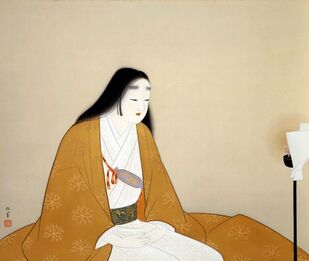 Madame Kusunogi Masashige,1944 |  Large snowflakes,1944 |  Shizuka,1944 |

Woman waiting for the moon to rise,1944
Shōen received many awards and forms of recognition during her lifetime within Japan, being the first female recipient of the Order of Culture award, as well as being hired as the Imperial Household's official artist, which had previously only employed one other official woman in the position.
 Bijinga by Uemura Shōen |  Bijinga by Uemura Shōen 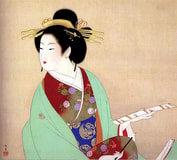 Bijinga by Uemura Shōen  Bijinga by Uemura Shōen |
In 1949 Uemura Shōen died of cancer just a year after receiving the Order of Culture Award.
0 Comments