Film & TV
Belle de jour (film, 1967) Starring Catherine Deneuve, Jean Sorel and Michel Piccoli
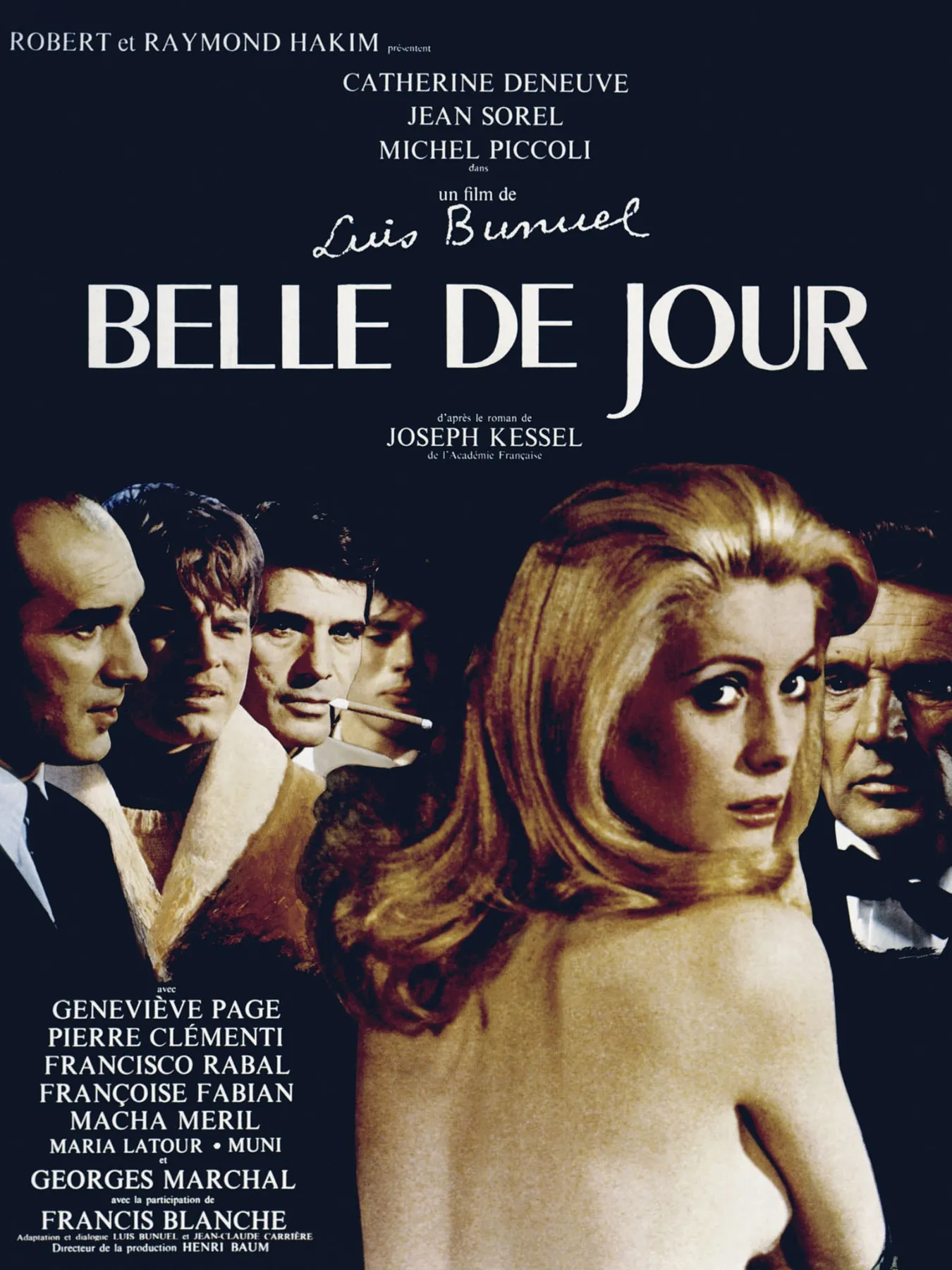
Belle de jour (1967) is a French and Italian coproduction directed by Luis Buñuel, from a screenplay he wrote with Jean-Claude Carrière, adapted from the 1928 novel by Joseph Kessel. Catherine Deneuve plays Séverine Serizy, a young bourgeois wife in Paris who cannot bear her husband's touch and who begins spending her afternoons, two o'clock to five, in a discreet brothel.
The film moves between what happens and what Séverine imagines without marking the border between them, and Buñuel refused to tell audiences which scenes were which. It won the Golden Lion at the Venice Film Festival in 1967 and remains the most commercially successful film of his career.
Plot
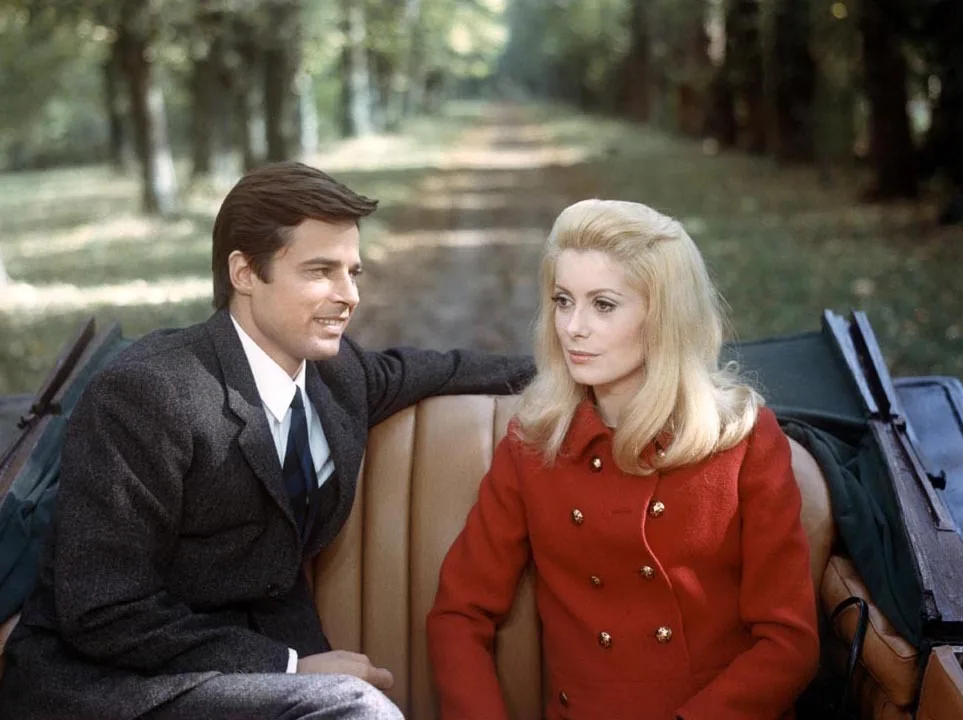
A landau moves along an avenue of bare trees, driven by two coachmen. Inside it, Séverine Serizy is with her husband, Pierre Serizy, a surgeon, and he is telling her with great courtesy that he has had enough of her coldness.
He has her dragged from the carriage, bound to a tree, whipped by the coachmen, and given to one of them.
She is in bed in a Paris apartment, and her husband is asking what she was thinking about. She tells him she was thinking of him.
Their marriage is affectionate and unconsummated. Pierre Serizy respects her refusal and waits.
At a ski resort the Serizys meet their friends Henri Husson and Renée. Husson looks at Séverine in a way she dislikes and speaks to her in front of both their spouses as though the matter were already settled.
Back in Paris, Renée tells Séverine that a woman they both know, Henriette, has gone to work in a brothel. Séverine is unsettled, and more unsettled when roses arrive from Husson.
At the tennis club, Husson returns to the subject. He tells her that respectable women sometimes work in such houses for their own reasons, and he gives her an address: 11, Cité Jean de Saumur. He also tells her he wants her, and she refuses him.
A memory surfaces from her childhood: a workman putting his hand on her, and a communion she would not take.
She goes to the address. The house is run by Madame Anaïs, who looks her over, understands her, and names her Belle de jour, because she can only come in the afternoons.
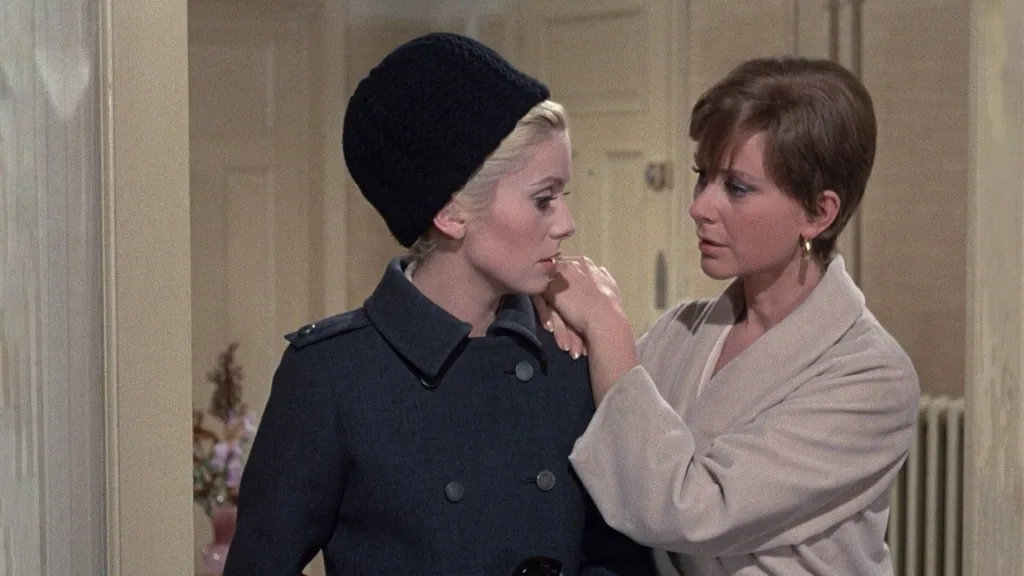
Her first client is a heavy commercial traveler. Séverine tries to leave, and it is the flat authority in Madame Anaïs's voice that keeps her in the room.
She stays away a week, then returns, and settles into the hours of two to five. In the evenings she goes home to her husband, who suspects nothing.
She imagines Pierre and Husson together in a farmyard, throwing mud at her while she stands tied in a white shift.
The clients arrive. A professor requires an elaborate humiliation with a maid, a whip, and a script, and complains when it is performed without conviction. A Japanese client produces a small lacquered box, and whatever is inside it makes one of the other women refuse him and makes Séverine laugh.
An aristocrat takes her to his house in the country, dresses her in black veils, lays her in a coffin beneath his dead daughter's portrait, weeps over her, and has his gardener throw her out in the rain.
Her own life with her husband, meanwhile, begins to work. She sleeps with Pierre Serizy for the first time in the film.
Then Marcel comes to the house, a young thief with steel-capped teeth and a cane that unscrews into a blade, and his associate Hyppolite. Marcel wants Séverine, gets her, and does not intend to share her with anyone.
Husson turns up at Cité Jean de Saumur and finds her there. She begs him not to tell her husband, he gives his word, and he tells her that now he has seen her like this he no longer wants her.
Marcel becomes jealous and unmanageable. Séverine tells Madame Anaïs she is finished, and Madame Anaïs, who has seen it before, lets her go.
Hyppolite follows her home. Marcel comes to the apartment and threatens to tell Pierre Serizy everything, and Séverine talks him out of the door. On the stairs he speaks of her husband as the obstacle.
He waits in the street. When Pierre Serizy comes home, Marcel shoots him three times, runs, and is shot dead by the police at the corner.
Pierre Serizy lives. He is blind, paralyzed, mute, and in a wheelchair, and the police can find no motive for any of it.
Séverine nurses him. Husson comes to the apartment, tells her he intends to explain matters to her husband, and she does not stop him.
Husson goes into the room and comes out again. Séverine finds Pierre Serizy crying behind his dark glasses.
Then she imagines it otherwise: her husband takes off the glasses, stands up, and asks her what she is thinking about. Outside the window, harness bells sound, and the landau passes along the avenue with nobody in it.
Cast
- Catherine Deneuve as Séverine Serizy, called Belle de jour
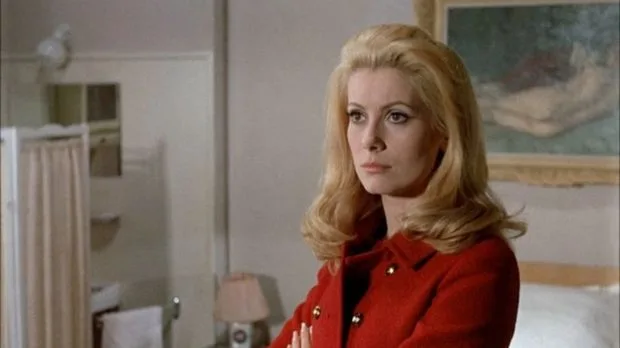
Catherine Deneuve as Séverine Serizy, called Belle de jour in film Belle de jour (1967) - Jean Sorel as Pierre Serizy, her husband, a surgeon
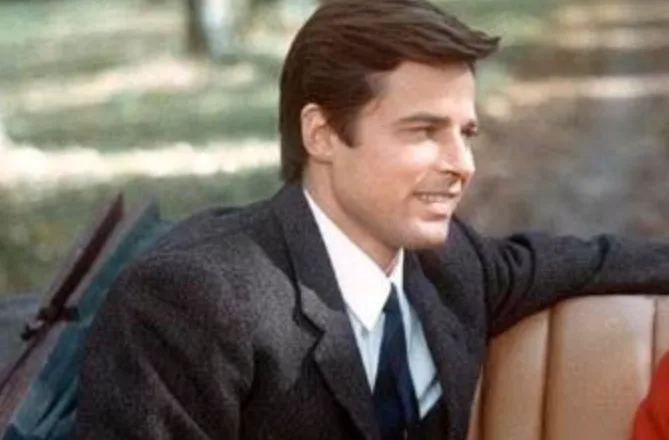
Jean Sorel as Pierre Serizy, her husband, a surgeon, in film Belle de jour (1967) - Michel Piccoli as Henri Husson
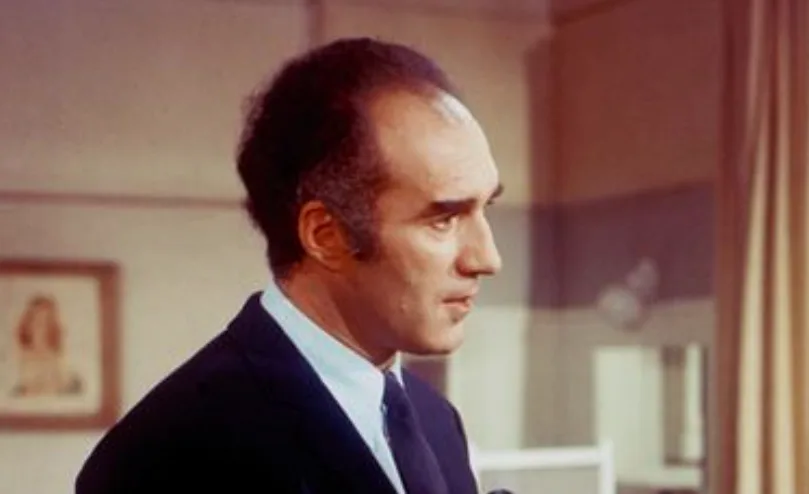
Michel Piccoli as Henri Husson in film Belle de jour (1967) - Geneviève Page as Madame Anaïs, who keeps the house
- Pierre Clémenti as Marcel
- Francisco Rabal as Hyppolite, his associate
- Françoise Fabian as Charlotte
- Maria Latour as Mathilde
- Macha Méril as Renée
- Marguerite Muni as Pallas, the maid
- Francis Blanche as Monsieur Adolphe
- Georges Marchal as the Duke
- François Maistre as the Professor
- Dominique Dandrieux as Séverine as a child
- Bernard Musson as the footman
Catherine Deneuve was twenty-two, and the performance is built almost entirely out of stillness. She plays Séverine's fantasies with the same composure she brings to a tennis club or a dinner table, so the whipping and the coffin arrive at the same temperature as the conversation, which is what makes them difficult to place.
Michel Piccoli gives Husson a bored, courteous appetite. He propositions a friend's wife the way another man would offer a cigarette, and his one act of real cruelty is performed off screen and reported by a closing door.
Geneviève Page is the film's most practical figure. Madame Anaïs runs a business, and her tenderness toward Séverine is genuine and entirely compatible with sending her into a room.
Pierre Clémenti plays Marcel as an adolescent with a weapon, vain about his patent shoes and his metal teeth. Jean Sorel has the thankless part and plays it straight, a decent husband who is given nothing to do but be patient and then be shot.
Production
The Hakim brothers, Robert Hakim and Raymond Hakim, Egyptian-French producers with a taste for putting respected directors on erotic material, brought the project to Luis Buñuel in 1966. He did not admire Joseph Kessel's novel, calling it a bit of a soap opera, and took the job for that reason: "I found it interesting to try to turn something I didn't like into something I did."
He and Jean-Claude Carrière did their research in the brothels of Madrid, interviewing the women there about their clients' requirements. Most of the requests in the finished film came out of those conversations rather than out of Kessel.
Buñuel was not consulted about his lead. He believed Catherine Deneuve had been imposed on him by the Hakims and by François Truffaut, her lover at the time, and the shoot was uncomfortable on both sides.
He mocked what he considered her prudery. She said afterward: "I felt they showed more of me than they'd said they were going to. There were moments when I felt totally used. I was very unhappy."
Principal photography ran from 10 October to 12 December 1966, entirely around Paris: a house on the Place Albin-Cachot in the thirteenth arrondissement for the brothel, the Rue de Messine for the Serizys' apartment, the Champs-Élysées, and the Chalet de la Grande Cascade in the Bois de Boulogne. Buñuel put himself in two shots, as a customer at the Cascade and as a passerby, and his own hands load Marcel's pistol.
Sacha Vierny photographed the film in color with no stylistic partition between the real scenes and the imagined ones, using the same light, the same lenses, and the same unhurried framing for both. Robert Clavel's brothel is furnished like a respectable apartment, brocade, lamps, and a hall stand, which is what makes it unsettling.
There is no musical score. What the film has instead is a small repertory of sounds, harness bells, carriage wheels, cats, cowbells, a wind, which recur until the audience begins treating them as a signal, and the final shot consists of almost nothing else.
Catherine Deneuve's wardrobe was designed by Yves Saint Laurent, who met her on this film and stayed her friend and couturier for the rest of his life. Her clothes are the coldest thing in the picture: a black double-breasted coat buttoned to the throat, a tan gabardine with military shoulders, plain shifts in ivory and camel, and above all the short black dress with a wide ivory satin collar and matching cuffs, which the Musée Yves Saint Laurent still keeps and has exhibited.
The shoes were made by Roger Vivier to Saint Laurent's drawing, from the autumn-winter haute couture collection of 1965, low-heeled with a squared buckled front. Buñuel had a documented fetish for them, which is why Séverine buys shoes every time she goes shopping and why the camera keeps returning to her feet, and Deneuve said the character's style owed a great deal to the image Saint Laurent had found for her.
Two things in the film were never explained on purpose. Buñuel would not say what was in the Japanese client's little box, and he would not say where the imagined scenes end, telling interviewers that he did not know either.
Release/reception
Belle de jour opened in France on 24 May 1967 and in Italy on 14 September. It sold 2,162,160 tickets in France, the largest audience of Buñuel's career, and the censors of several countries cut it.
At the Venice Film Festival in September 1967 it won the Golden Lion and the Pasinetti Award. The New York Film Critics Circle named it best foreign film of 1968, and Catherine Deneuve was nominated for the BAFTA for best actress, two years after The Umbrellas of Cherbourg (Les Parapluies de Cherbourg, 1964).
The film then disappeared for roughly two decades because of a rights dispute. Martin Scorsese arranged its American reissue in 1995, presented under his name through Miramax, and backed the DVD release that followed.
It holds an approval rating of 95 percent on Rotten Tomatoes from 60 reviews, whose consensus calls it radiantly filmed and resistant to easy interpretation. Roger Ebert gave it four stars and put it among his Great Movies, and Empire placed it fifty-sixth in its hundred best films of world cinema in 2010.
Its longest afterlife has been in fashion rather than in film criticism. The black dress with the ivory satin collar is reproduced every few seasons, the Vivier buckled pump has never entirely gone out of production, and a film about a woman who cannot be touched became the most-copied wardrobe of the decade.