People
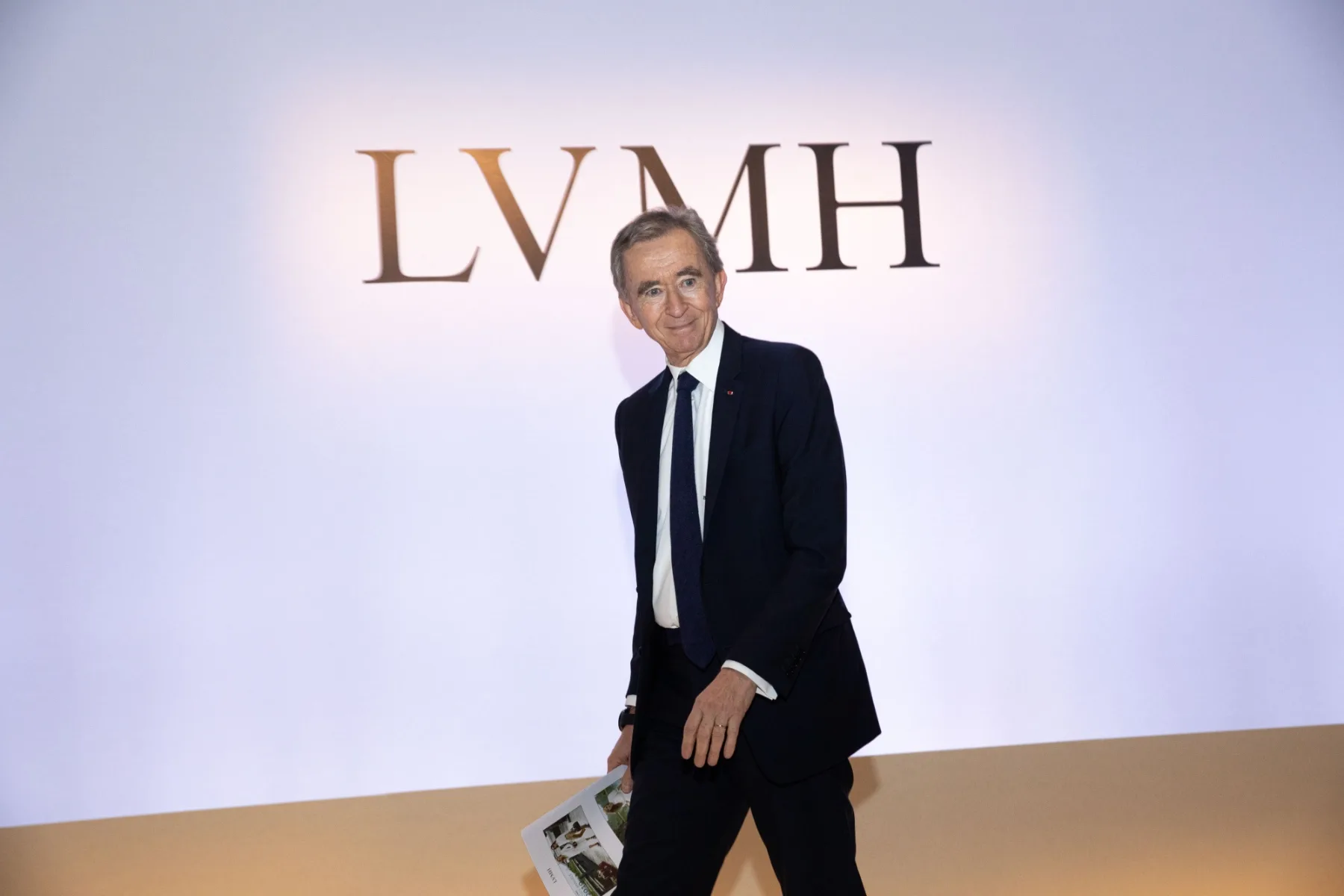
Bernard Arnault (born Bernard Jean Étienne Arnault; 5 March 1949 )
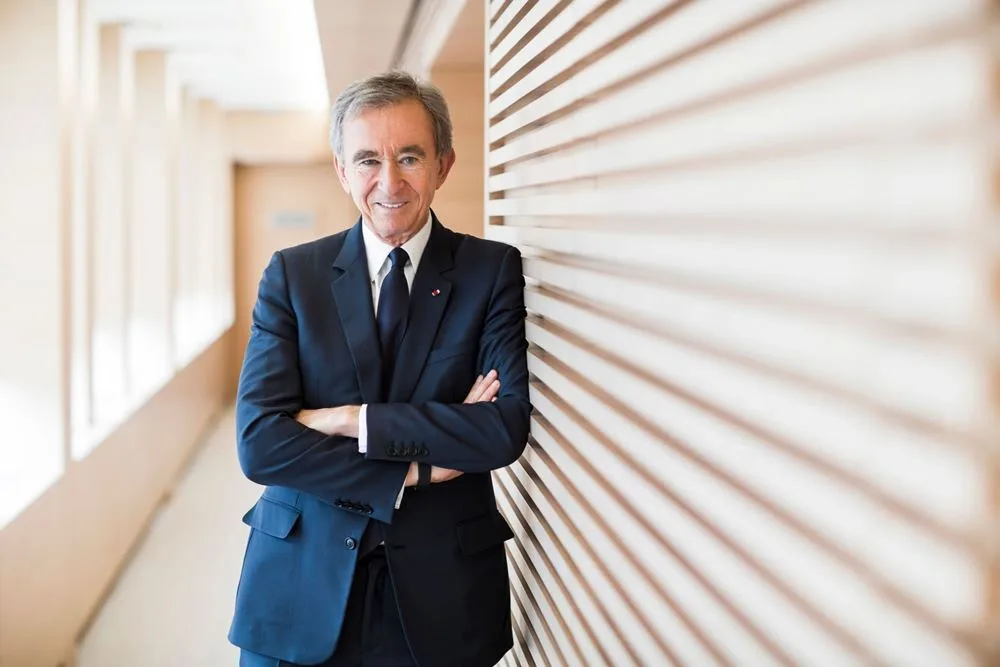
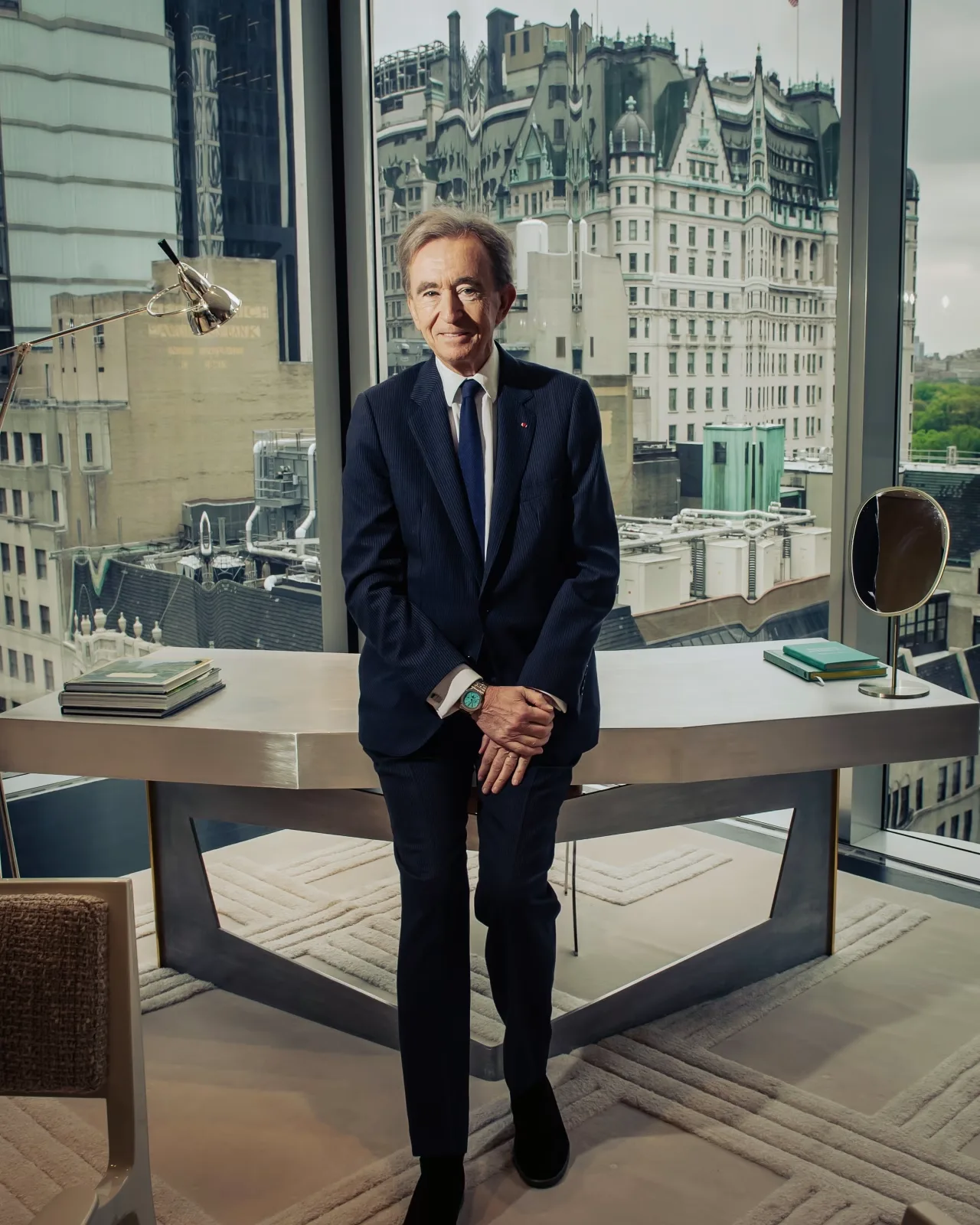
Bernard Arnault (born Bernard Jean Étienne Arnault; 5 March 1949) is a French businessman, art collector, and the chairman and chief executive officer of LVMH, the world's largest luxury goods company. Over more than three decades, he has assembled a portfolio of roughly seventy-five luxury houses, including Louis Vuitton, Christian Dior, Fendi, and Bulgari, and has, at various points, ranked as the wealthiest person on earth. He is also a classically trained pianist, a longtime patron of architecture and contemporary art, and the founder of the Fondation Louis Vuitton in Paris.
Biography
Bernard Arnault was born in Roubaix, a textile-industry town in northern France, on 5 March 1949, and raised in a devoutly Catholic household.
His father, Jean Léon Arnault, a graduate of the École Centrale Paris, ran a civil engineering firm called Ferret-Savinel. His mother, Marie-Josèphe Savinel, was herself a trained pianist — and, by every account, had a particular fascination with the house of Christian Dior.
Arnault studied piano seriously as a boy, practicing Chopin, Liszt, and Schumann, and for a time considered a career as a concert pianist before concluding, in his own later telling, that he simply didn't have the temperament for it.
He turned instead to engineering, studying civil engineering and mathematics at the elite École Polytechnique, and graduated in 1971.
Arnault joined his father's company at twenty-two. By 1974 he was its Director of Company Development, and had already begun pushing Ferret-Savinel toward a new business entirely — first timeshare developments on the French Riviera, then real estate more broadly.
In 1978 he married his first wife, Anne Dewavrin. He and Anne Dewavrin had two children together, Delphine Arnault, born in 1975, and Antoine Arnault, born in 1977.
In 1981, when François Mitterrand's newly elected Socialist government began nationalizing French industries, Arnault moved his young family to the United States, convinced the French business climate had turned too restrictive for what he wanted to build. He founded Férinel Inc. and developed luxury condominiums in Palm Beach, Florida.
The years in America left a real mark on him: he returned to France in 1983, once the political climate had shifted again, having come to believe — in a way genuinely unusual for a French industrialist of his generation — that a company, tended properly, could be built the way an American entrepreneur built one: aggressively, and around a single, durable idea.
That idea, when he found it, turned out to be sitting inside a company nobody particularly wanted.
With the help of Antoine Bernheim of the investment bank Lazard Frères, Arnault engineered the 1984 acquisition of Boussac Saint-Frères, a debt-ridden textile and retail conglomerate — reportedly paying a symbolic one French franc while assuming its liabilities. Buried inside it was a fashion house that hadn't turned a real profit in years: Christian Dior, the very label his mother had once admired from a distance.
Arnault restructured Boussac with a severity that startled the French business establishment — roughly nine thousand jobs cut, most of the conglomerate's other assets sold off, only Dior and the department store Le Bon Marché kept. The French press gave him a nickname that has followed him ever since: "The Terminator."
In 1987, two other French luxury companies, the champagne and cognac house Moët Hennessy and the leather-goods maker Louis Vuitton, merged to form LVMH. The marriage was troubled almost immediately — Louis Vuitton's Henry Racamier and Moët Hennessy's Alain Chevalier were locked in a power struggle for control of the new company, and Racamier, wary that LVMH's identity would tilt too far toward spirits, invited Arnault, fresh off his success reviving Dior, to invest as an ally.
Arnault instead built quiet alliances on both sides of the fight, and by 1989, at forty, had taken control of LVMH outright — a maneuver still described by some as a hostile takeover, though Arnault has always disputed the characterization.
He has run the company ever since, building it from a business worth roughly four billion dollars into one worth several hundred billion, and acquiring dozens of storied houses along the way: Fendi, Givenchy, Bulgari, Tiffany & Co., among many others.
A prolonged, ultimately unsuccessful attempt to take a controlling stake in Hermès, stretched out over most of the 2010s, earned him a second nickname, this one coined by the Hermès family itself: "the wolf in cashmere" — a phrase that stuck precisely because it captured both halves of the same man at once, the connoisseur and the predator.
His first marriage ended in divorce in 1990.
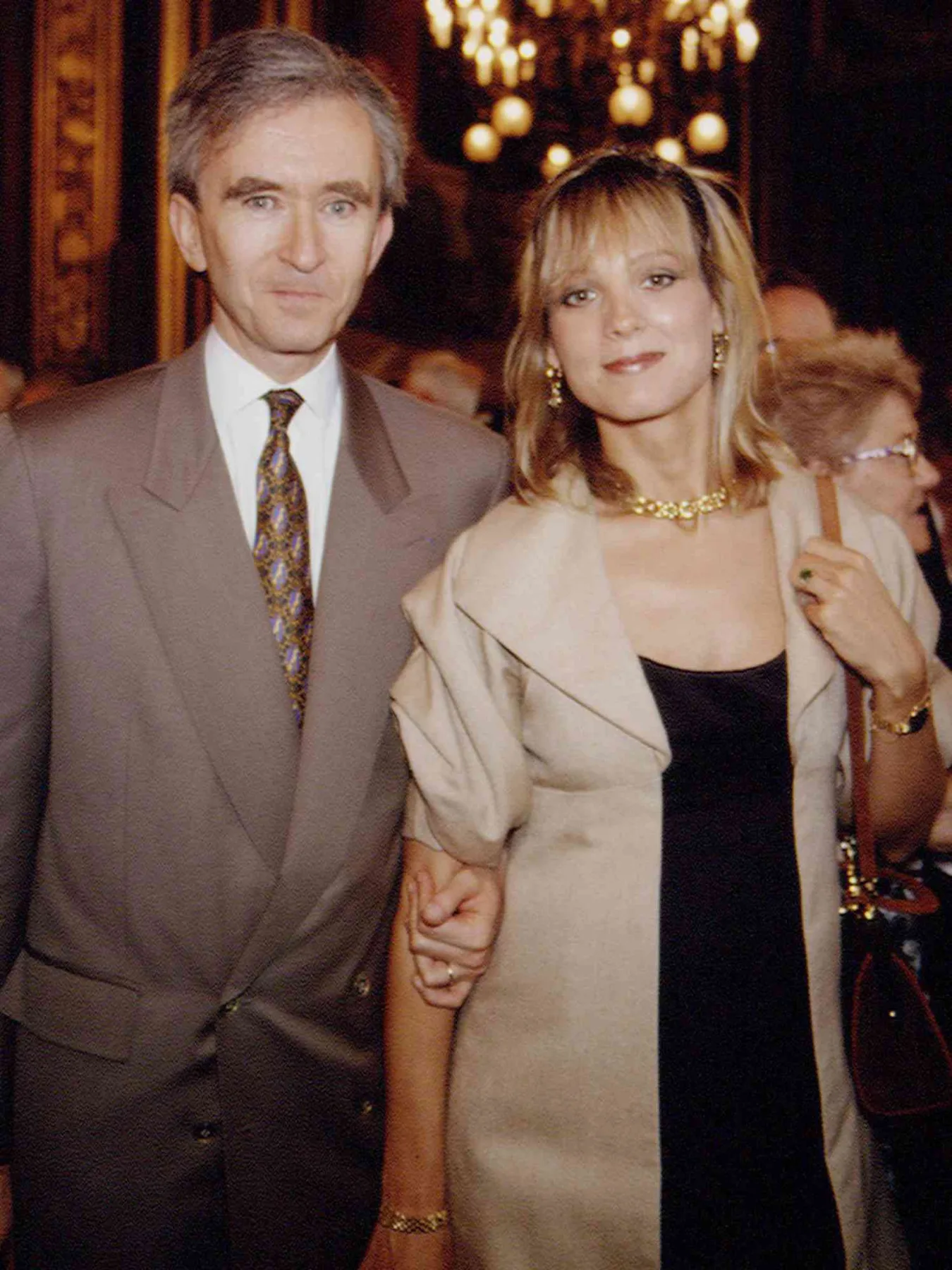
In 1991 he married his second wife, Hélène Mercier, a Canadian-born concert pianist trained at the Vienna Academy of Music, Juilliard, and the Paris Conservatoire. By more than one account, he courted her partly by sitting down and playing Chopin for her himself. They had three sons together: Alexandre Arnault, Frédéric Arnault, and Jean Arnault.
Four of his five children now hold senior positions across the LVMH empire: Delphine Arnault chairs Christian Dior Couture, Antoine Arnault is vice-chairman and CEO of Christian Dior SE, Alexandre Arnault is president of Tiffany & Co., and Frédéric Arnault became CEO of LVMH Watches before adding the top job at Loro Piana in 2025. Only the youngest, Jean Arnault, remains outside the executive suite for now, working within Louis Vuitton's own watch division.
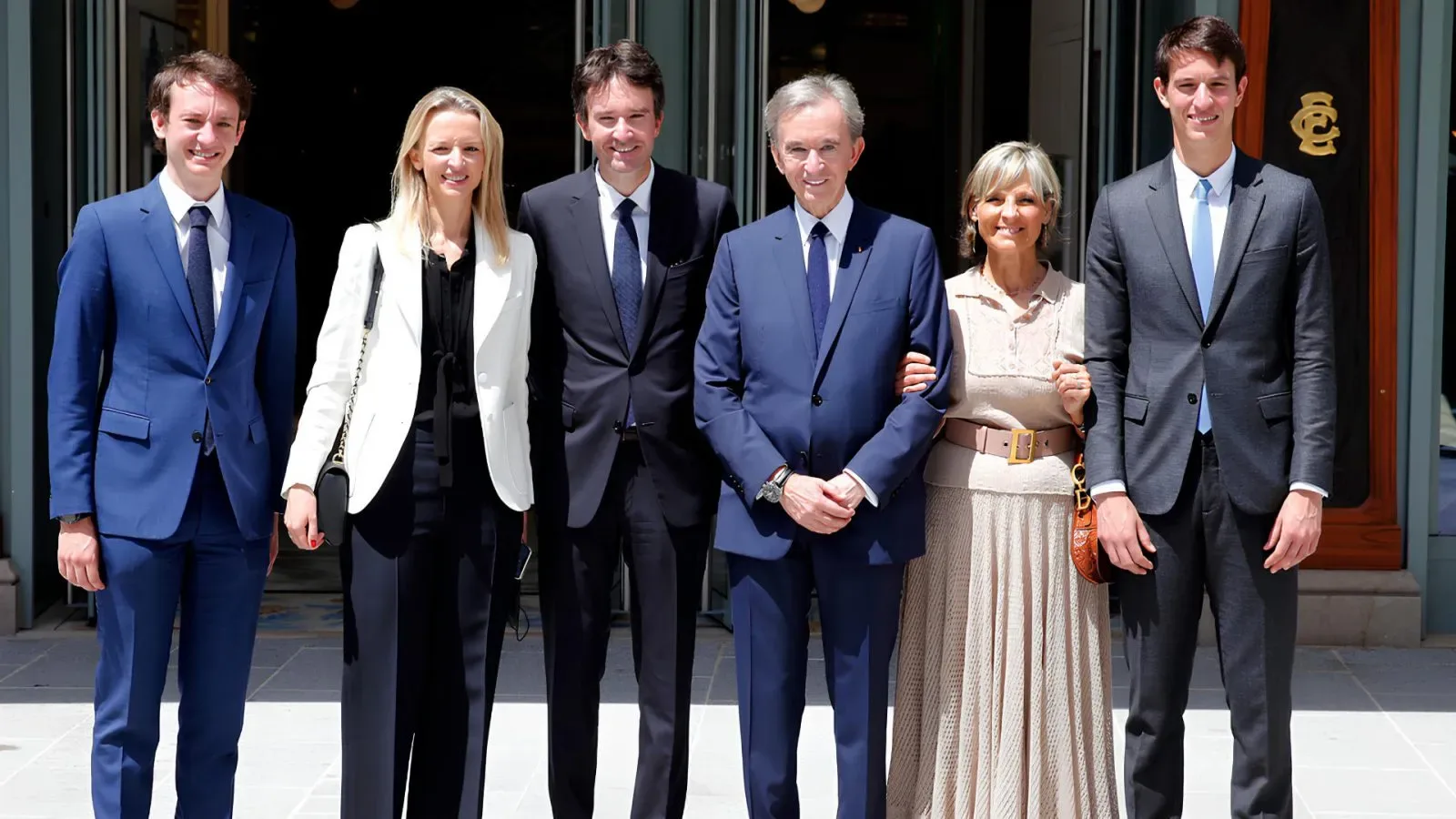
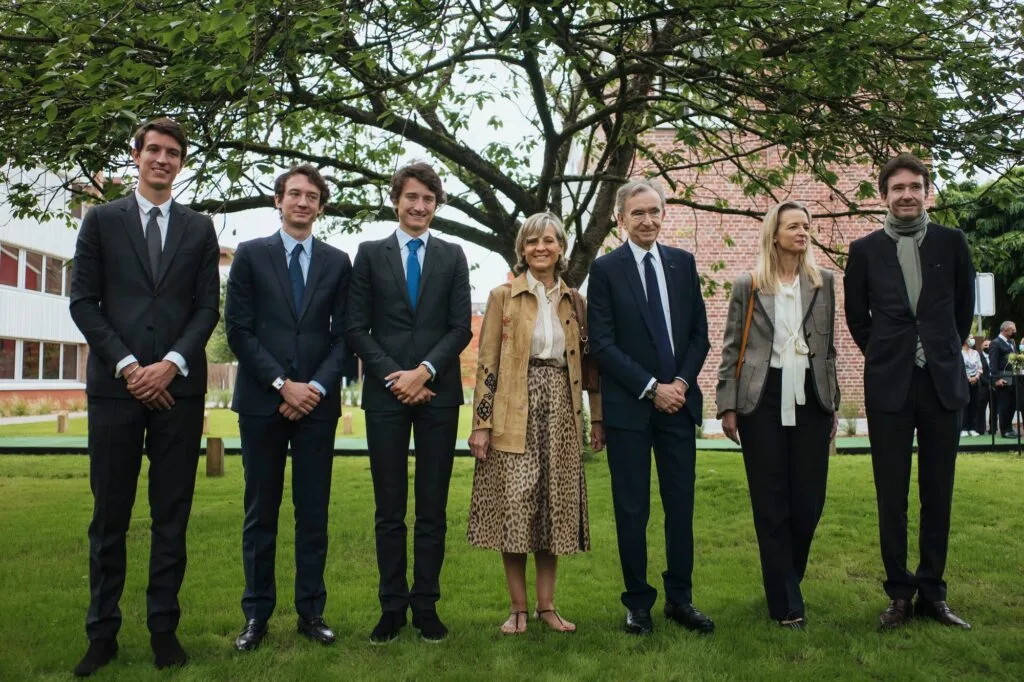
Arnault's daily life runs on a discipline that shows up in nearly every account of him: workdays that stretch from roughly eight in the morning to half past eight at night, mornings often begun with classical music, Saturday mornings spent personally touring as many as twenty-five of his own stores — and his competitors' — checking inventory and presentation for the smallest flaws.
He keeps a Yamaha grand piano in his Paris office and takes twenty-minute breaks to play it. In his rarer free hours, he plays tennis, sometimes against his friend Roger Federer.
"Every morning I have fun when I arrive," Arnault told Bloomberg. His daughter Delphine has put it more bluntly: "He works twenty-four hours. When he sleeps, he's dreaming of new ideas."
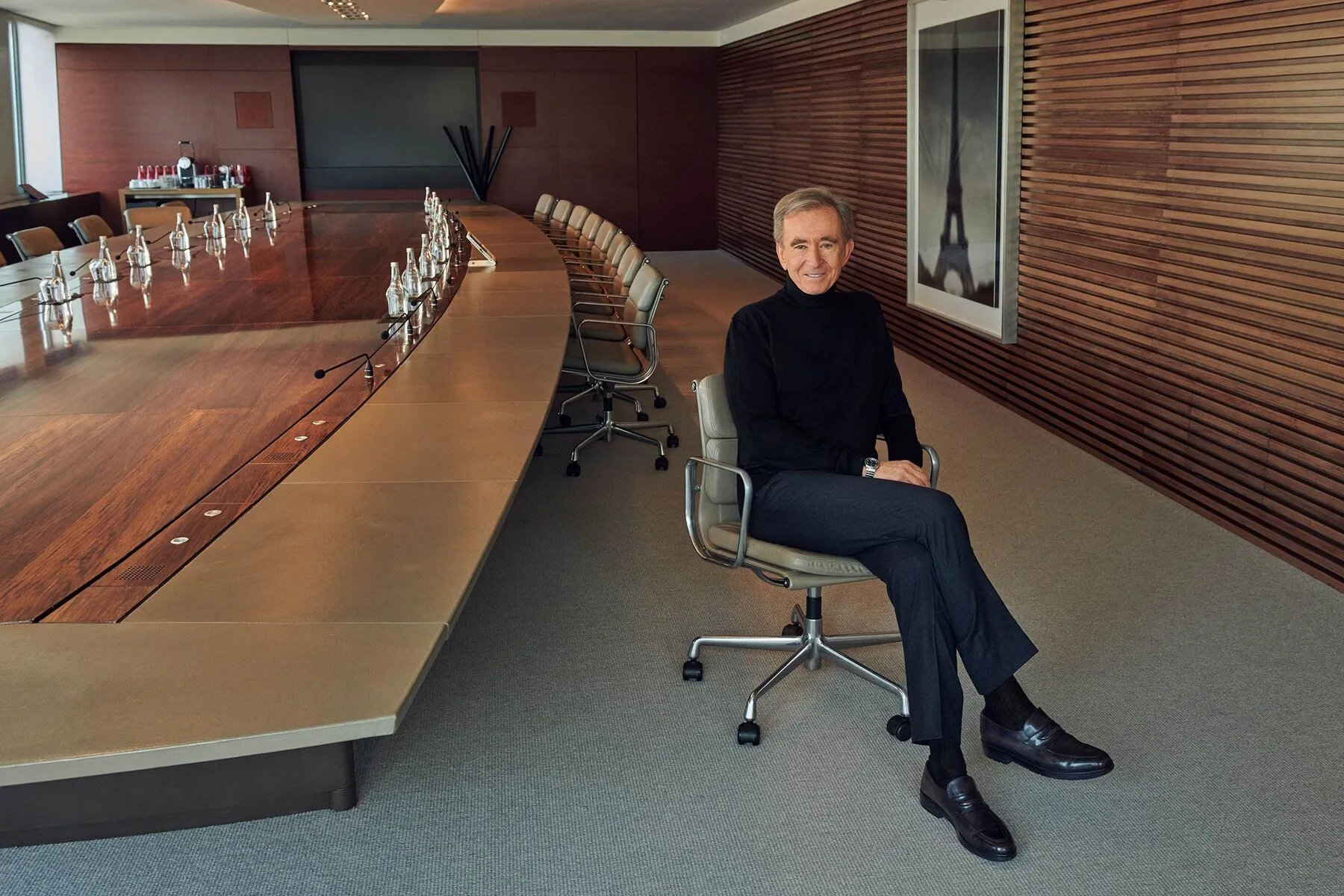
Alongside the business, Arnault built something more personal: a serious, decades-long art collection, and eventually a museum to house it.
In 2014 he opened the Fondation Louis Vuitton in Paris's Bois de Boulogne, commissioning his friend, the architect Frank Gehry, to design it. Arnault's own brief to the architect was simple and telling: he wanted, he said, "a haute couture building."
The result — a structure of twelve billowing glass sails, a decade in the making — now hosts major exhibitions of Mark Rothko(born Markus Yakovlevich Rotkovich), David Hockney, Jean-Michel Basquiat, and Gerhard Richter alongside Arnault's own holdings.
Gehry and Arnault's collaboration lasted more than twenty years, until the architect's death in 2026.
Arnault's public tribute to him showed something rarely visible in the coverage of the world's richest man: real, unguarded feeling. He called Gehry "a very dear friend," and said he owed the architect "one of the longest, most intense, and most ambitious creative partnerships I have ever had the privilege to experience," and described his friend's work in language closer to poetry than to a press release — Gehry, he said, would remain "a genius of lightness, transparency, and grace," a man who could "pleat glass like canvas" and "make it dance like a silhouette."
In 2023, France awarded Arnault its highest honor, the Grand Cross of the Legion of Honour.
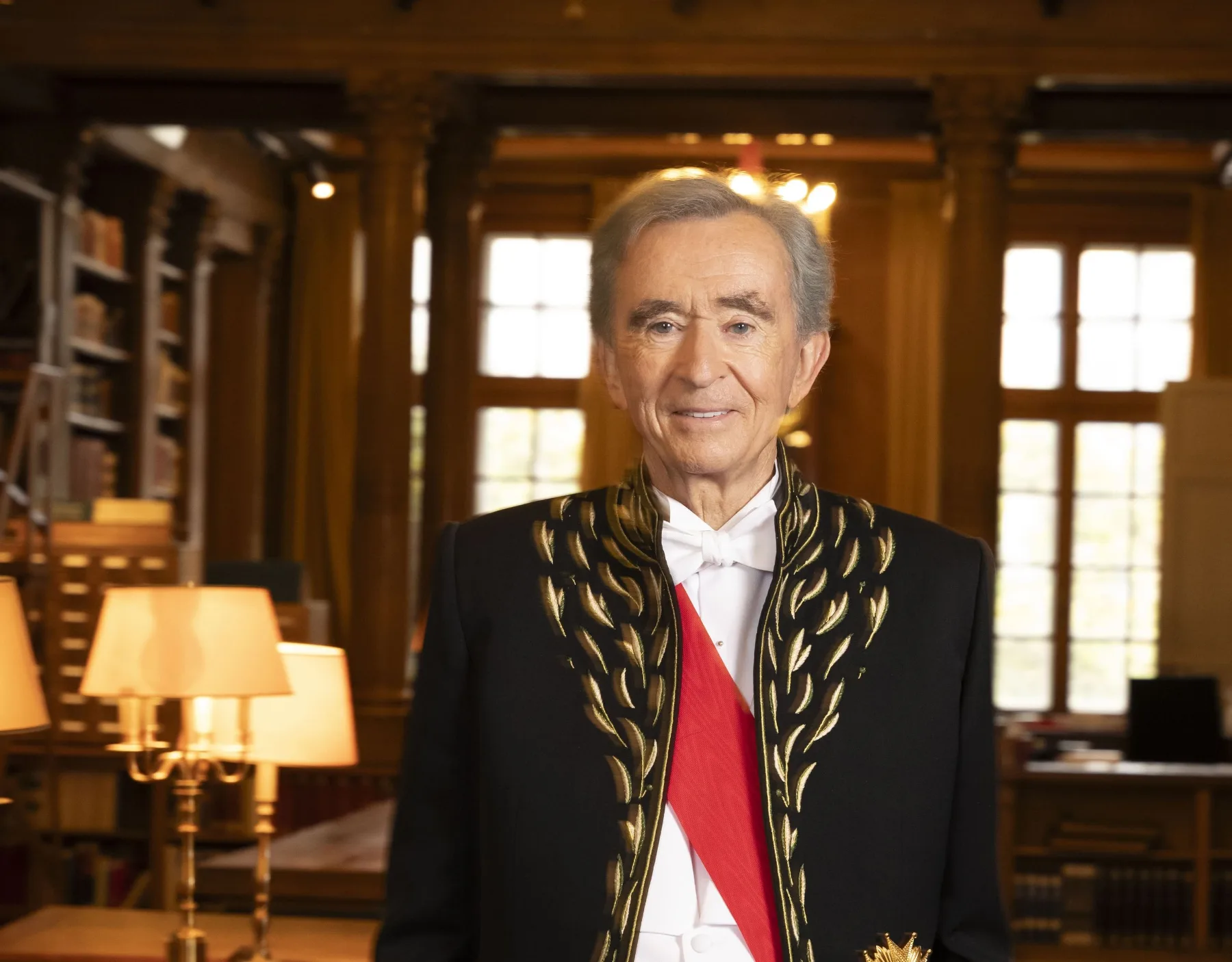
Bernard Arnault is one of the wealthiest people alive — a fact about him that dominates in the public imagination. Somewhere underneath the rankings is a boy who once seriously considered a career playing Chopin, a son who spent his adult life circling back, deal by deal, toward the fashion house his mother had once admired so much.