People
Clark Gable (born William Clark Gable; 1 February 1901 – 16 November 1960)
"He was a king wherever he went. He earned the title. He walked like one, he behaved like one, and he was the most masculine man that I have ever met in my life. Gable had balls." - Joan Crawford
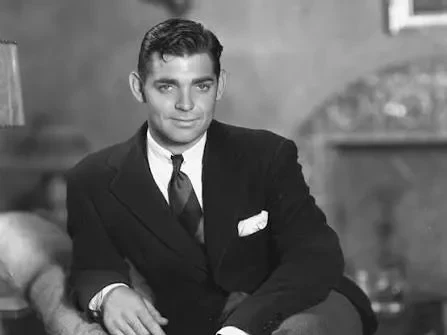
Clark Gable (born William Clark Gable; 1 February 1901 – 16 November 1960) was an American actor known as the "King of Hollywood" during the peak of the studio system. An Ohio mechanic's son who reinvented his voice, posture, and name on the way to stardom, he built a screen persona defined by amused authority, physical ease, and a narrow mustache paired with a sensual smile that became instantly recognizable worldwide. He won the Academy Award for Best Actor forIt Happened One Night (film, 1934) and created his most enduring character as Rhett Butler in Gone with the Wind (film, 1939). Although married for 5 times, his greatest love was his third wife Carole Lombard, whose sudden death in a 1942 plane crash marked him for the rest of his life.

Biography
William Clark Gable was born on 1 February 1901 in Cadiz, Ohio. He was the only child of William Henry Gable, an oil-well driller, and Adeline Hershelman Gable.
His mother died when he was ten months old. For a time, the infant Clark lived with relatives while his father continued working in the oil fields.
In 1903, William Henry Gable married Jennie Dunlap Gable. She became the central maternal figure of Clark's childhood and encouraged qualities in him that his father did not always understand.
Jennie Gable taught her stepson to play the piano and introduced him to literature. He later learned brass instruments and became the youngest member of the local men's band, playing the French horn.
His father preferred hunting, machinery, and physical labor. Clark learned those skills too. He could dismantle and repair an automobile, handle tools, shoot, and work outdoors, but he also liked reciting William Shakespeare's sonnets when he felt safe enough to do so.
The combination would remain visible throughout his life. The cultivated voice, tailored clothes, and polished manners of the future film star never entirely concealed the Ohio mechanic underneath.
At sixteen, Gable left school and took a series of jobs. He worked in a tire factory, carried water for miners, labored in oil fields, and followed his father to Oklahoma.
A touring theatrical production awakened his ambition to act. Gable began working with small stock companies, often doing whatever was required behind the scenes before receiving minor parts onstage.
The work was uncertain. Companies failed, salaries disappeared, and Gable repeatedly returned to manual labor when acting could not support him.
In Portland, Oregon, he met Josephine Dillon, an American actress, theatrical manager, and acting teacher seventeen years older than he was. Dillon saw possibilities in the tall, underfed young man that few others had noticed.
She began a patient reconstruction. Dillon paid to repair his teeth and improve his wardrobe. She taught him posture, movement, facial control, and the careful use of his large body.

Most important was his voice. Gable's natural speaking voice was high and lacked authority. Dillon trained him to lower it and develop the deep resonance, deliberate pace, and slightly roughened tone that later became inseparable from his screen presence.
The transformation was not merely cosmetic. Gable learned to listen, pause, and react. His mature performances would depend less on elaborate emotional display than on a lifted eyebrow, an interrupted smile, a change in posture, or a silence held half a second longer than expected.
And he changed his stage name. It was no longer W. C. Gable. It became Clark Gable.
Gable married Dillon on 13 December 1924. The couple moved to Hollywood, where Dillon served as his manager. He started to appear in small and frequently uncredited parts in silent films.
His early screen work led nowhere. Gable returned to the stage and eventually went to New York, where Broadway offered him the training and serious employment that Hollywood had not.
He appeared in Machinal (play, 1928), written by the American playwright and journalist Sophie Treadwell. As a working-class lover who becomes part of a woman's desperate escape from an oppressive life, he displayed an unsettling directness that attracted attention.
Gable and Dillon increasingly lived separate lives and filed for divorce in March 1929. The divorce finalized in April 1930, but the physical and vocal discipline Dillon had given him remained the foundation of everything that followed.

A few days after his divorce from Dillon, Gable married the Texas socialite Maria Franklin Prentiss Lucas Langham, known as Ria Langham.
His performance as a condemned prisoner in The Last Mile (play, 1930) helped bring him back to Hollywood at the moment when talking pictures needed actors with trained voices.
Gable appeared as a villain in The Painted Desert (film, 1931), opposite the American actors William Boyd and Helen Twelvetrees. He entered the film clean-shaven and comparatively unknown, but his physical confidence made the conventional hero seem pale beside him.
Metro-Goldwyn-Mayer signed him in 1931 and immediately placed him in a succession of films. The studio first used him as a gangster, chauffeur, laborer, or dangerous outsider, often opposite one of its established female stars.
The American actress Joan Crawford, one of MGM's biggest female stars, wanted him as her co-star for her film Dance, Fools, Dance (1931). This was Gable's first starring role.

In Dance, Fools, Dance, the forceful screen chemistry between the two stars was obvious. They began a long professional association on screen and a private affair off screen.
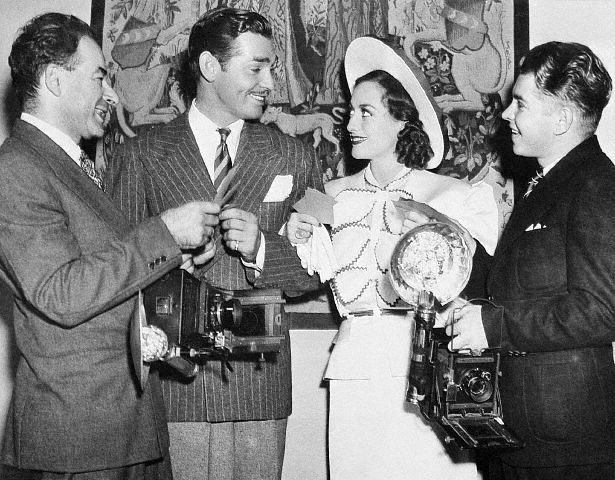
That same year, he appeared with the American actress Norma Shearer in A Free Soul (film, 1931). His character was brutal and sexually commanding, but Gable's relaxed stillness kept him from becoming a theatrical villain.
He did not plead with the camera to find him attractive. He occupied the frame as though admiration were inevitable.
Gable married Langham again, on 19 July 1931. She was older than he was and helped introduce him to a more formal social world.
Ria Langham refined his public presentation. Evening clothes, polished shoes, dinner jackets, and carefully fitted suits became part of the Gable image, but he wore them without the delicacy associated with a traditional matinee idol.
His tailoring emphasized breadth and height. Jackets had strong shoulders, generous lapels, and a clearly defined waist. High-rise trousers lengthened his line, while dark fabrics and white shirts framed the face that audiences were learning to recognize.
In Possessed (film, 1931), Gable again appeared with Joan Crawford. Crawford's glamorous ambition met Gable's amused authority, creating a romantic balance in which neither performer seemed decorative beside the other.
His stardom became secure with Red Dust (film, 1932), after which he became MGM's top romantic leading man and would never play a supporting role again.
Red Dust was set on a rubber plantation in French Indochina. Gable played a rough plantation manager caught between a married woman, played by the American actress Mary Astor, and a wisecracking prostitute, played by the American actress Jean Harlow.
Jean Harlow brought out one of Gable's greatest strengths. He could receive a woman's wit without surrendering masculine authority. A grin, a sideways glance, or a moment of apparent defeat often made him funnier than a spoken joke.
Gable and Harlow made six films together before Harlow's early death. Their chemistry depended on physical ease and equality. She could tease him, challenge him, and expose his vanity, while he gave her the space to be comic, sensual, and unexpectedly tender.
Clark Gable met the American actress Carole Lombard while filming No Man of Her Own (film, 1932). He did not fall in love with her then; she was still married to the American actor William Powell.

By 1933, Gable's screen identity was recognizable. His dark hair was brushed cleanly away from his face, and the narrow mustache that became his signature sharpened the line of his upper lip without disguising his expressions.
His face was not conventionally perfect. His ears were prominent, and his smile pulled slightly to one side. Those irregularities made his elegance more persuasive. He looked finished but not fragile.
In 1934, MGM lent Gable to Columbia Pictures for It Happened One Night, directed by the Italian-born American filmmaker Frank Capra. Gable was reportedly unenthusiastic about the assignment, while his co-star, the French-born American actress Claudette Colbert, also expected little from the production.

Gable played Peter Warne, an unemployed newspaper reporter traveling by bus with a runaway heiress. The part stripped away much of the heavy masculinity MGM had built around him.
His Peter Warne was impatient, observant, teasing, and capable of looking foolish. Gable could boast about his skill at hitchhiking and then watch in disbelief as Colbert stopped a car by lifting her skirt and showing one leg.
The performance revealed the charm beneath his authority. His dialogue came quickly, but his comedy often rested in reaction. He listened to Colbert, allowed her to win scenes, and made irritation look like the beginning of desire.
The clothes supported this ease. Gable wore wide-legged trousers, soft shirts, knitted layers, a Norfolk-style jacket, a practical trench coat, and a felt hat whose brim he handled with unconscious precision.
In the film's most influential clothing moment, Gable undressed for bed and revealed that he wore no undershirt beneath his shirt. A widely repeated story claimed that American undershirt sales declined afterward.
Whether or not the commercial effect was as dramatic as legend suggested, the scene demonstrated the reach of his image. A garment he did not wear could become news.
It Happened One Night became a major success and won the five principal Academy Awards: Best Picture, Best Director, Best Adapted Screenplay, Best Actress for Claudette Colbert, and Best Actor for Clark Gable.
Gable accepted his Oscar with characteristic brevity. He preferred to describe himself as fortunate rather than important, once saying, "I'm just a lucky slob from Ohio."
It Happened One Night is the real Gable. He was never able to play that kind of character except in that one film. They had him playing these big, huff-and-puff -man lovers, but he was not that kind of guy. He was a down-to-earth guy, he loved everything, he got down with the common people. He didn't want to play those big lover parts; he just wanted to play Clark Gable, the way he was in It Happened One Night, and it's too bad they didn't let him keep up with that." -- Frank Capra on Clark Gable
He continued to alternate contemporary romance with adventure. In Manhattan Melodrama (film, 1934), he appeared opposite the American actors Myrna Loy and William Powell. In Men in White (film, 1934), he played a doctor whose professional commitment unsettles his private life.
Gable and Myrna Loy became one of MGM's most popular screen pairings. Her intelligence and composure met his physical assurance without being overwhelmed by it.
In The Call of the Wild (film, 1935), Gable starred opposite the American actress Loretta Young. During the production, a sexual encounter took place between them, and Young gave birth to their daughter, Judy Lewis, on 6 November 1935.
The circumstances were concealed for decades. The event was long presented as an affair, but after Loretta Young's death, members of her family said she had privately described the encounter as rape. Gable never publicly acknowledged Judy Lewis as his daughter.
That year, he played the mutinous officer Fletcher Christian opposite the British actor Charles Laughton in Mutiny on the Bounty (film, 1935). Gable received another Academy Award nomination for Best Actor.
The film placed him in naval coats, high collars, breeches, and open-necked shirts, using historical costume to intensify rather than soften his modern masculinity. Even in period dress, Gable seemed less like a man preserved from the past than a contemporary figure temporarily placed within it.
In China Seas (film, 1935), he reunited with Jean Harlow for a story of danger, cargo, and romantic rivalry. Harlow's pale gowns and Gable's white tropical uniforms created a polished visual contrast against the heat and disorder of the setting.
Gable starred with the American actress and singer Jeanette MacDonald and the American actor Spencer Tracy in San Francisco (film, 1936). As a nightclub owner who survives the 1906 earthquake, he moved easily between swagger, sentiment, and physical action.
His acting style was limited in transformation but unusually truthful within its range. Gable rarely disappeared into a character. Instead, he refined a recognizable screen personality: direct, skeptical, amused by pretension, and more vulnerable than the broad shoulders initially suggested.
The failure of Parnell (film, 1937), in which he played the Irish political leader Charles Stewart Parnell, demonstrated the limits of that personality. The solemn historical romance denied Gable the movement, wit, and physical informality that made him convincing.
He recovered with films that returned him to modern action and romantic contest. Test Pilot (film, 1938), with Myrna Loy and Spencer Tracy, gave him a character whose recklessness was attractive until its human cost became impossible to ignore.
By then, Gable was regularly ranked among Hollywood's greatest box-office attractions. Publicity called him the "King of Hollywood," a title grander than his own view of himself but perfectly suited to the authority he carried on screen.
His marriage to Ria Langham ended in divorce on 7 March 1939. Three weeks later, on 29 March, Gable married Carole Lombard in Kingman, Arizona.

The romance between the two began after they met again at a party in 1936, and it grew from a friendship formed after each had moved on to other parts of life.
The marriage changed the rhythm of his private life. Gable and Lombard bought a ranch in Encino, California, for $50,000, where they tried to live beyond the formality of the studio system.
They called each other "Ma" and "Pa." Lombard's language was irreverent, her humor fearless, and her energy more than equal to Gable's.
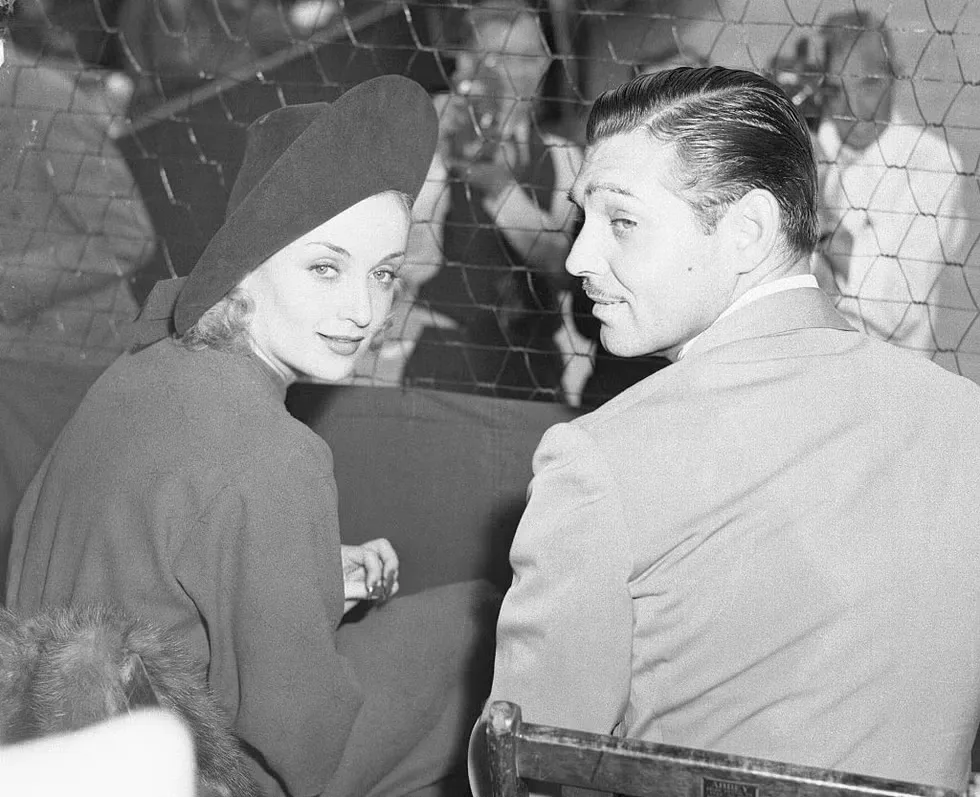
At the ranch, Gable's clothes became practical. He wore open-necked shirts, knitwear, high-waisted trousers, worn leather jackets, boots, and broad-brimmed hats. The polish remained, but it no longer looked arranged for a studio portrait.

The couple hunted, fished, kept animals, entertained friends, and performed ordinary domestic tasks with enthusiasm. Their happiness depended partly on the contrast between Hollywood's king and queen and the deliberately informal life they created at home.
The year 1939 brought Gable both domestic happiness and professional significance. He was offered the role of Rhett Butler in Gone with the Wind (film, 1939), adapted from Margaret Mitchell's 1936 best-selling novel of the same name, written by the American writer Margaret Mitchell.
Gable had resisted the role originally because expectations were impossibly high. When his wife Lombard bought him a copy of the novel, Gable had even refused to read it.
Opposite the British actress Vivien Leigh as Scarlett O'Hara, Gable made Rhett's cynicism attractive without hiding its cruelty. His best moments came when confidence cracked and the audience saw disappointment, tenderness, or exhaustion beneath the amusement.

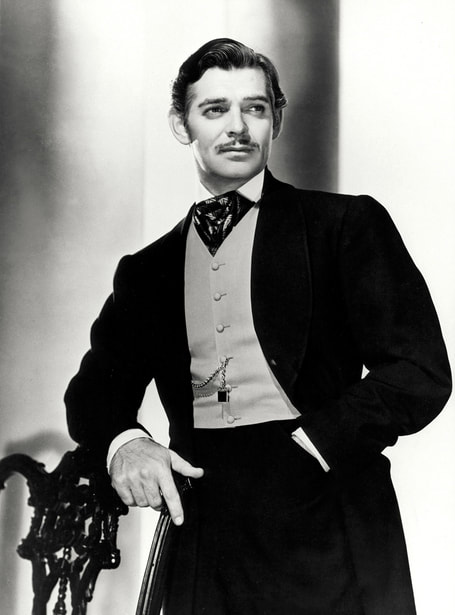
The American costume designer Walter Plunkett dressed Rhett in dark frock coats, fitted waistcoats, formal cravats, riding clothes, evening dress, and military uniform. The clothes moved from polished control toward emotional disorder as Rhett's certainty weakened.
A black coat, white linen, sharply tied cravat, dark hair, and clipped mustache created one of cinema's most recognizable male silhouettes. Yet Gable kept the image alive through movement: a hand placed in a pocket, a hat tilted back, or a smile that warned before it charmed.
During production, Gable treated the American actress Hattie McDaniel with warmth and respect. When segregation prevented McDaniel from attending the Atlanta premiere, Gable considered refusing to attend. McDaniel reportedly persuaded him to go.
Hattie McDaniel later became the first Black performer to win an Academy Award, receiving Best Supporting Actress for her portrayal of Mammy.
Gone with the Wind became one of the most successful films ever made. Gable received his third Academy Award nomination for Best Actor, and Rhett's final line, "Frankly, my dear, I don't give a damn," entered film history.
Years later, Gable remarked that his popularity would always be revived by a Gone with the Wind re-release.
Gable followed the epic with Strange Cargo (film, 1940), his last film with Joan Crawford. In Boom Town (film, 1940), he reunited with Spencer Tracy and Claudette Colbert in a story of oil, money, friendship, and ambition that echoed parts of his own early life.
Carole Lombard became deeply involved in the American war effort after the United States entered the Second World War. In January 1942, she traveled to Indiana to sell war bonds.
On 16 January, the airplane carrying Lombard home crashed into Potosi Mountain near Las Vegas, Nevada. All twenty-two people aboard were killed, including Lombard's mother, Elizabeth Jayne Peters, and the American MGM publicity executive Otto Winkler, who had been the best man at Gable and Lombard's wedding.
Gable traveled to Nevada and waited while search teams climbed toward the wreckage. Lombard was thirty-three.
Her death altered him profoundly. One month after Carole Lombard's death, Gable returned to the studio having lost twenty pounds. He completed Somewhere I'll Find You (film, 1942) nonetheless, opposite the American actress Lana Turner.
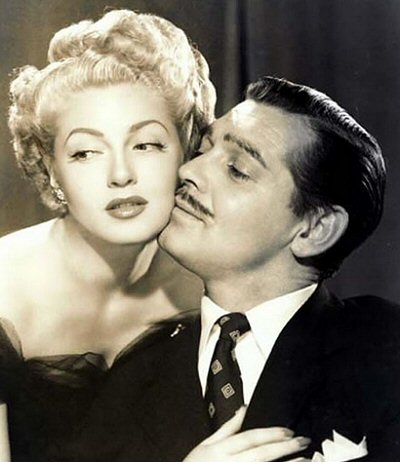
MGM tried to preserve the familiar Gable image, but private grief had made it difficult for him to inhabit uncomplicated romance.
Friends saw a heavier, quieter man, whose spontaneous pleasure, so visible during his marriage to Lombard, did not fully return.
On 12 August 1942, at forty-one, Gable enlisted in the United States Army Air Forces. Carole Lombard had encouraged him to support the war effort while she was alive, and his service became both public duty and private tribute.
He completed officer training and was commissioned as a second lieutenant. He later became head of a motion-picture unit assigned to document aerial combat and help recruit gunners.
Gable trained as an aerial gunner and traveled to England with the 351st Bomb Group. He flew five combat missions in B-17 Flying Fortresses, carrying camera equipment while also facing enemy fire.
On one mission, a shell passed through his boot and narrowly missed his head. The danger was real, not a publicity arrangement.
Gable received the Air Medal and the Distinguished Flying Cross. His military appearance was stripped of Hollywood ceremony: closely cut hair, service uniform, leather flight jacket, heavy boots, and the expression of a man aware that rank and fame offered no protection in the air.
He left active duty as a major in 1944. His discharge papers were signed by Captain Ronald Reagan, an actor and fellow officer who would later become president of the United States.
Gable returned to the screen in Adventure (film, 1945) opposite the British actress Greer Garson. The advertising announced, "Gable's back and Garson's got him," but returning to Hollywood did not mean returning to the man he had been before the war.
His face had become heavier and more weathered. He retained the mustache, strong tailoring, and assured walk, but his best postwar performances carried fatigue beneath the confidence.
In The Hucksters (film, 1947), opposite the British actress Deborah Kerr, he played an advertising executive disgusted by manipulation but not entirely innocent of it. The role allowed his skepticism toward polished institutions to become part of the character.
His wardrobe during the postwar years remained grounded in classic American tailoring. Double-breasted suits, peak lapels, broad overcoats, patterned ties, pocket squares, and felt fedoras gave structure to his large frame.
He wore formal clothes with less visible delight than actors who treated dressing as display. On Gable, a dinner jacket looked correct because he seemed capable of forgetting it the moment something more interesting entered the room.
Away from work, he preferred tweed jackets, soft-collared shirts, sweaters, pleated trousers, field clothes, and boots. The distinction between public and private dress was clear, but ease joined both.
On 20 December 1949, Gable married the English model and actress Sylvia Hawkes Ashley, the widow of the American silent-film star Douglas Fairbanks. The union brought together two glamorous public figures but little domestic peace.
The marriage ended in divorce in April 1952. By then, Gable's relationship with MGM had also begun to weaken.
He returned to Africa for Mogambo (film, 1953), directed by the American filmmaker John Ford. The story reworked the romantic triangle of Red Dust, with the American actress Ava Gardner in the uninhibited Jean Harlow role and the American actress Grace Kelly as the restrained married woman.
Gable's safari clothing gave his mature image a new texture. Khaki shirts, field jackets, scarves, riding trousers, boots, and weathered hats suited an actor whose authority now depended as much on age and experience as on beauty.
A romantic involvement developed between Gable and Grace Kelly during the production. The relationship ended, but the film brought Kelly her first Academy Award nomination and gave Gable one of his strongest later successes.
In 1954, after more than two decades, Gable left MGM and became an independent actor. He no longer wanted a studio to determine his salary, schedule, or roles.
The decision gave him greater financial control, although not every independent production matched the quality of his earlier work. He appeared in Soldier of Fortune (film, 1955) opposite the American actress Susan Hayward and in The Tall Men (film, 1955) with the American actress Jane Russell.
On 11 July 1955, Gable married Kathleen Gretchen Williams, professionally known as Kay Williams, a former actress and model who had previously been married to the sugar heir Adolph Bernard Spreckels Jr.
Gable became stepfather to Kay Williams's two children, Joan Spreckels and Adolph Bernard Spreckels III, known as Bunker. The marriage gave him a quieter family life during his final years.
He formed a production company and produced The King and Four Queens (film, 1956), in which he starred opposite the American actress Eleanor Parker. The title played openly with his established nickname.
Gable understood the value of the image even when he disliked its exaggerations. The mustache, raised eyebrow, broad shoulders, and crooked smile had become a form of visual shorthand understood around the world.
His style endured because it depended on proportion rather than novelty. Strong shoulders balanced his height. High-waisted trousers created a long, uninterrupted line. Wide lapels and substantial collars held their scale against his face and chest.
Even his more formal clothes retained movement. A coat was often carried rather than carefully worn, a tie loosened, or a hat pushed back. His elegance appeared most convincing when one detail suggested that comfort had won over ceremony.
Gable accepted roles that acknowledged his age. In Run Silent, Run Deep (film, 1958), he played a submarine commander opposite the American actor Burt Lancaster. Their contrasting acting styles made the conflict between experience and younger authority unusually sharp.
In Teacher's Pet (film, 1958), he appeared with the American actress and singer Doris Day as a self-educated newspaper editor who distrusts academic instruction. The role returned him to comedy and to the kind of proud, practical outsider he had always played well.
By then, the changing Hollywood around him belonged increasingly to younger actors trained in more psychologically explicit styles. Gable did not imitate them.
His technique remained economical. He trusted the camera, avoided unnecessary gestures, and allowed personality to carry what another actor might have explained.
In It Started in Naples (film, 1960), opposite the Italian actress Sophia Loren, his maturity became part of the romance. Dark suits and American neatness met Loren's vivid dresses and Mediterranean energy, making cultural contrast visible before either character spoke.
Gable's last role was Gay Langland, an aging Nevada cowboy, in The Misfits (film, 1961). The screenplay was written by the American playwright Arthur Miller for the American actress Marilyn Monroe, his wife at the time.
Filming took place in the Nevada heat. Nearly all the principal performers, from Marilyn Monroe to the American actor Montgomery Clift, brought some private difficulty to the production.
Gable insisted on performing physically demanding scenes and completing the work with the professionalism that had governed his career.
As Gay Langland, he wore faded denim, dusty work shirts, boots, a battered cowboy hat, and the tired expression of a man whose idea of freedom no longer fits the world around him.
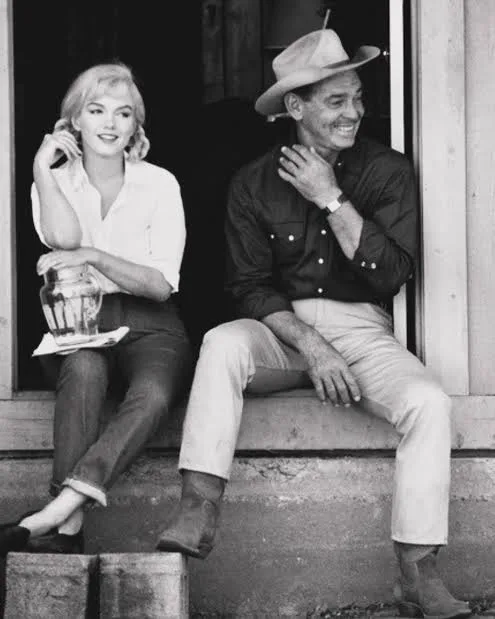
The clothes had none of Rhett Butler's finish, but they completed the same story from the opposite end. The dark frock coat had promised command. The worn denim admitted that command could not last.
Gable gave the character humor, tenderness, pride, and a frightening burst of desperation. The performance did not ask the audience to forget the King of Hollywood. It allowed them to watch that image grow old.
Filming ended on 4 November 1960. Two days later, Gable suffered a severe heart attack and was admitted to Hollywood Presbyterian Hospital in Los Angeles.
While he was in the hospital, Kay Gable was pregnant with their child. Gable appeared to be recovering, but on 16 November he suffered another heart attack and died. He was fifty-nine.
Gable was a great, great guy, and certainly one of the great stars of all times, if not the greatest. I think that I sincerely doubt that there will ever be another like Clark Gable; he was one of a kind." —- Robert Taylor
Clark Gable was buried at Forest Lawn Memorial Park in Glendale, California, beside Carole Lombard. Kay Gable honored the place that Lombard had retained in her husband's life.
Their son, John Clark Gable, was born on 20 March 1961, four months after his father's death.
The Misfits was released in 1961. Its final image of Gable driving into the darkness belonged to a film, but it also seemed to close an era.
Clark Gable's authority did not come from physical perfection or elaborate technique. It came from contradiction: refinement over rough beginnings, humor beneath command, shyness beneath swagger, and vulnerability behind one of cinema's most assured smiles.
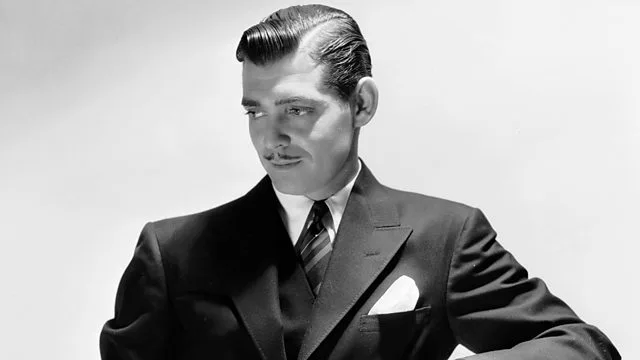
The mustache, dark suit, tilted hat, and broad shoulders created an icon. The listening, the pauses, and the crooked grin made him human.
He was as masculine as any man I've ever known, and as much a little boy as a grown man could be – it was this combination that had such a devastating effect on women." —- Doris Day on Clark Gable